Mark Edward Chard | June 2026
On 12 December 2020, at 4:15 in the morning, my twin soul brother, Darren John Chard passed away.
He was forty seven years old (nearly forty eight). I was in Altea, Spain. The world I had known for my entire life ended quietly, without warning, in the dark hours before dawn.
What happened next - what has been happening ever since - is the reason I am writing this post.
Last week, the University of Illinois Press formally moved the complete manuscript of Transdiasporic Lament and the Revelationary Spirit: Relational Geometry, Black Maternal Theology, and the Architecture of Threshold Experience into peer review. Senior Acquisitions Editor Dominique Moore wrote to confirm that readers are now being queried. A manuscript of approximately 88,000–90,000 words — five and a half years of work, written from a coastal town on the Spanish Mediterranean, animated entirely by grief, love, and the refusal to let Darren's death be the end of the conversation — is now in the hands of international academic reviewers at one of North America's most distinguished university presses.
I want to say something honest about what that means.
What the Monograph Argues
Transdiasporic Lament and the Revelationary Spirit is a work in three parts.
The first, The Longest Lament, is a Black Maternal Theology of the Cross. It begins with Rachel — the mother who refused to be comforted — and moves through Job, Lamentations, Hosea, the women at the foot of the cross, Mary Magdalene at the empty tomb, and the mothers of the African American tradition who have been carrying the weight of catastrophic loss for four centuries and have, against every reasonable expectation, refused to stop hoping. The argument is that God does not silence lament. God answers it.
The second part, Revelationary Spirit, began the night Darren died. In the hours after the phone call came to attend the hospital, something extraordinary happened — an experience of geometric form, of luminous structured presence, of a word that arrived not as sound but as absolute certainty: Yesssssss. I did not know, at that moment, what sacred geometry was. I had not studied the Enochic tradition.
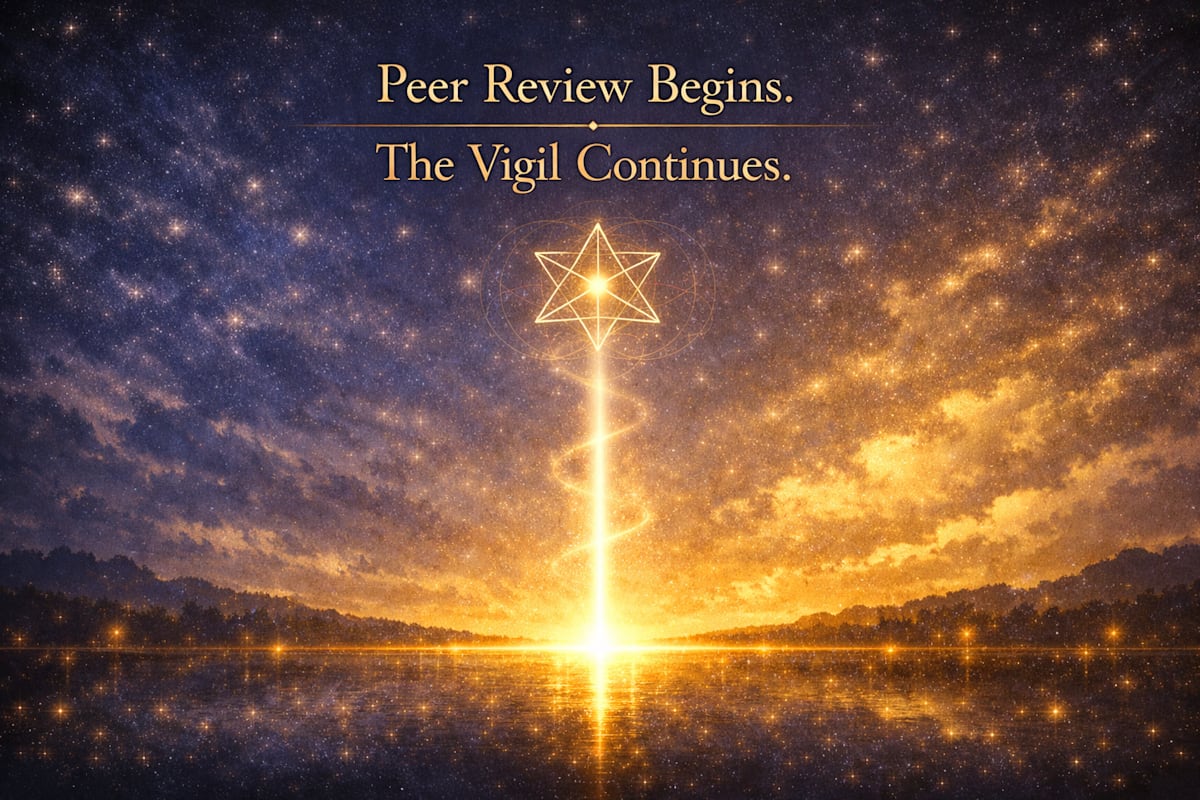
The experiences arrived before the framework. What I have been doing in the years since is trying to understand, with whatever scholarly tools I possess, what was given to me in that very early morning in December 2020. The argument of Revelationary Spirit is that Relational Geometry — the geometry of sacred form, of Metatron's Cube, of the structured luminous architecture that appears at the threshold of divine encounter — is not arbitrary. It is communicative. It is the language of the threshold.

The third part is a synthesis. Its central claim is simple and, I believe, original: Black Relational Eschatology and Relational Geometry are the same discovery, approached from different directions. The mothers who refused to let death have the final word, and the geometry that arrives at the boundary between life and whatever lies beyond it, are describing the same reality. Love refuses to disappear. That is the thesis. Everything else is elaboration.
On Darren
I cannot write about this monograph without writing about my twin soul, Darren. It would be dishonest to pretend otherwise.
Darren was not a theologian. He was not an academic. He was my twin soul, the other half of a single fertilised egg, the person I had known longer than I had known anyone or anything, the one whose absence has never, for a single day in five and a half years plus, felt like absence in the ordinary sense of that word. He has been present throughout this research programme in ways I cannot fully explain but refuse to minimise.
Kenny Corris — a professional medium with sixty-four years of experience, recognised internationally for his work — has seen Darren. Physically. Twice. Independently. He has written about it, provided information that contained specific, named predictions — celebration, invites, recognition, being seen, six years — that have been substantially fulfilled in the months since, including last week's news from Illinois Press.
I am not asking anyone to accept what I am saying, but it's the truth.
I am saying with total honesty, is that the research programme documented in this monograph was not generated by a scholar working alone in a study. It was generated by a grieving twin who was accompanied. And I believe that accompaniment is real.
The monograph is dedicated to Darren. It always was.
What Comes Next
The University of Illinois Press holds a distinguished record in African American religious studies and Black cultural history — precisely the field this monograph inhabits. In parallel, UKZN Press has expressed interest in the manuscript for the African market, and I have committed to a formal submission to UKZN Press immediately upon confirmation of my appointment as Honorary Lecturer in the School of Arts, Theology and Religion at the University of KwaZulu-Natal — an appointment confirmed in principle, with formal Board ratification scheduled for 29 June 2026.
The co-publication model — Illinois Press holding North American, European, and UK rights; UKZN Press holding African rights — would position this work at the intersection of two continents, two publishing traditions, and two scholarly conversations that have not yet been brought into sufficient dialogue with each other.
Alongside the monograph, a research programme of 28 peer-reviewed papers is in active development across major international journals, including work published and forthcoming in Theology (T&T Clark/Duke University Press), Biblical Interpretation (Brill), and the Journal of Theology for Southern Africa, among others. Three papers written explicitly in the tradition of the Ujamaa Centre's Contextual Bible Reading methodology — the scholarly home of Professor Gerald West's extraordinary legacy, and the Professor, who I wish to emulate, are currently under review at DHET-accredited South African journals.
A Note on the Journey
When Darren passed away in December 2020, I had no institutional affiliation, no publication record, and no obvious path into the academy. I was an independent scholar in a small Spanish town, caring for ageing parents, working from a tablet on a table, and trying to make sense of an experience of loss that had no adequate framework.
Five and a half years later, a major monograph is at Illinois Press. Twenty-eight papers are in the publishing pipeline, some of which are already accepted and will be published this year. An Honorary Lecturership appointment at one of Africa's leading research universities is days away from formal confirmation. And Darren through whatever means he has available to him from wherever he now is in Spirit, has been present at every significant milestone.
The shooting star at 4am on the morning of the Board's Management Committee meeting. The lights in the room the night the revised manuscript went back to the Journal of Near-Death Studies, it's a ground breaking paper undergoing peer review, the geometry, arriving virtually every evening, luminous and structured and unmistakably intentional.

I do not know how to account for all of this in purely academic language. What I can say is that it began with love — a love that refused to accept that death was the end of the conversation, and that it continues to be sustained by that same love, now distributed across the threshold of death in ways I am still learning to understand.
The monograph is my attempt to give that love a form worthy of the reality it is trying to describe.
Peer review begins. The vigil continues.
Mark Edward Chard is Honorary Lecturer, The School of Arts, Theology and Religion at the University of KwaZulu-Natal.
He is a Full Member of the Society of Biblical Literature and the European Association of Biblical Studies, and a Member of the American Academy of Religion.
His research spans Black Maternal Theology, womanist biblical hermeneutics, transdiasporic lament, sacred geometry, and phenomenology of religion.
ORCID: 0009-0004-9342-5223