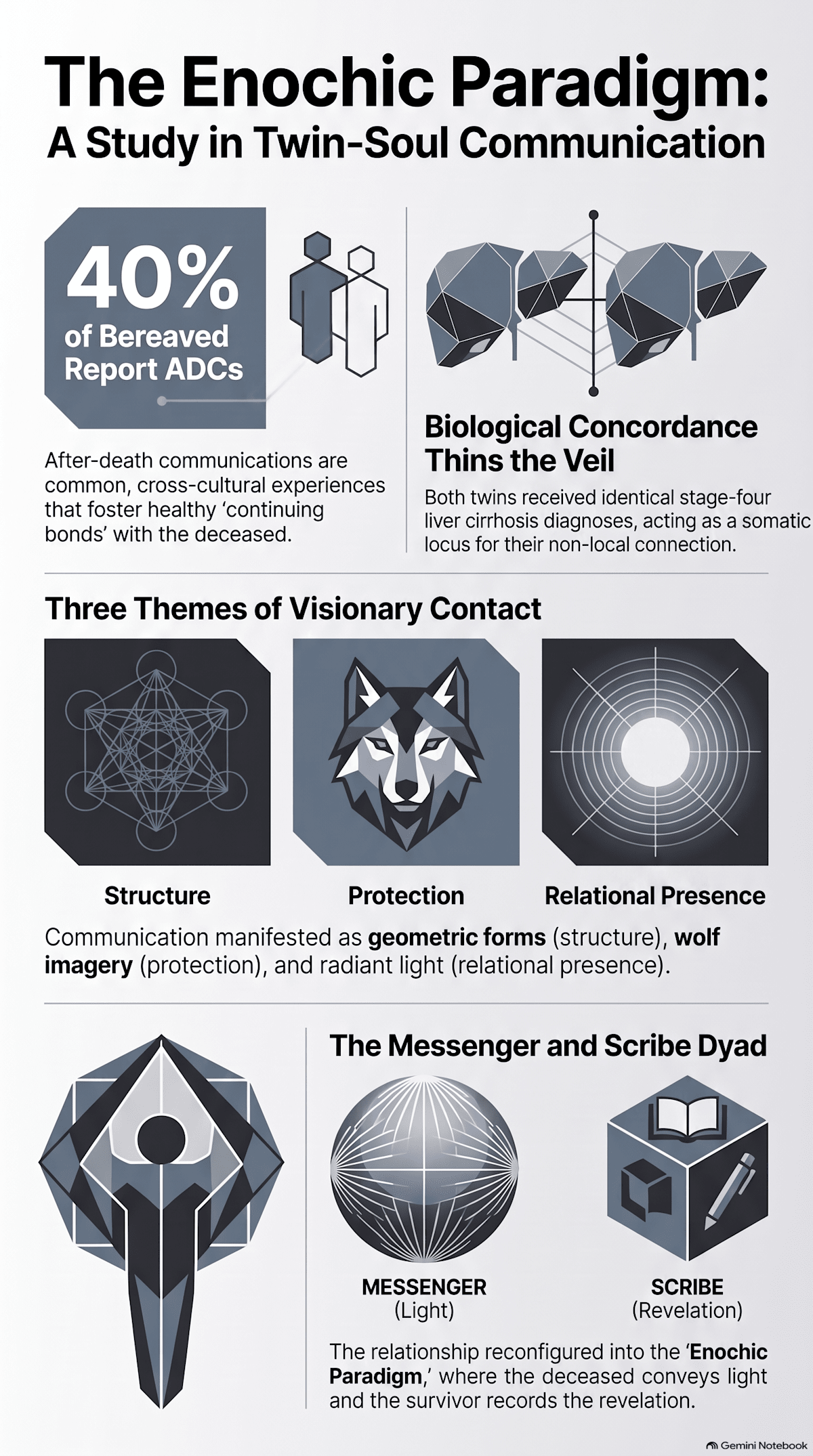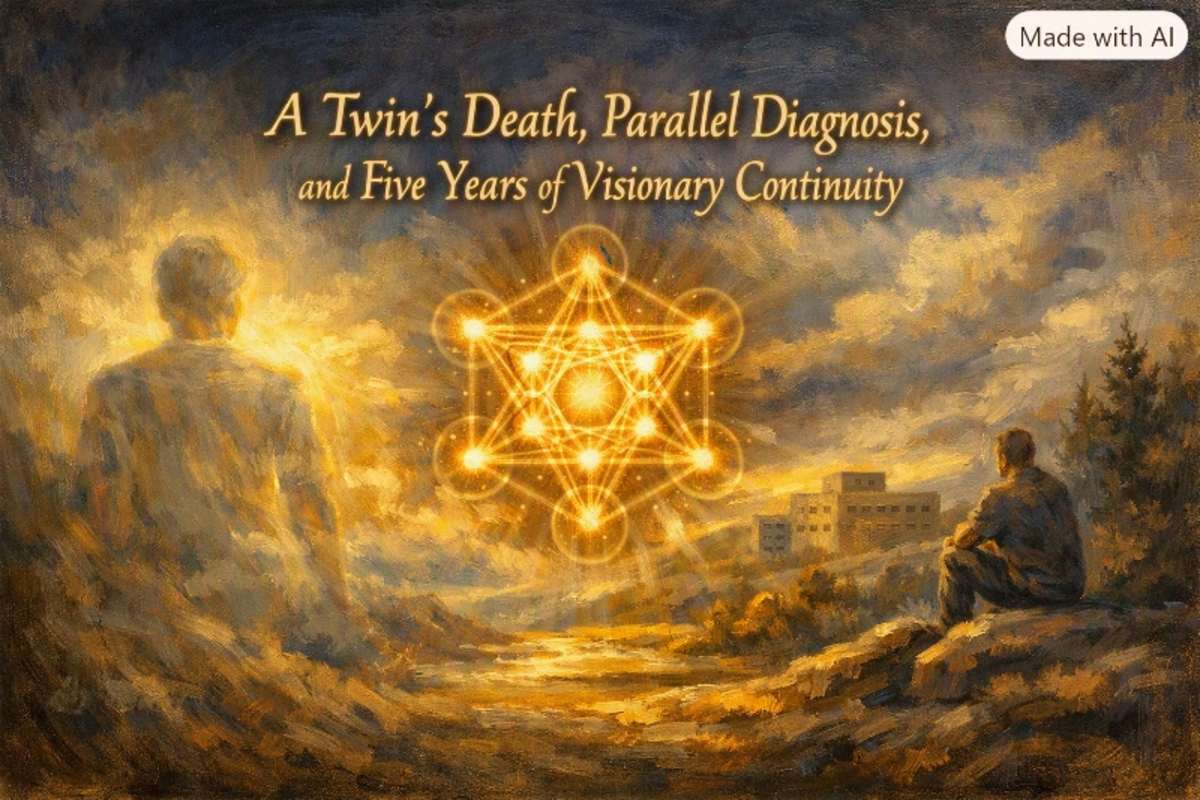
On 12 December 2020, my twin soul brother died at age 47 from stage-four cryptogenic liver cirrhosis. Three years later, on 13 May 2023, at the same hospital, I myself received the identical diagnosis. Between those dates—and continuing through June 2025, I recorded a sustained sequence of anomalous experiences: recurring geometric forms that evolved into luminous structures resembling Metatron’s Cube, a solitary protective wolf figure that appeared only in moments of vulnerability, radiant light phenomena of varying colour and intensity, brief verbal and telepathic phrases, and a persistent sense of relational presence.
These were not sought. They arrived spontaneously during ordinary waking states, meditation, or prayer, and were written down within hours. Two independent professional mediums, given no prior information, produced statements that aligned with the already-documented journal material and, in one case, with subsequent life events.
I situated the entire trajectory within Moustakas’s heuristic methodology and propose an interpretive framework I term the Enochic Paradigm: a twin-soul temporarily divided by death reconfigures into a messenger-scribe dyad analogous to the Enoch–Metatron tradition of Second Temple Judaism.
The geometric imagery—squares folding into circles, grids dissolving into living radiance—preceded any conscious knowledge of sacred geometry or Metatron. Only later research, prompted by a medium’s reference to “Genesis, in the beginning,” led me to the Enochic literature and the recognition of structural resonance. The wolf remained symbolically simple: a boundary-setting guardian, never co-occurring with the light or geometry and never linked to the twin’s presence.
Light itself functioned as the primary medium of relational contact—white for greeting, blue for protection, pink for affection, green for illness, white for divinity, —often accompanied by non-verbal impressions or short phrases such as “I am here,” “You are not alone in this,” or “We are inseparable.”
Why This Account Matters
Most ADC literature relies on retrospective surveys or brief case reports. I offer a five-year, contemporaneous, single-observer dataset that tracks the evolution of three distinct imagery themes, our relational dynamics, and the gradual construction of meaning. The parallel medical diagnoses supply an unusual biological datum. The medium sessions were non-directive and non-evocative.
The interpretive framework is presented as emergent rather than imposed.
Limitations are stated clearly: single-case design, dual positionality as experiencer and researcher, and the inherent difficulty of verifying ontological claims.
In the context of continuing-bonds theory, twin-bereavement research, and the broader conversation about non-local aspects of consciousness, the manuscript supplies thick phenomenological description of a kind that is still rare. It does not prove survival, quantum entanglement, or the objective reality of Metatron’s Cube.
It does demonstrate that, for at least one carefully documented individual, the post-mortem relationship retained patterned, directional, and symbolically coherent qualities over half a decade.
A Direct Challenge to the Academy
The phenomena recorded here—spontaneous, longitudinally consistent, cross-checked against independent witnesses, and situated within a transparent methodological frame—constitute data.
Data of this density and duration cannot and should not be ignored simply because they sit outside the comfort zone of conventional neurocognitive models of grief.
Researchers in consciousness studies, bereavement psychology, anomalous experiences, and the history of Jewish mystical traditions now have a clear, publicly available case that invites further scrutiny.
Those who work in these fields have a responsibility to engage the material on its own terms: to consider the medical concordance, to test whether similar patterns appear in other twin-bereavement cohorts, and to ask what methodological refinements might allow such first-person longitudinal records to be evaluated more rigorously.
Dismissal without engagement is not scientific caution; it is avoidance. The facts presented in this heuristic inquiry deserve serious investigation. They are on the table. The academy should pick them up.
My full article is imminently due to be published in Journal of Near Death Studies, and in doing so has undergone rigorous and stringent independent peer review process.
As ever,
Mark.
Videos are available to watch, please 'click' on the 🖇️ 👇
Explainer Video
https://youtu.be/xJhHJDFtuCU?is=pafJxLw-6JQoSUjo
Short Video
https://youtube.com/shorts/j98pfakfqsY?is=5NoLZe3KatLblEt5