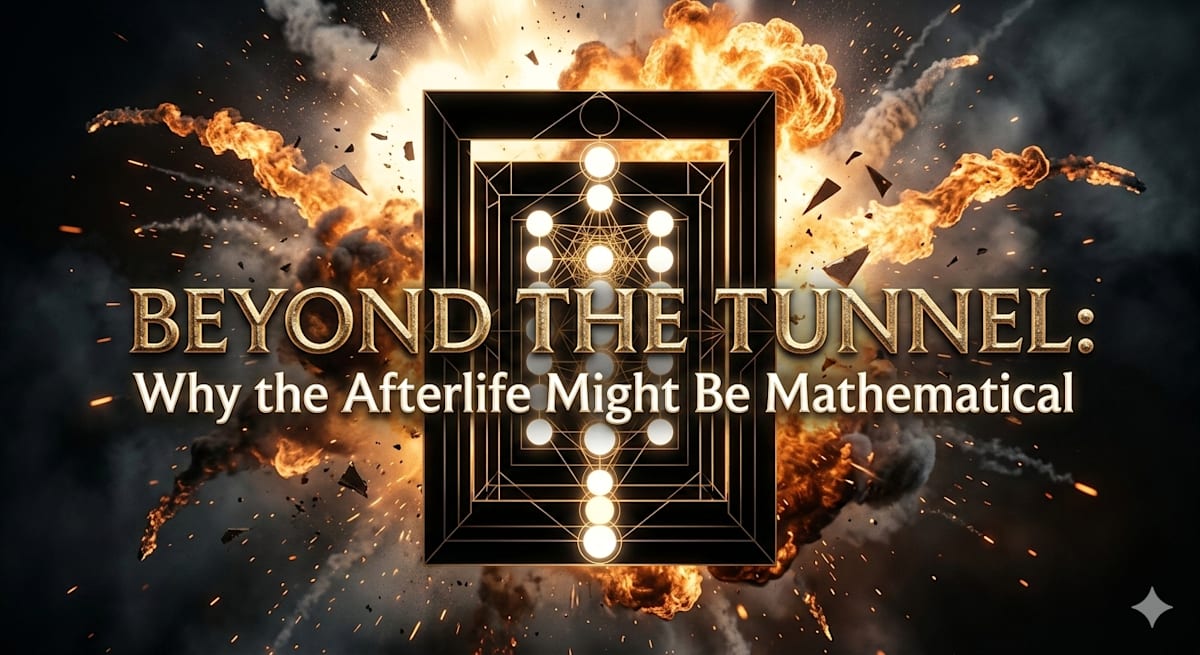
When we contemplate the threshold of death, we typically reach for a familiar iconography of emotional reassurance: the radiant tunnel, the welcoming embrace of ancestors, or the blissful dissolution of the self. These narratives are deeply human, yet they often lack the structural rigor required to describe a truly transcendent reality. What if the "language" of the afterlife is not found in sentimental reunions, but in a sophisticated architectural and mathematical grammar?
The work of independent scholar Mark Edward Chard offers a radical shift in perspective. Through a longitudinal study spanning over five years following the death of his identical twin, Darren, Chard has documented a series of waking visions that suggest a transition from organic contingency to geometric necessity. His "Scribal Consciousness" hypothesis invites us to view after-death communication (ADC) not as a haunting, but as a systematic restructuring of perception—moving us beyond the tunnel and into the calculus of the divine.
The "Quadrant Rule" of Divine Vision
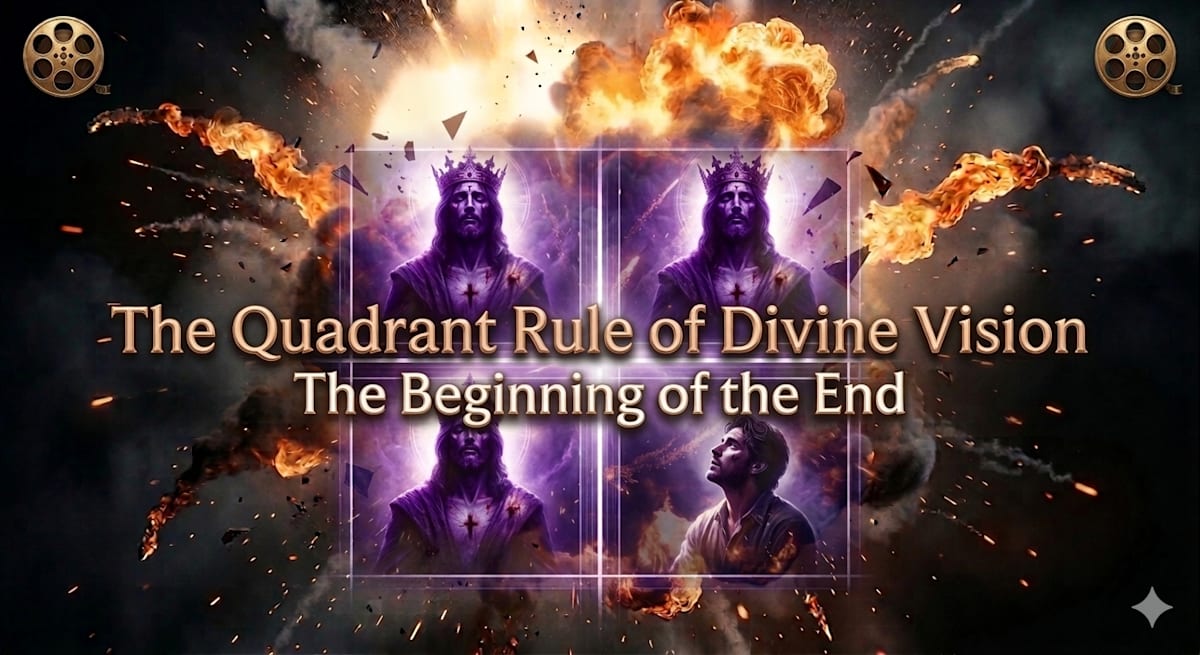
Before the emergence of abstract data, Chard’s visions established a rigid, invariant visual structure. This was not a fluid dreamscape, but a space governed by structural dominance. In this visionary field, a strict "three-quarters" rule applied: a Christological figure consistently occupied the upper left, upper right, and lower left quadrants. Darren, the deceased twin, appeared exclusively in the lower right.
This configuration served as a theological guardrail, ensuring that the communication remained Christocentric rather than mediumistic. By framing the personal (the brother) within the divine (the Christ), the vision established an ontological primacy where the individual is subordinate to the absolute order. This is not mere "brain noise"; it is a regulated, hierarchical event. Chard describes the central figure’s appearance with a focus on its regal, sacrificial gravitas:
"The first consists of images of Christ: crucified, crowned, suffused with a deep purple hue — the colour of royal suffering, holding crucifixion and exaltation simultaneously."
2 From Flesh to Flame (The Metatron Transformation)
To interpret this shift from the personal to the pattern, Chard draws upon the 3 Enoch (Sefer Hekhalot) tradition. This ancient text narrates the transformation of the patriarch Enoch into the angel Metatron, the "Prince of the Presence." Chard views this "Flesh-to-Flame" sequence as a primary metaphor for how post-mortem consciousness is transfigured.
The afterlife, in this view, is not a destination but a fundamental restructuring of somatic existence into a luminous, mathematical mode of being. As Enoch is "re-coded" from matter into fire, he gains the capacity to perceive the divine order directly. This process is captured in the startlingly precise imagery of 3 Enoch 15:1:
"At once my flesh turned to flame, my sinews to blazing fire, my bones to juniper coals, my eyelashes to lightning flashes, my eyeballs to fiery torches, the hair of my head to hot flames, all my limbs to wings of burning fire, and the substance of my body to blazing fire."
3 The "Geometric Ledger" Hypothesis
The most provocative data in Chard’s study involves "geometric ledgers"—black rectangular fields containing ordered columns of radiant white circles. Chard proposes the Scribal Consciousness hypothesis: that the deceased may participate in recording or communicating divine order through a mathematical symbolic grammar analogous to Metatron’s celestial record-keeping.
These elements are not random; they are deeply rooted in the history of sacred geometry:
- Rectangles: These signify bounded sacred space. Much like the Holy of Holies in Solomon’s Temple was a perfect cube, or the New Jerusalem is described as a square, these rectangles represent the threshold between the mundane and the holy.
- Columns: These represent celestial hierarchy and the vertical axis—a "Jacob’s Ladder" of ordered degrees of divine proximity.
- Circles: These symbolize luminous souls or points of divine light, shifting from pale grey to radiant white as the transfiguration intensifies.
4 It’s Not Just "Brain Noise" (The Timing Evidence)
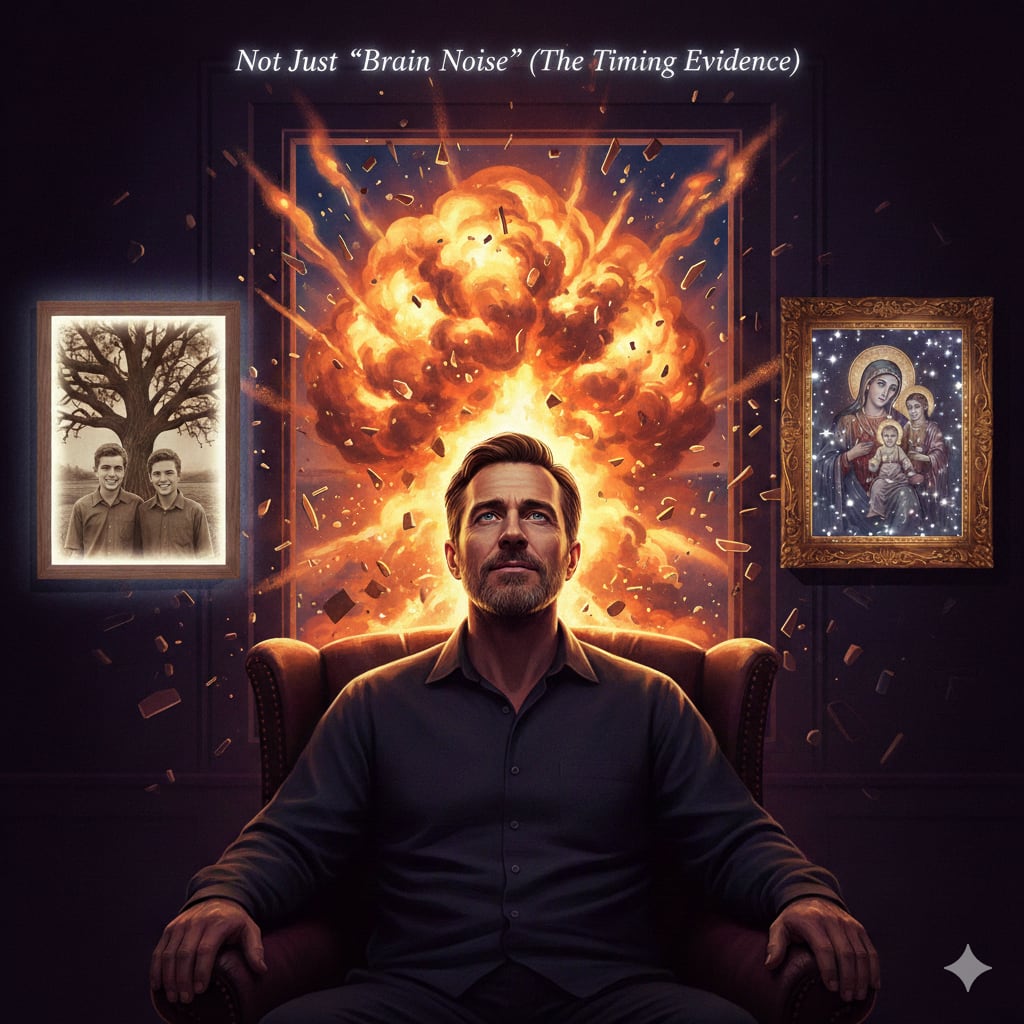
Reductive materialists often dismiss such visions as phosphenes (neurological noise) or "conceptual priming," where the brain simply projects what it has recently studied. However, Chard’s data presents a formidable challenge to these explanations.
The critical temporal fact is that the basic geometric configuration—the rectangles and columns—remained consistent for four and a half years, from June 2021 until his intensive academic study of the Enoch-Metatron tradition began in December 2025. The visions preceded the scholarship, suggesting that the experience was the source of his intellectual inquiry, not the result of it.
Furthermore, the Phase 3 visions displayed a level of intentionality that random cortical firing cannot replicate. Individual circles were observed to perform a specific, purposive movement: approach → hover → consistent leftward departure. This suggests an active, cross-ontological communication rather than a static hallucination.
5 The Sacred Domestic Response
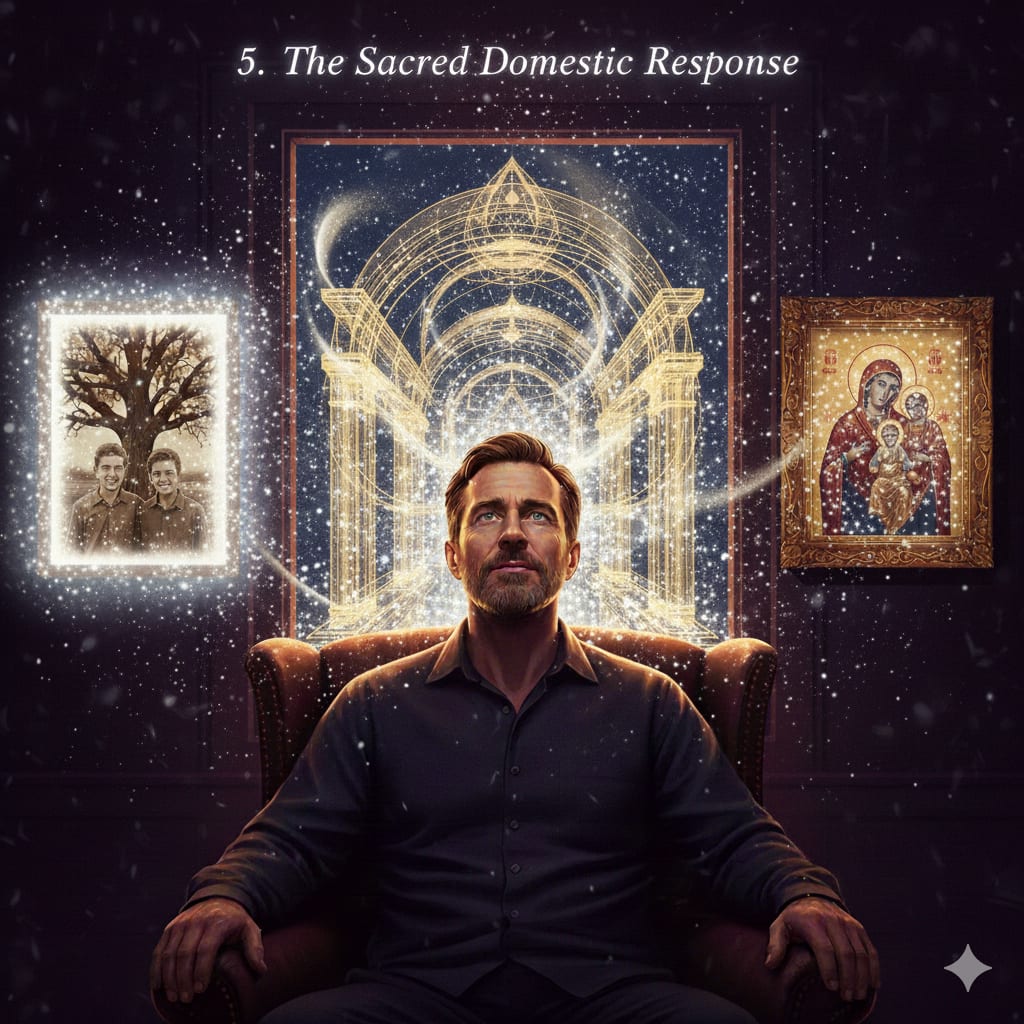
Perhaps the most jarring evidence of this phenomenon is what Chard calls the interpenetration of the visionary and the physical. These were not purely internal mental events; the physical environment of his prayer space appeared to react in real-time.
During these visions, two specific objects in the room—a photograph of Darren beneath a tree and a devotional image of the Holy Family—exhibited environmental phenomena. Chard observed the border of Darren’s photograph illuminating with white light, while "twinkling white lights" appeared specifically within the frame of the Holy Family image. This suggests a bridge where the apophatic knowledge of the divine realm bleeds into our tangible, domestic reality.
Conclusion: The Final Calculation
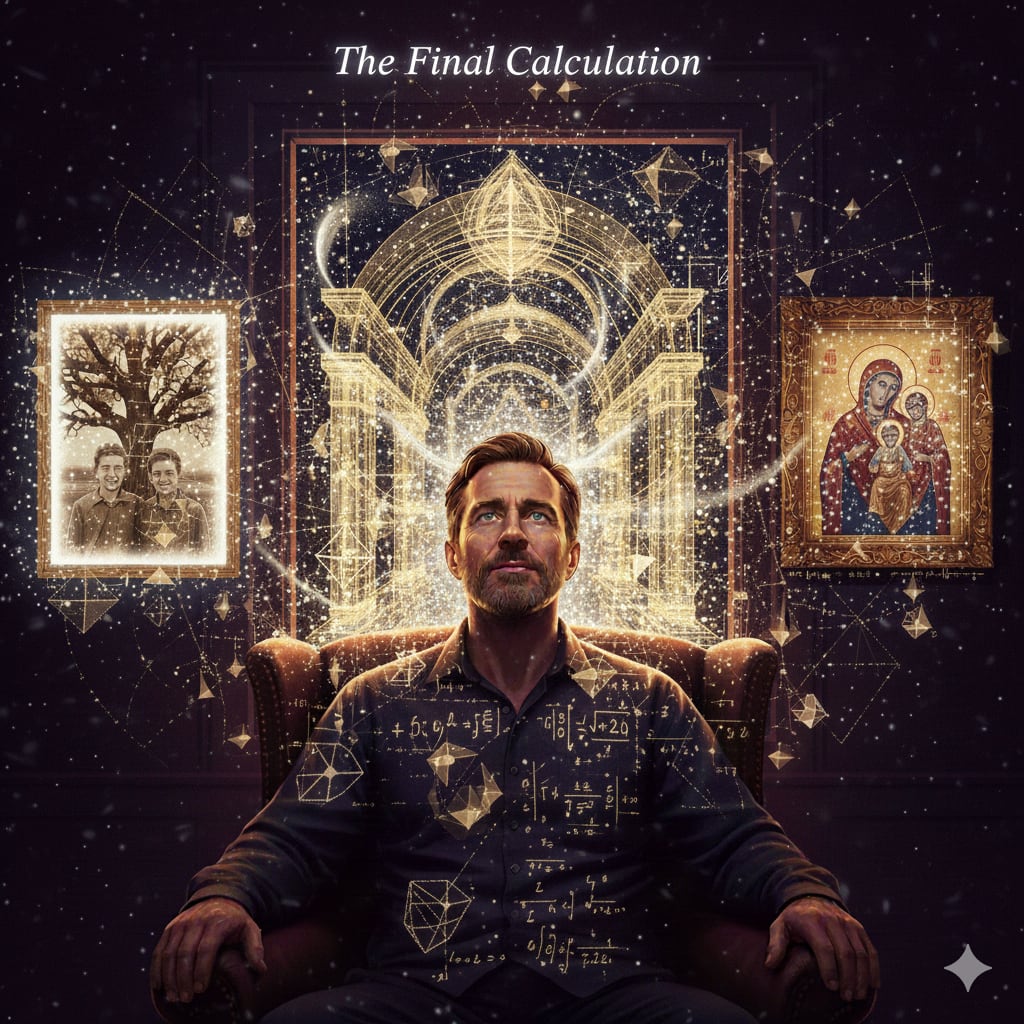
The progression from "flesh" to "flame" represents a radical reimagining of human destiny. If we adopt Chard’s lens, death is not a fading into the void, but an entry into the mathematical order of divine reality. It is a shift from the messy, organic narratives of earth to the structured, luminous grammar of the cosmos.
This research challenges us to move beyond the search for "comforting ghosts" and toward an encounter with divine patterns. If, as the ancient sages and modern physicists suggest, the foundation of the universe is built on mathematical order, why should we expect the afterlife to speak any other language? We must ask ourselves: are we prepared to accept that the soul’s final destination is not a place, but a calculation—a realization that matter is a language of Spirit?