Have you ever considered that a straight line could be a weapon? Or that a geometric shape could silence an entire system of spiritual knowledge?
In modern society, we are taught to view geometry as a neutral, objective branch of mathematics. We look at architectural blue-prints, city grids, and artistic proportions as matters of pure logic or simple aesthetics.
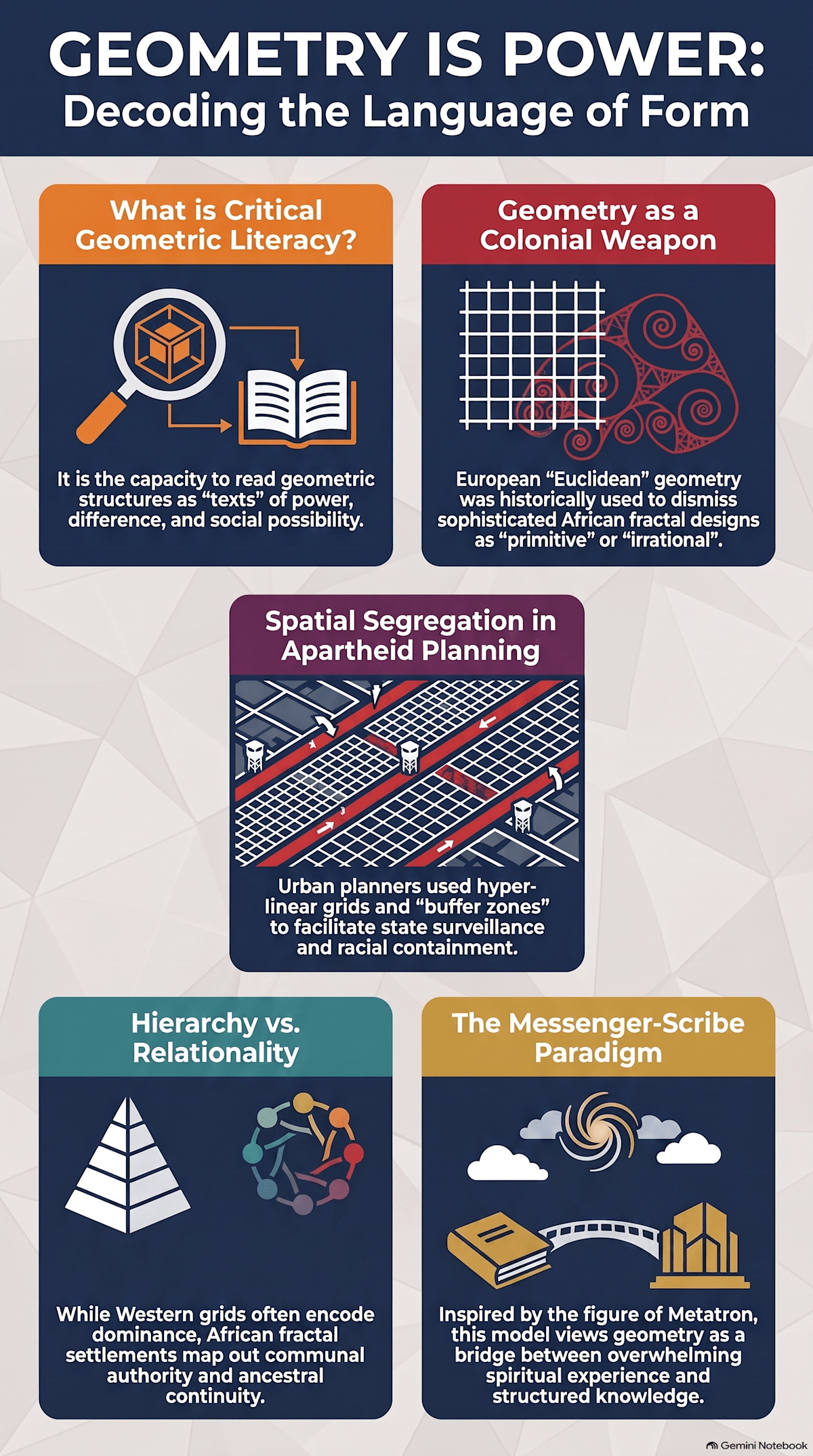
But geometry is never neutral. It is a dense cultural technology that has been used for centuries to classify bodies, partition land, and decide whose knowledge matters.
In my latest research article, "Critical Geometric Literacy: Extending the Study of Religious Diversity through Sacred Geometry and the Enochic Messenger–Scribe Paradigm," I introduce a new framework to decode these silent structures of control. It is called Critical Geometric Literacy (CGL).
The Hidden Power of the Euclidean Grid
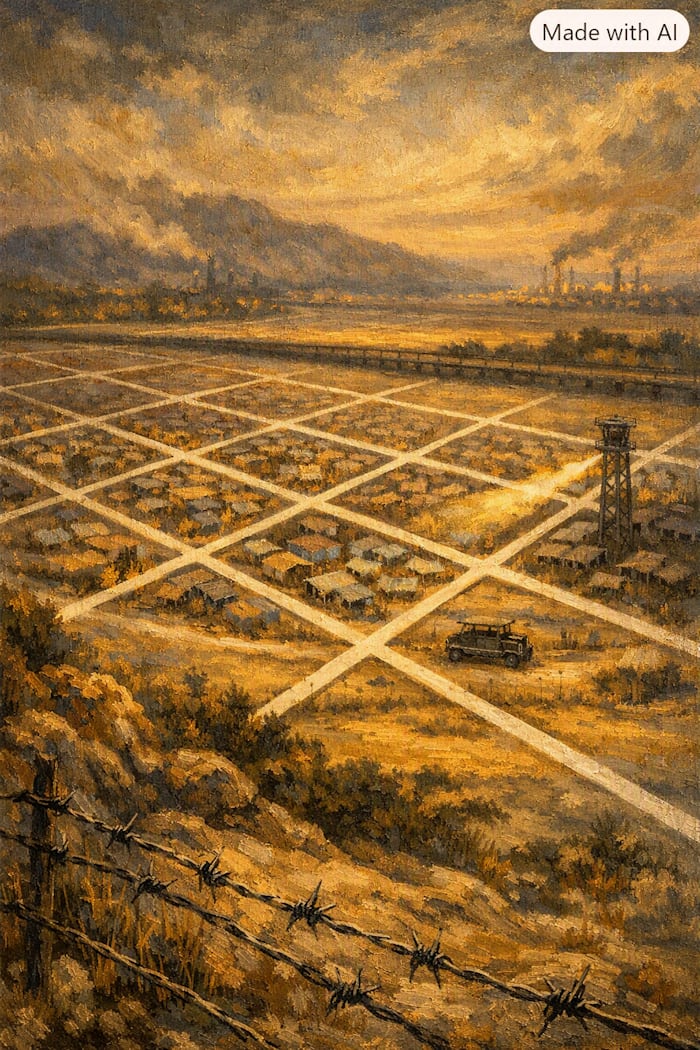
For centuries, Eurocentric intellectual traditions have elevated standard Euclidean geometry—characterized by rigid straight lines, perfect right angles, and non-scaling grids—as the ultimate hallmark of human rationality and civilization. Conversely, the fluid, organic, or non-linear spatial practices of the Global South were routinely dismissed by colonial authorities as "primitive," irregular, or pre-rational.
Far from remaining confined to abstract academic debates, this geometric bias was directly weaponized in the material enforcement of colonial and apartheid statecraft:
- The 300-Meter Segregation Buffer: Apartheid urban planning in South Africa utilized precise, calculated 300-meter strips of open veld, rail lines, or industrial zones to physically partition racialized groups in post-1950 Johannesburg.
- Panoptic Surveillance Grids: The design of Black townships like Soweto relied on hyper-linear, uniform geometric grids deliberately engineered to optimize state surveillance, panoptic police visibility, and swift military containment.
When we look at the apartheid city layout, we are not looking at accidental urban sprawl; we are looking at an aggressive, material exercise in geometric subjugation.
Reclaiming Epistemic Justice Through African Fractals
To challenge this dominant narrative, we must look to alternative, highly sophisticated geometric traditions that have been systematically marginalized.
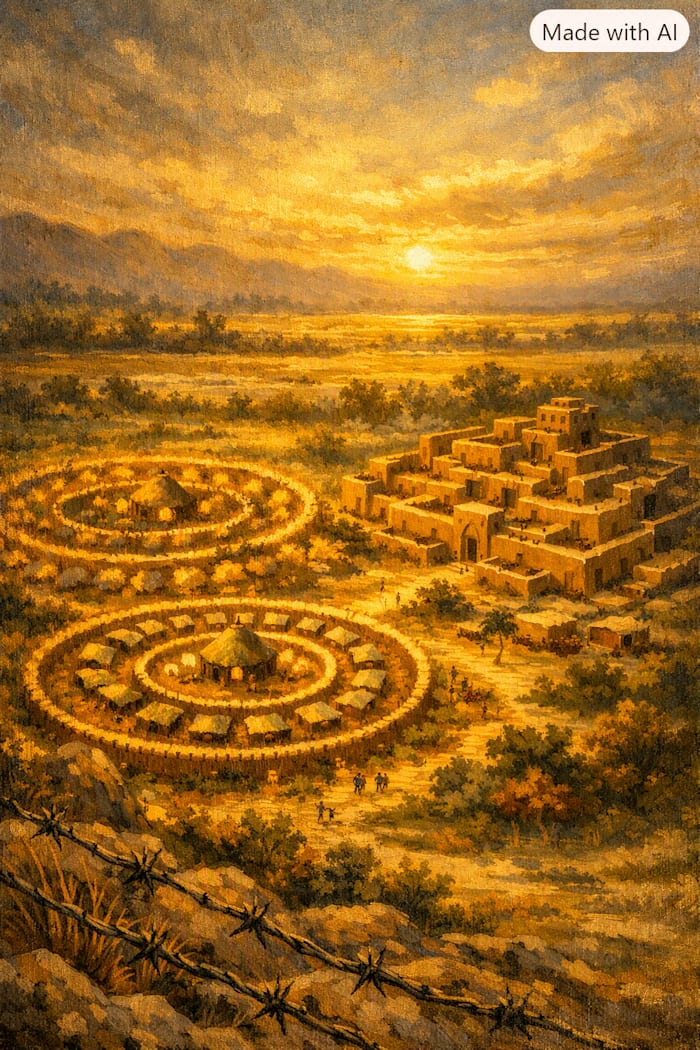
As the groundbreaking work of Ron Eglash demonstrates, indigenous African architecture frequently bypasses linear Euclidean design in favor of self-similar, recursive fractal structures.
Consider these distinct examples:
The Ba-Ila Settlements (Zambia):
This design features a massive ring of circular structures enclosing smaller concentric rings, scaling down recursively to individual family quarters and interior altars. This layout maps out relational proximity to ancestral lineages and communal, distributed authority.
The Logone-Birni Palace (Cameroon):
This architecture utilizes recursive scaling rectangles, where the progression of physical scale corresponds directly to the increasing sacred status and spiritual restriction of the inner sovereign core. These mathematical structures represent sophisticated indigenous worldviews where geometry serves as a live medium for relationality, cosmic continuity, and spiritual alignment
The Enochic Messenger-Scribe: Navigating Threshold Knowledge
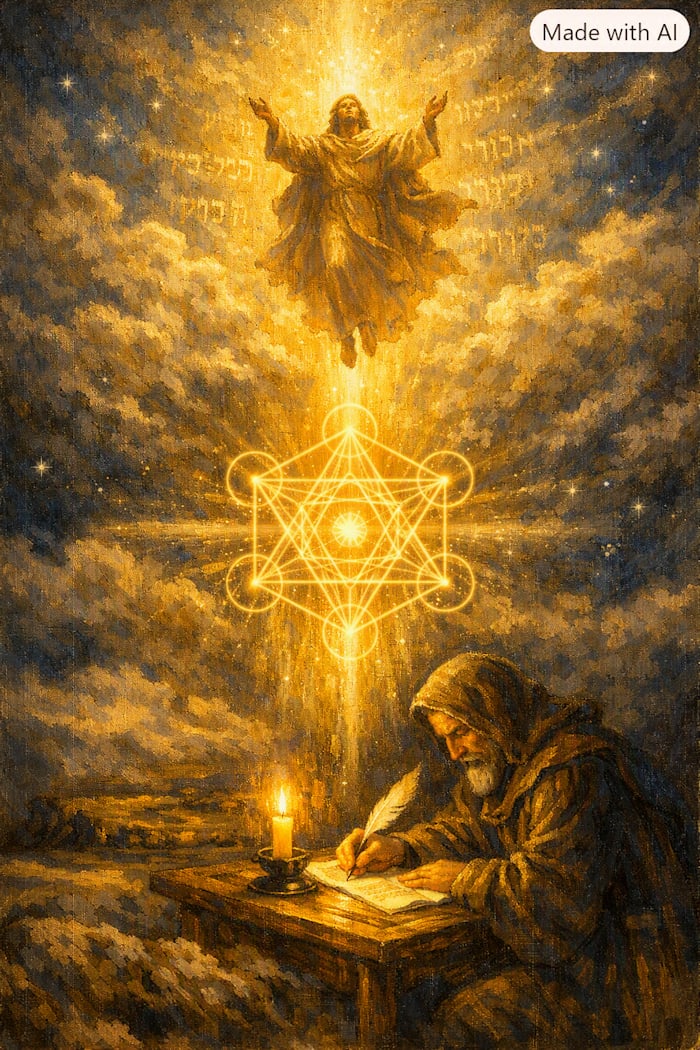
How do scholars responsibly discuss knowledge that emerges at the absolute thresholds of dominant, materialistic rationality—such as visionary encounters, sacred geometries, or trans-mortal after-death communications (ADC)? Historically, the Western academy has pathologized or dismissed these phenomena as unscientific subjectivity.
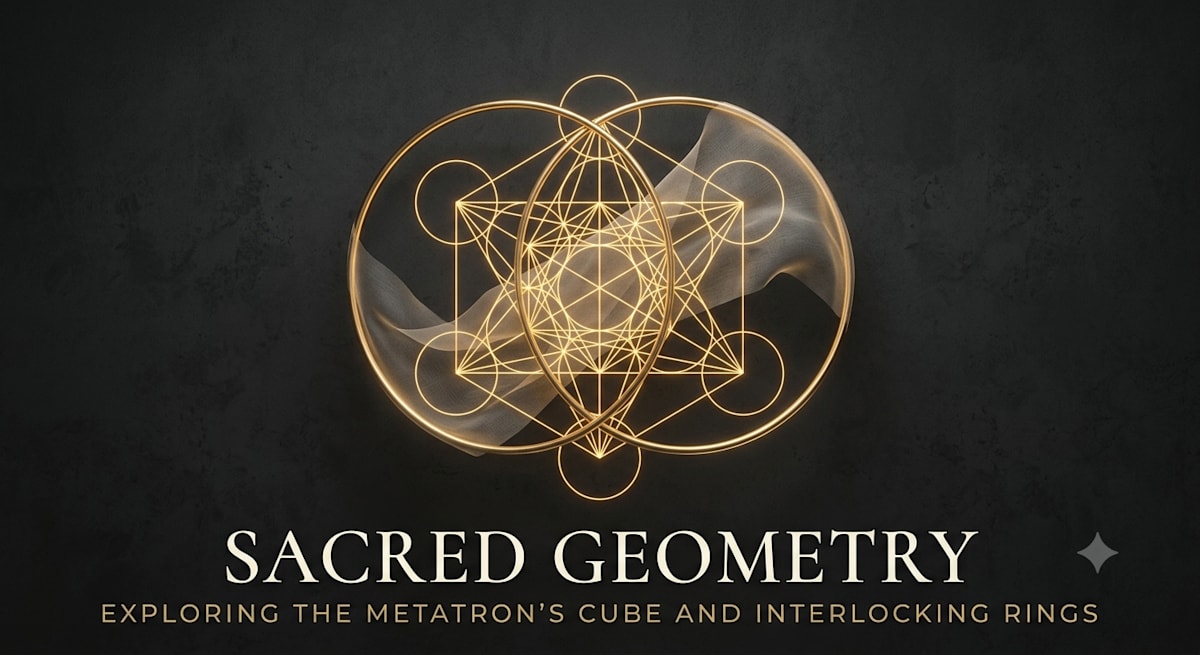
To bridge this gap, my paper develops the Enochic Messenger-Scribe Paradigm, drawing from the ancient mystical text of 3 Enoch (Sefer Hekhalot). In this tradition, the human figure of Enoch is translated to the heavenly realm, transforming into the angelic scribe Metatron.
Metatron operates in a dual, relational register:
- The Messenger: He experiences and receives knowledge from the overwhelming proximity of non-ordinary realities.
- The Scribe: He performs the precise work of translation, organizing and rendering that fluid, overwhelming threshold experience into structured, geometric knowledge (historically represented by Metatron's Cube) that finite human consciousness can receive and analyze.
By viewing this ancient paradigm through modern transpersonal frameworks like Jorge Ferrer’s participatory epistemology, we discover a bulletproof method for handling threshold experiences. The researcher operating as a messenger-scribe does not assume an attitude of detached, cold clinical objectivism, nor one of uncritical subjectivism. Instead, they perform a rigorous, accountable mediation—translating raw spiritual affect into coherent, analytical frameworks that are legible to the wider academy.
Why Form Matters
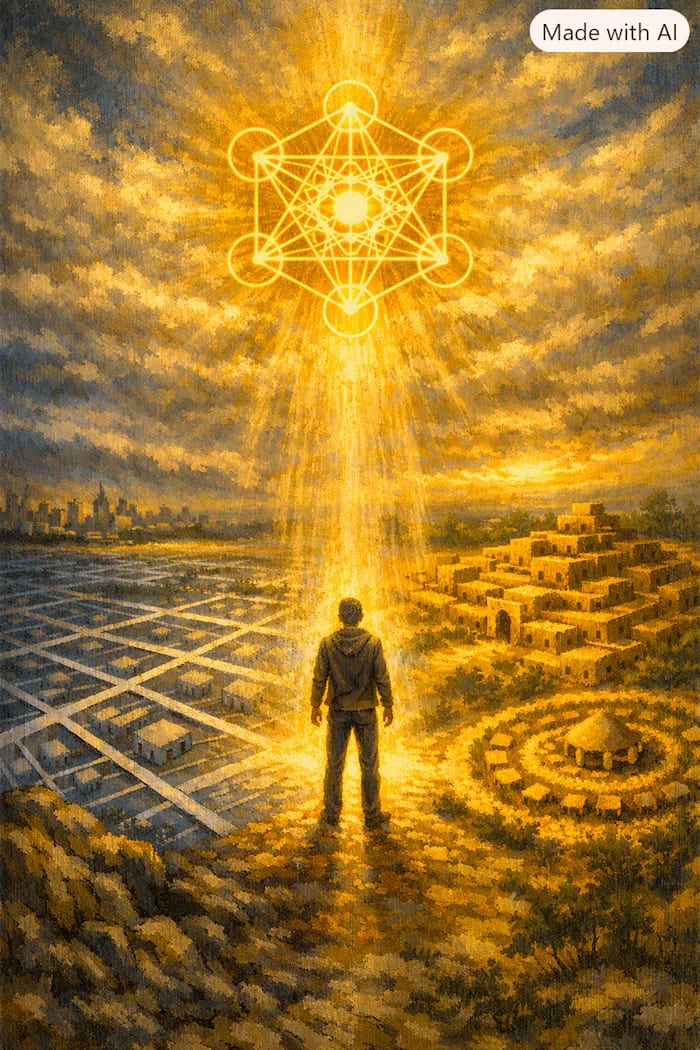
Critical Geometric Literacy demands that we stop treating form as an afterthought. Whether we are analyzing the layout of a university campus, the architecture of a historic cathedral, or the spiritual realities of trans-mortal connection, we must learn to read form as a direct language of power, difference, and resistance.
By unpacking the hidden politics of the shapes that surround us, we don't just expand our academic repertoire—we engage in a profound act of epistemic liberation.
Join the Conversation
If you're interested in reading the full theoretical breakdown, structural criteria, and technical appendices, you can access the complete paper now.
Let's discuss in the comments:
- How do the geometric layouts of the spaces you navigate every day shape your sense of belonging or exclusion?
- Can sacred geometry be intentionally used today as a tool for social healing and decolonial resistance?
Please 'click' on the video 🖇️ 👇 to watch videos on this subject:
Long Explainer:
https://youtu.be/mCO0ls4VWg8?is=Ibw-kdl0F776YUIh
Short Video:
https://youtube.com/shorts/HYMN5SLxpzU?is=MdNuWN3v6E6tBMYF