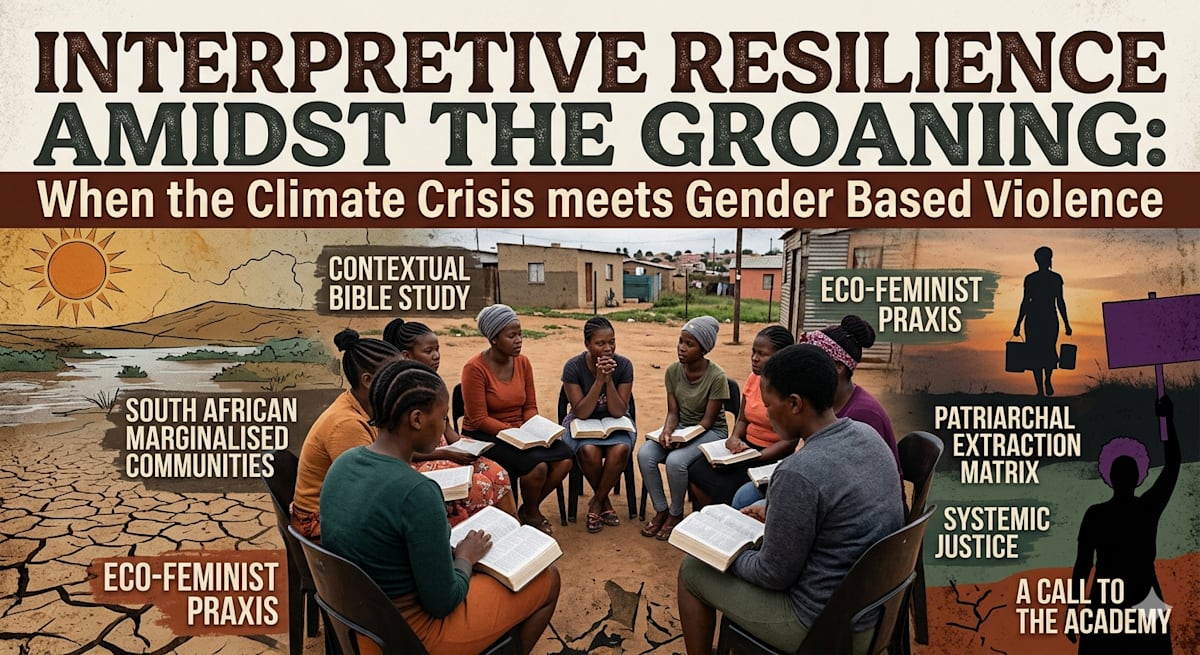
The Earth is groaning (Romans 8:22), and so are the women and girls in South Africa’s marginalized communities.
When we talk about the climate crisis, we often speak in environmental abstractions—parts per million of carbon, shifting rainfall data, or melting ice caps. But for poor Black women in South African townships and rural settlements, the polycrisis is not an abstraction. It is an immediate threat to bodily safety.
In a forthcoming paper titled “Interpretive Resilience Amidst the Groaning: Contextual Bible Study as Eco-Feminist Praxis for Climate Justice and Gendered Healing in South African Marginalised Communities,” I explore how the Ujamaa Centre’s pioneering Contextual Bible Study (CBS) methodology serves as a vital tool for community resistance at the under-explored intersection of climate collapse and gender-based violence (GBV).
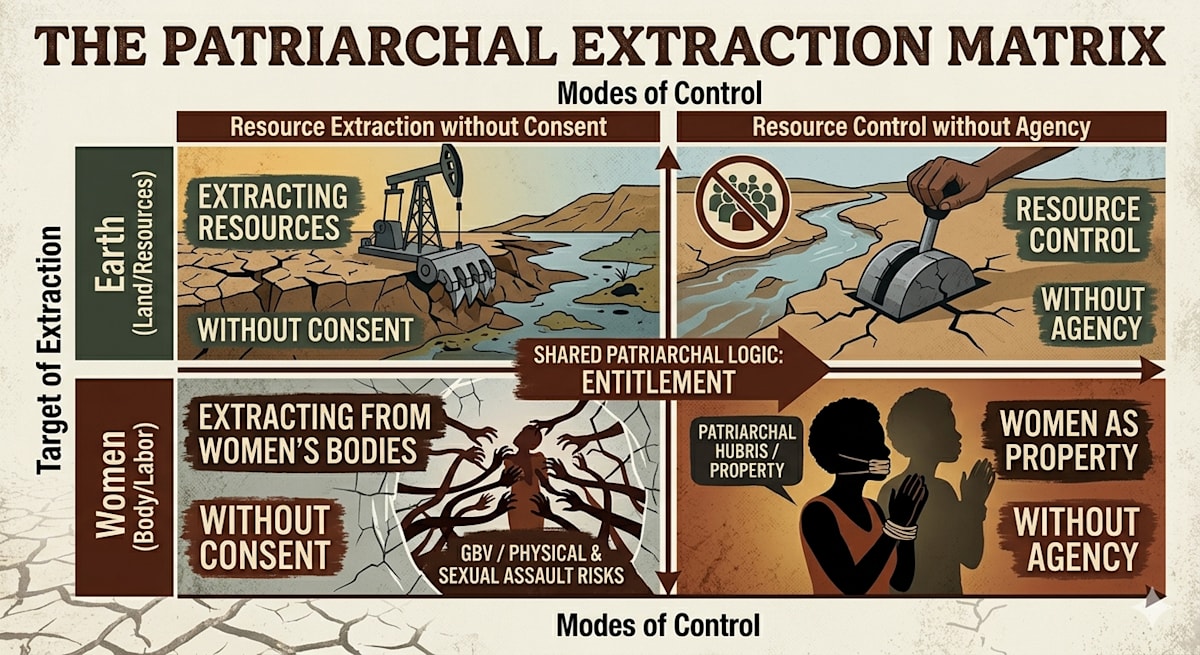
The Patriarchal Extraction Matrix
African eco-feminism insists that the violation of the land and the violation of women are not parallel, isolated accidents. They are twin expressions of the exact same patriarchal logic.
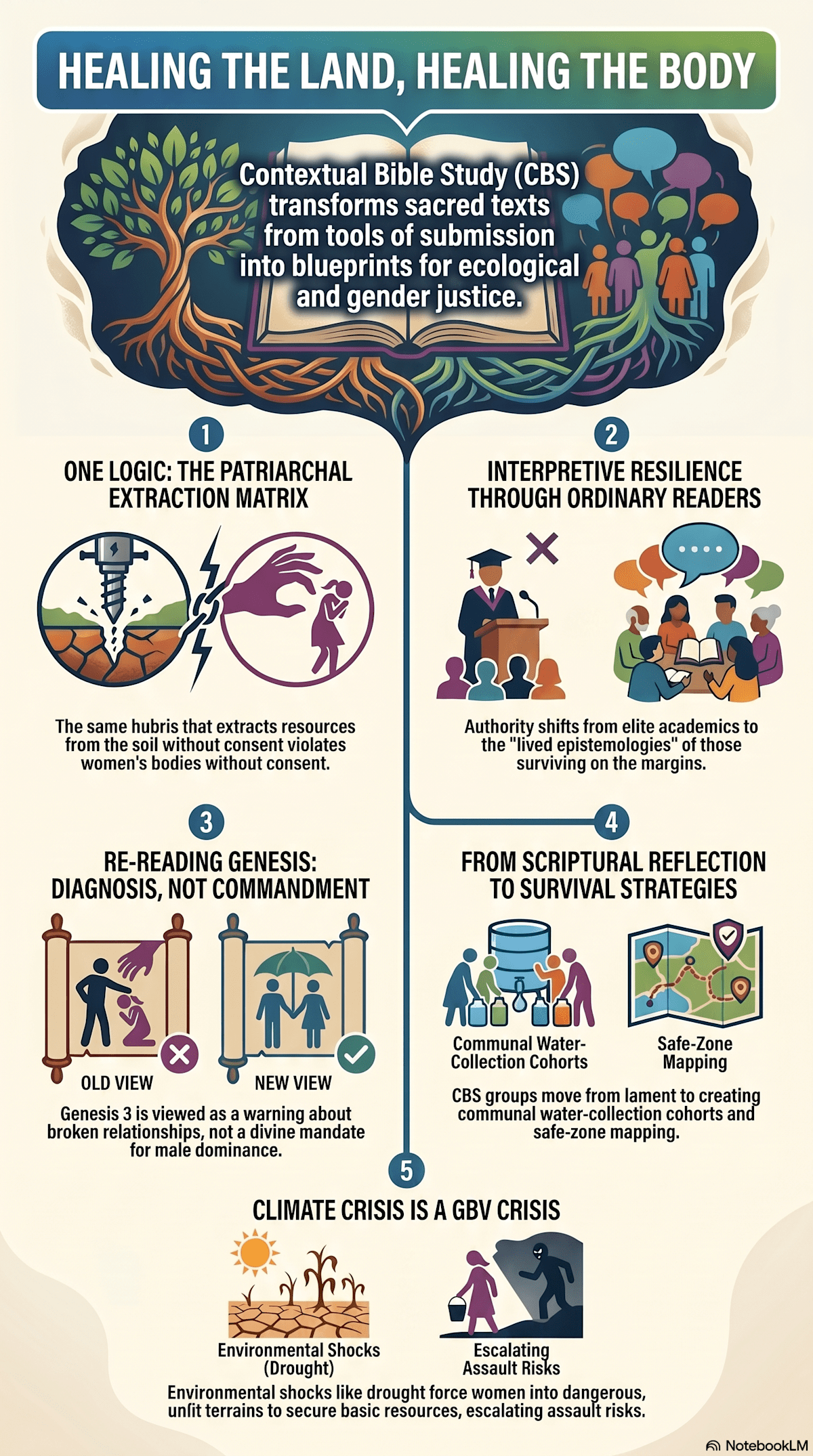
The Patriarchal Extraction Matrix: The same entitlement that extracts resources from the soil without consent extracts from women’s bodies without consent. The hubris that treats the Earth as property treats women as property.
In KwaZulu-Natal, which has experienced both catastrophic flooding and severe drought cycles over the last decade, this intersection is visceral. When water infrastructure fails or rivers become contaminated, women must walk significantly longer distances into unlit, unfamiliar terrains to secure basic resources. These long journeys—often before dawn or after sunset—expose them to heightened risks of physical and sexual assault. Furthermore, climate-induced crop failures and economic devastation trigger immense domestic pressure, directly correlating with spikes in domestic violence.
The climate crisis is a GBV crisis. A theological critique of environmental degradation that ignores gendered violence is structurally blind, and a response to GBV that ignores ecological collapse is equally incomplete.
Hermeneutical Insurgency: Turning Text into Resistance
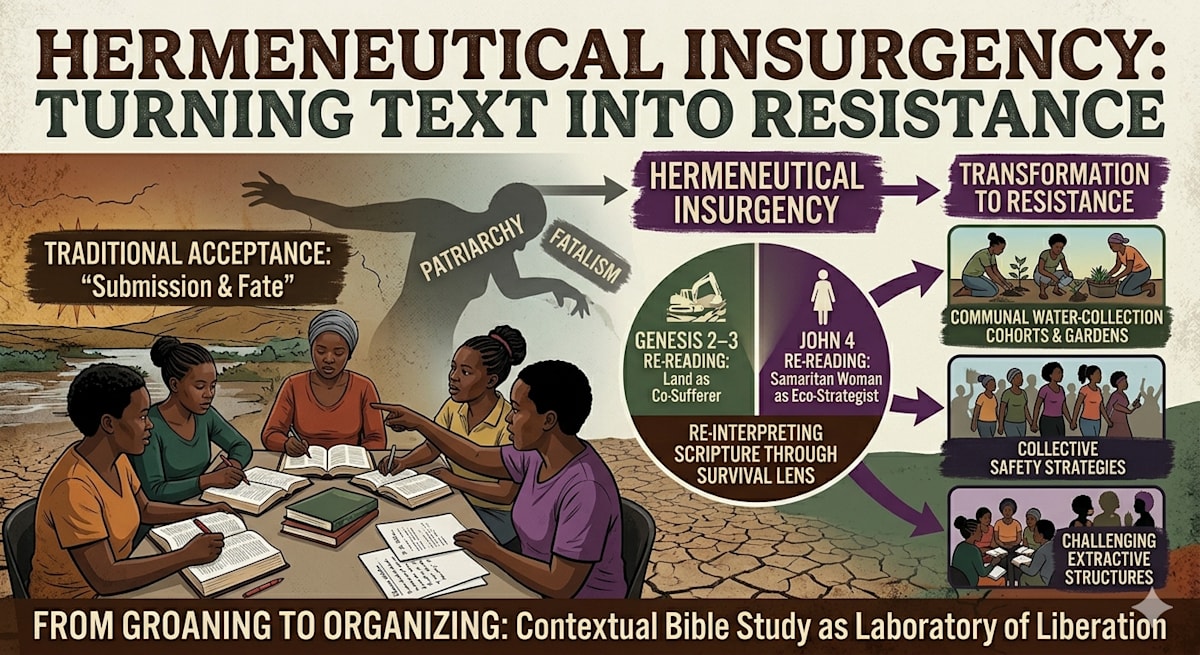
Traditional, detached academic commentaries—primarily written in the Global North—frequently abstract biblical texts from the material conditions of life. When pulpits weaponize Scripture to preach fatalistic submission, they strip marginalized communities of their agency.
Contextual Bible Study serves as a hermeneutical insurgency, breaking down the hierarchy between the "trained" scholar and the "ordinary" reader. It honors a foundational liberationist truth: those living under systemic oppression possess an epistemological privilege when interpreting texts of suffering and hope.
When ordinary readers gather to read Scripture through the lens of survival, the Bible speaks completely differently:
Genesis 2–3: The Earth as Co-Sufferer
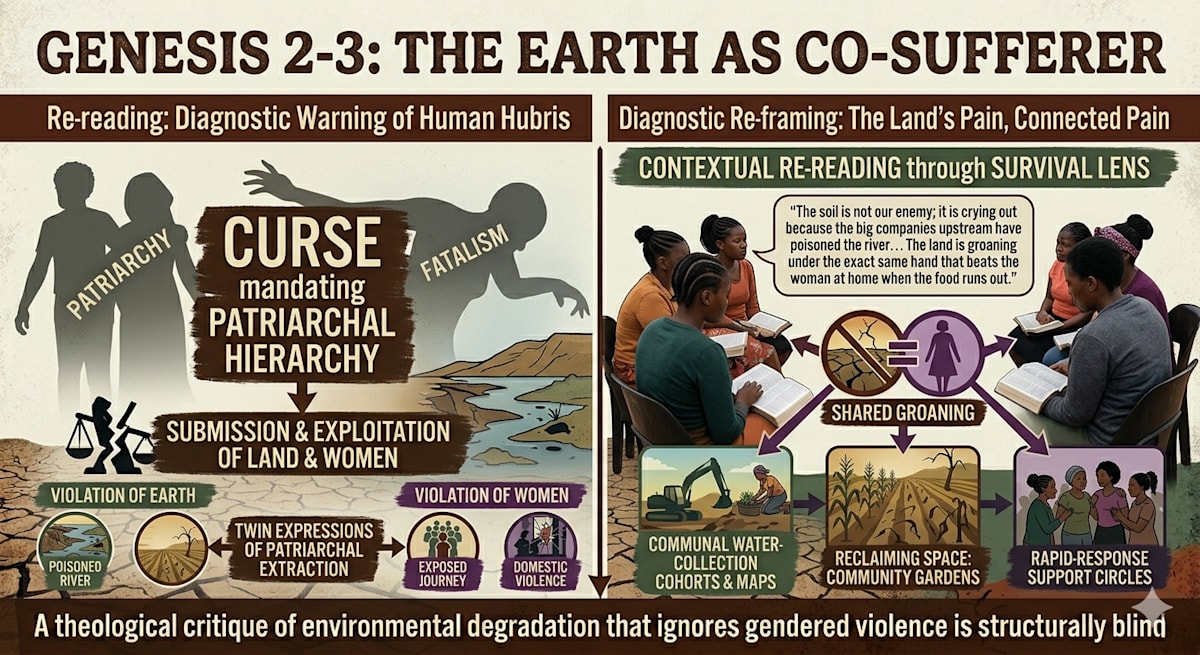
Rather than reading the "curse on the ground" as a divine mandate for patriarchal hierarchy, ordinary readers in CBS sessions re-read the text as a diagnostic warning about human hubris. As one participant from a rural community near Durban poignantly observed:
“The soil is not our enemy; it is crying out because the big companies upstream have poisoned the river... The land is groaning under the exact same hand that beats the woman at home when the food runs out.”
John 4: The Samaritan Woman as Eco-Heroine
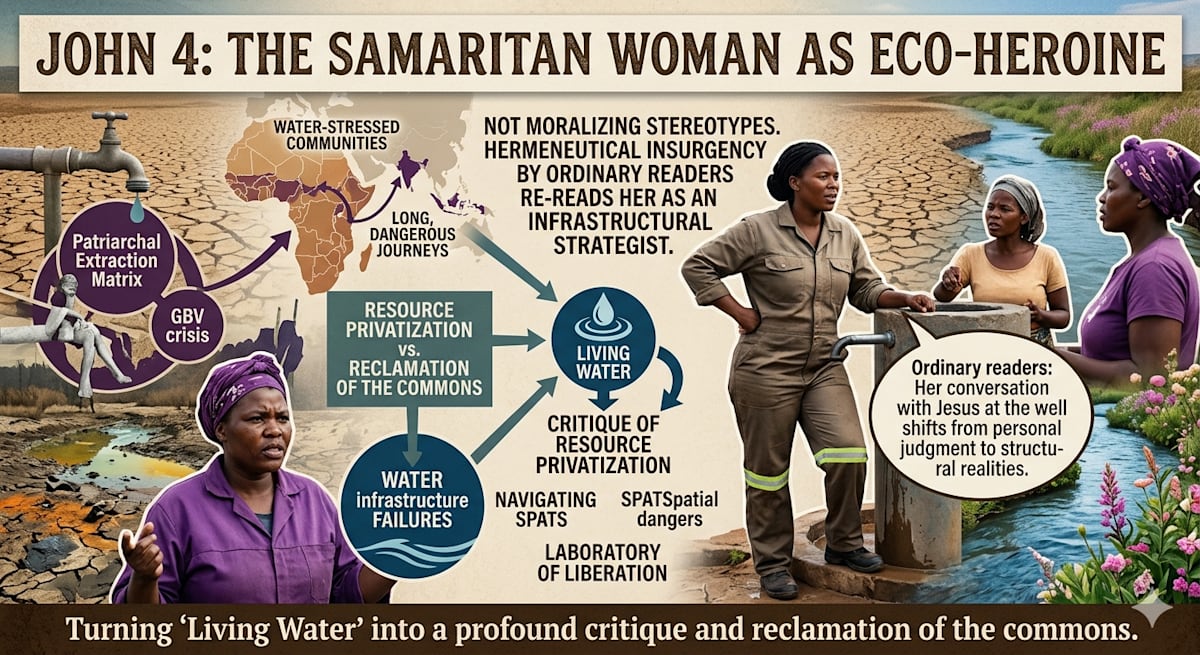
In many Western interpretations, the Samaritan woman is reduced to a moralizing stereotype about her marital history. But in water-stressed South African communities, she is instantly recognized as an infrastructural strategist navigating spatial dangers. Her conversation with Jesus at the well shifts from personal judgment to structural realities, turning "Living Water" into a profound critique of resource privatization and a reclamation of the commons.
From Groaning to Organizing
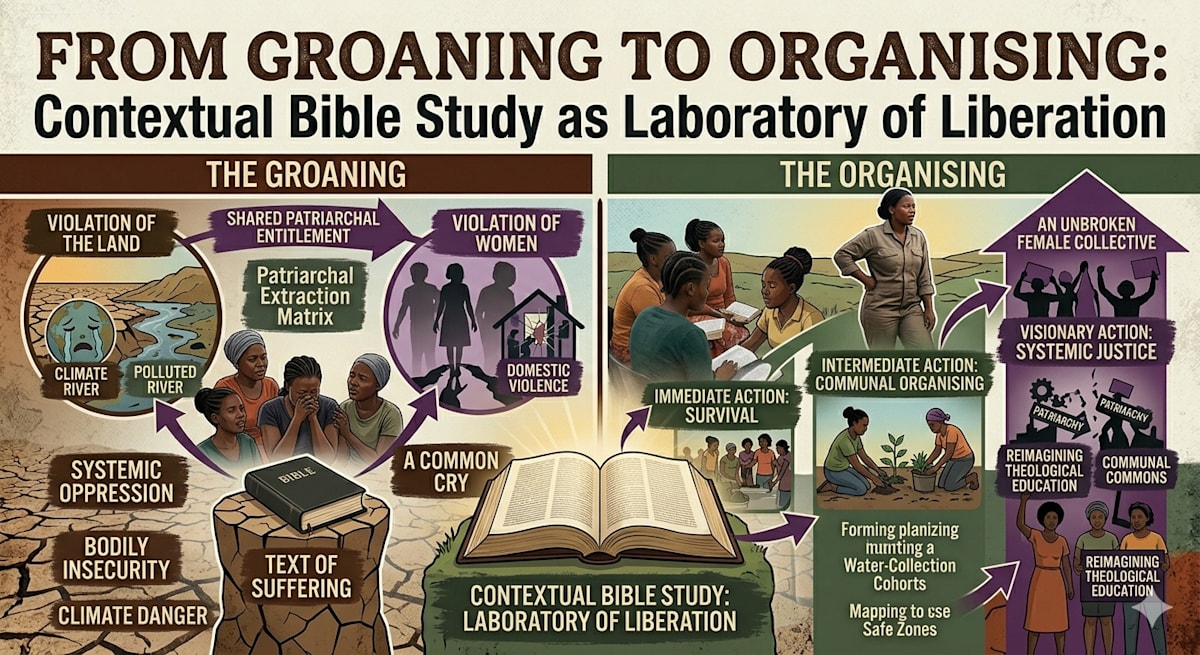
CBS is never an end in itself; it is a laboratory of liberation designed to move communities from lament to historical action. This eco-feminist praxis operates across three vital tiers:
Immediate Action (Survival): Designing collective safety strategies, such as forming communal water-collection cohorts, mapping safe zones, and organizing rapid-response support circles for survivors of trauma.
Intermediate Action (Communal Organizing): Reclaiming local ecological spaces through women-led ecological committees, launching community gardens to combat food insecurity, and running integrated climate-and-GBV workshops.
Visionary Action (Systemic Justice): Actively challenging macro-structures—extractive capitalism, water privatization, and patriarchal interpretations—while reimagining a theological education that centers the margins.
A Call to the Academy
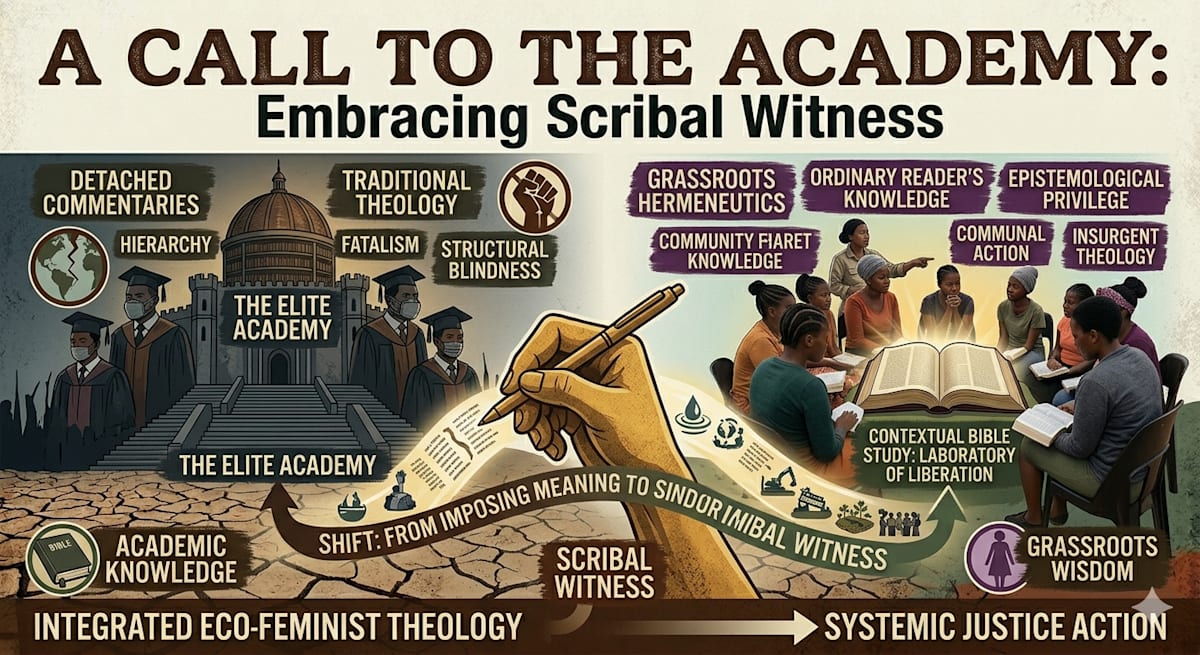
As researchers, our role is not to impose meaning or domesticate the voices of those on the underside of power. We must adopt a posture of scribal witness—standing in humility and solidarity to record, amplify, and protect the co-created theology of ordinary readers.
The groaning of the Earth and the groaning of women are a single cry. It is time for theological education to step out of elite libraries, sit in the circle of grassroots hermeneutics, and listen to the insurgent theology capable of healing both our environments and our bodies.
A video is also available to watch