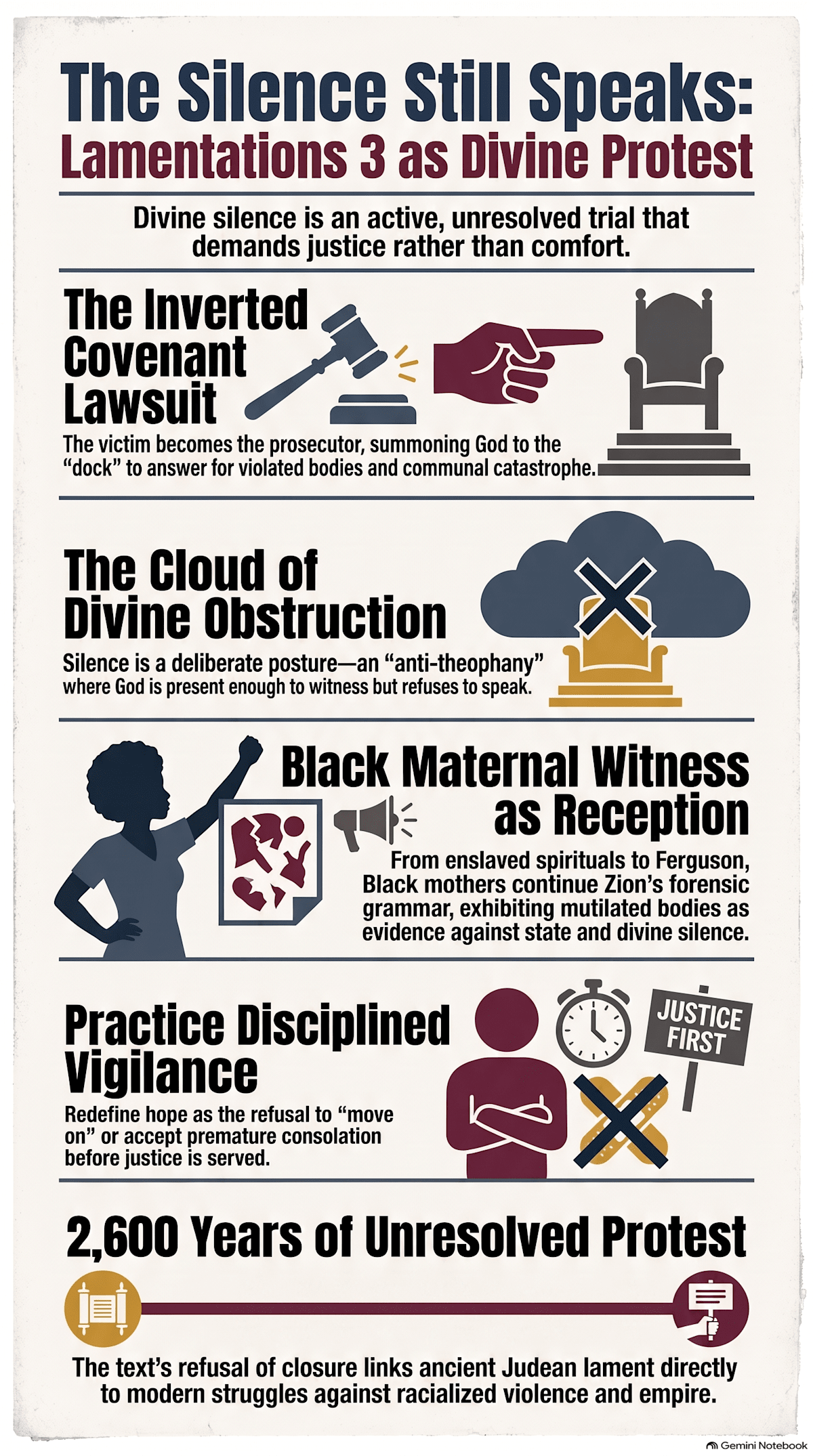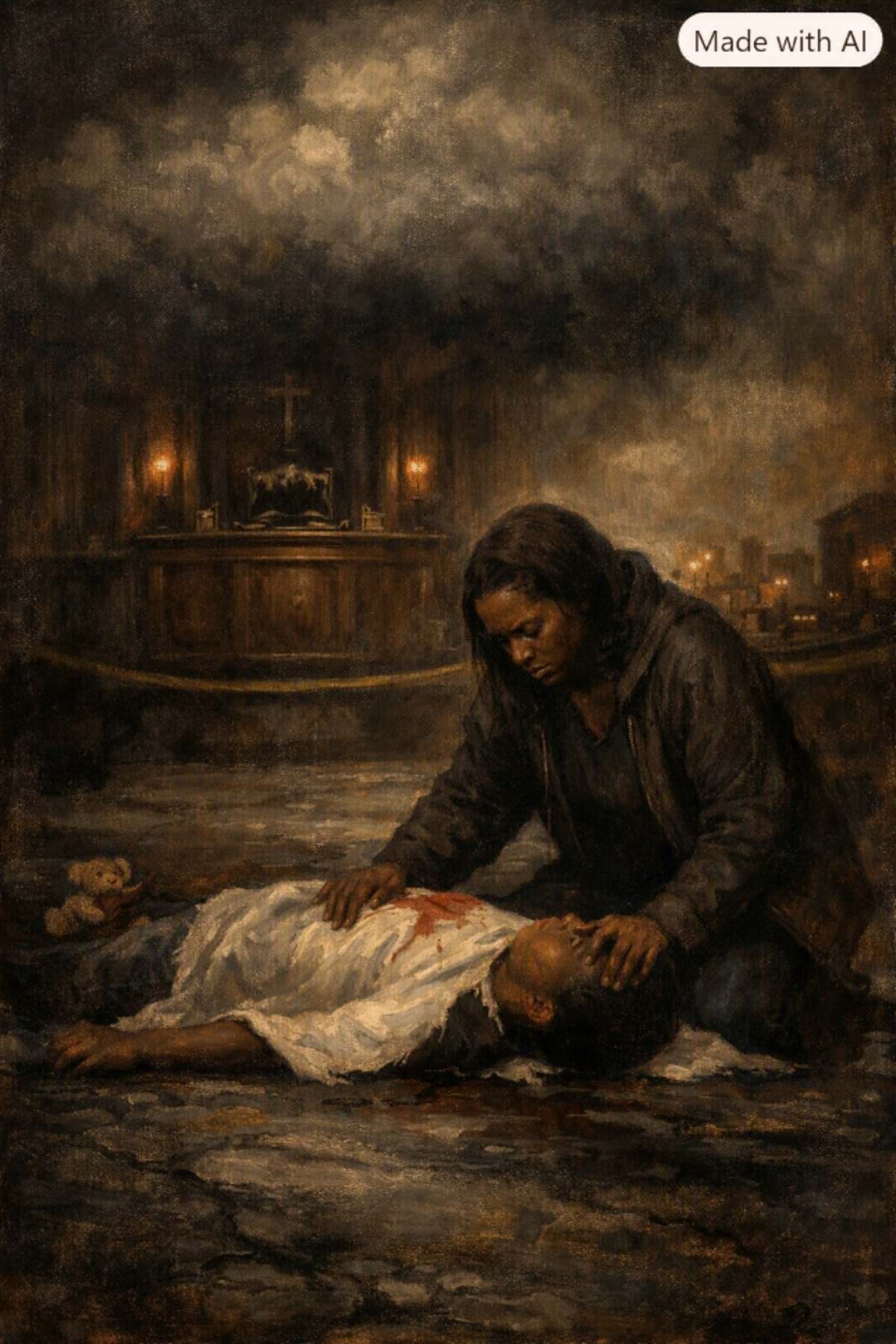
If you’ve spent time in church, or even just around standard self-help culture, you’ve likely heard variations of the same script when tragedy strikes:
- "God has a plan."
- "He’s in a better place."
- "Time heals all wounds."
- “We need to forgive and move on.”
But what happens when the wound is a murdered child? What happens when the silence from heaven is so thick it feels like a physical wall?
When Lesley McSpadden stood over the body of her 18-year-old son, Michael Brown—left uncovered on the Ferguson asphalt for over four hours—she didn't ask for a platitude. She cried out: "Where was God when my baby was lying there?"
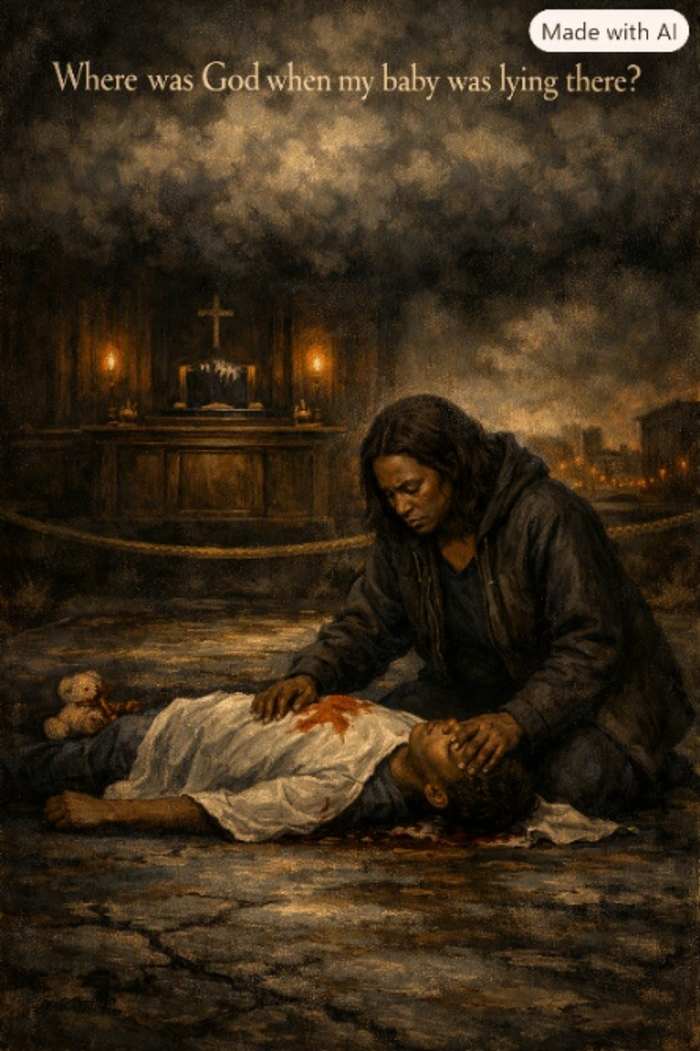
This wasn't a loss of faith. It was a courtroom summons. She was putting divine silence on trial.
My upcoming study in the prestigious USA
journal Biblical Theology Bulletin argues that this exact gut-wrenching posture isn’t a modern theological failure—it is a structural inheritance. The paper, titled "Lamentations 3 and Divine (Non-)Response: Black Maternal Continuations and the 'Mother in the Dock,'" connects the ancient poetry of the Bible to 400 years of Black mothers refusing to let God or the world off the hook.
Here is how a closer look at the Bible’s most devastating book completely flips our understanding of trauma, protest, and hope.
Inverting the Lawsuit: When the Victim Sues God

In the ancient world, if a nation fell to an empire, religious texts usually followed a strict pattern:
- The people sinned.
- God punished them.
- The people apologized.
- God fixed it.
We see this in Mesopotamian "city laments" like the Lament for Ur, where a grieving goddess begs the high god for mercy, and the god eventually relents.
But the biblical book of Lamentations does something radical and deeply uncomfortable. In chapters 1 and 2, a personified "Daughter Zion" stands up as a grieving mother and essentially files a lawsuit (a rîb) against God. She exhibits the bodies of her starved and violated children as physical evidence and demands that God look at what He has permitted.
And how does God respond? He doesn't.
The Myth of the "Hopeful Center"
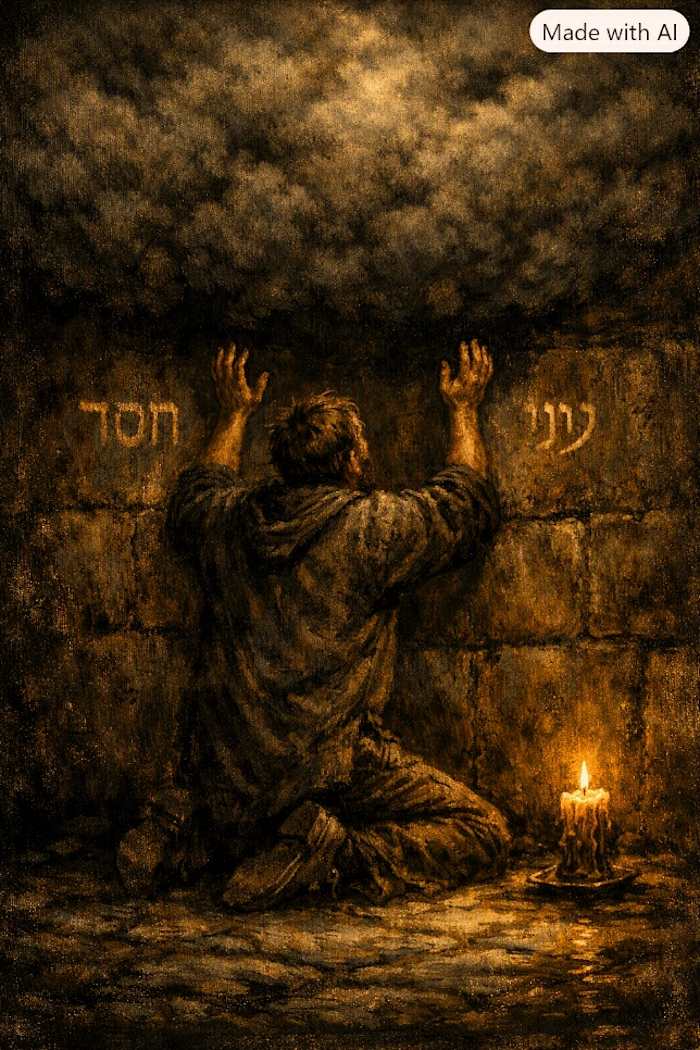
For centuries, theologians have looked at Lamentations 3 as a comforting escape hatch. It’s the chapter where the geber (the "strong man") says famous, beautiful words like: "The steadfast love of the Lord never ceases; his mercies never come to an end; they are new every morning." (Lam 3:22-23).
Commentators love to treat this as the turning point of the book—the moment where praise triumphs over pain.
But the paper challenges this "domesticated" reading. If you look closer at the Hebrew text, the geber isn't a cheerful bystander offering a motivational quote. His language is deeply tied to physical trauma and imprisonment. He uses terms like ʿônî (implying degradation and violation) and laments that God has "wrapped himself with a cloud so that no prayer can pass through" (Lam 3:44).
The "hope" in Lamentations 3 is immediately swallowed right back up by raw, desperate cries for vengeance and justice in the verses that follow. The cloud never lifts. God never speaks. The book doesn't end with a happy restoration; it ends with an unanswered question.
Living the Text: The Black Maternal Courtroom
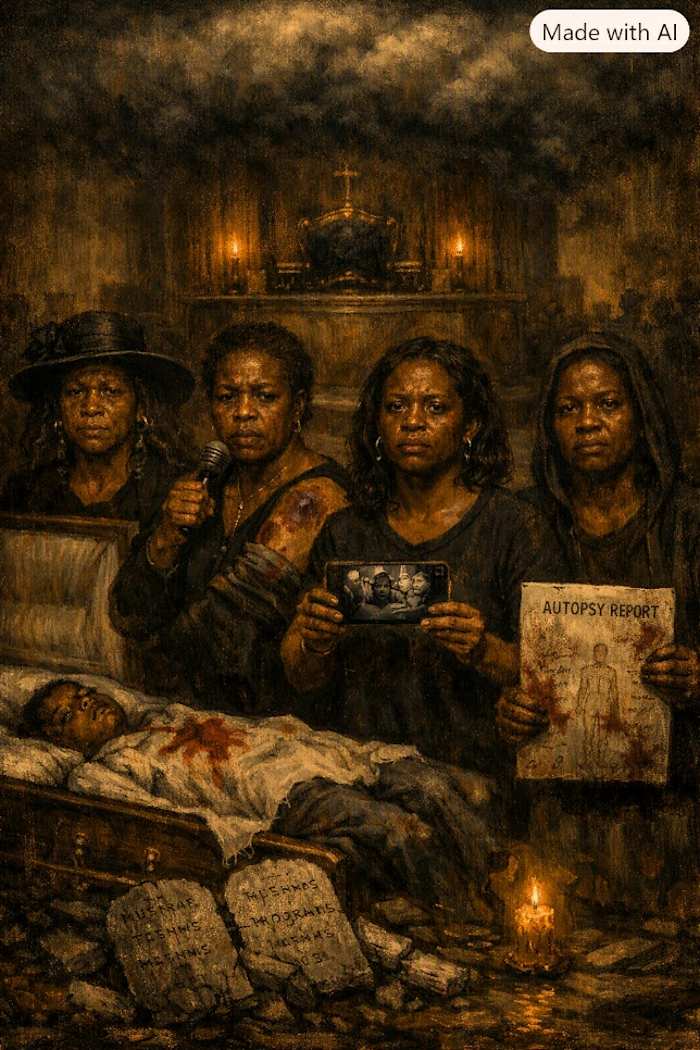
The paper's most powerful claim is that Black maternal witness across four centuries is a living continuation of this biblical courtroom. Enslaved women singing "Sometimes I Feel Like a Motherless Child" weren't looking for cheap comfort; they were naming a terrifying divine absence.
This isn't an academic exercise. It is a physical legacy:
- 1955: Mamie Till-Mobley insisted on an open casket for her lynched son, Emmett Till. Her statement, "Let the people see what they did to my boy," perfectly mirrors Daughter Zion’s ancient command: "See, O LORD, and look!"
- 1964: Fannie Lou Hamer stood before the Democratic National Credentials Committee, displaying her state-beaten body and demanding, "Is this America?"—simultaneously asking, "Is this your world, God?"
- Today: The "Mothers of the Movement"—Sybrina Fulton (mother of Trayvon Martin), Samaria Rice, Gwen Carr, and Lesley McSpadden—use cellphone videos, livestreamed autopsies, and public vigils as evidentiary exhibits.
Empire always commands grieving mothers to "move on" because open wounds are politically inconvenient. But these mothers, like the voices in Lamentations, refuse to leave the site of execution until they get an answer.
Reconfiguring Hope: Holding the Vigil Open
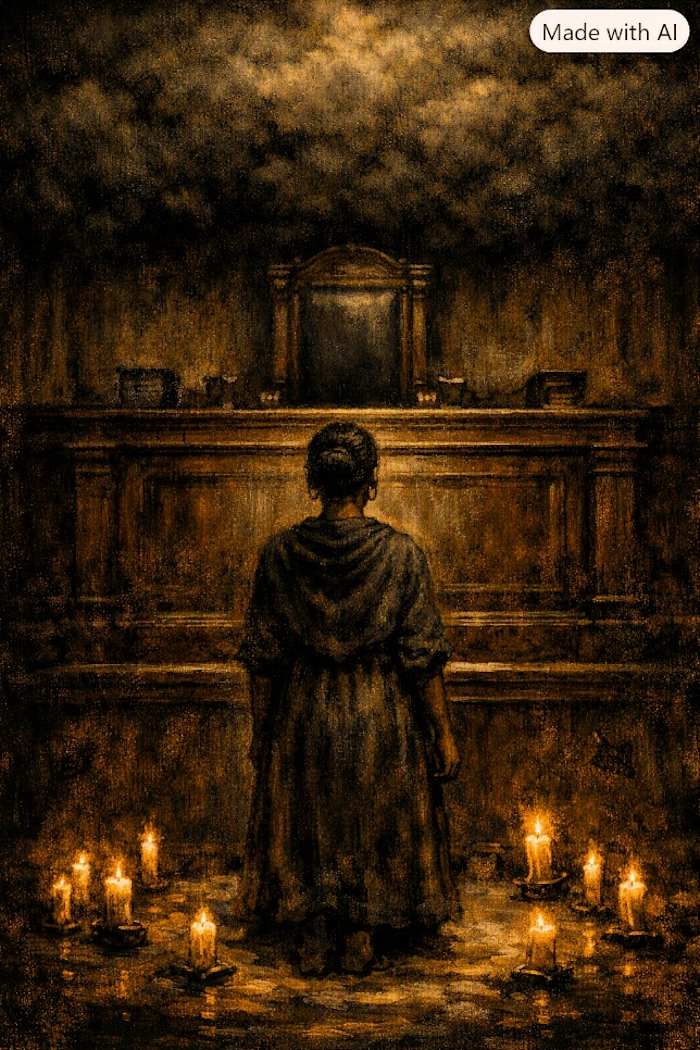
If God stays silent, where is the good news?
The paper suggests we need to redefine "hope" entirely. True hope isn't a sunny optimism that assumes everything happens for a reason. Rather, divine silence is a form of risked solidarity.
By refusing to interrupt the mother's grief with an easy answer or a premature promise of resurrection, God chooses to sit in the dock alongside the accused. He doesn't side with the bystanders telling the mother to calm down; He remains implicated, unspeaking, and present in the darkness of the cloud.
This has massive implications for how we live and worship. It means our churches and communities need to stop sprinting from Good Friday to Easter Sunday. We need to learn the art of "disciplined vigilance"—the courage to sit in unresolved grief, to speak the names of the dead, and to demand accountability.
Hope isn't the absence of anger. Sometimes, the most faithful thing a person can do is refuse to leave the courtroom until justice shows up.
To watch videos on this subject, please 'click' on the 🖇️ 👇:
Explainer Video
https://youtu.be/Fmgj7KZMB44?is=mQmHOOCrc56POGH9
Short Video
https://youtube.com/shorts/vU1hnrZ4aXY?is=Qn6rfXsj3gLWLDOH