In December 2020, in a quiet apartment in Spain, two nights after the death of my twin brother, Darren, the room suddenly filled with light. This was not the metaphorical glow of a fading memory or the internal illumination of a mind desperate for solace. It was a presence with weight—a light that possessed a specific quality of attention. Darren stood there, carrying the irreducible, specific gravity of his particular personhood, and spoke a single word: "Yesssssss."
It was not a word of comfort for my grief; it was a word of discovery—the report of a traveller who had found something remarkable and was eager to share the data. When the room returned to its ordinary silence, I was left with a question that has consumed my work since: Why, when the world falls apart, does the human mind reach for geometry? Why do we find crystalline patterns and ordered lattices at the very thresholds where ordinary life dissolves?
1 "Revelationary" as an Active Vision
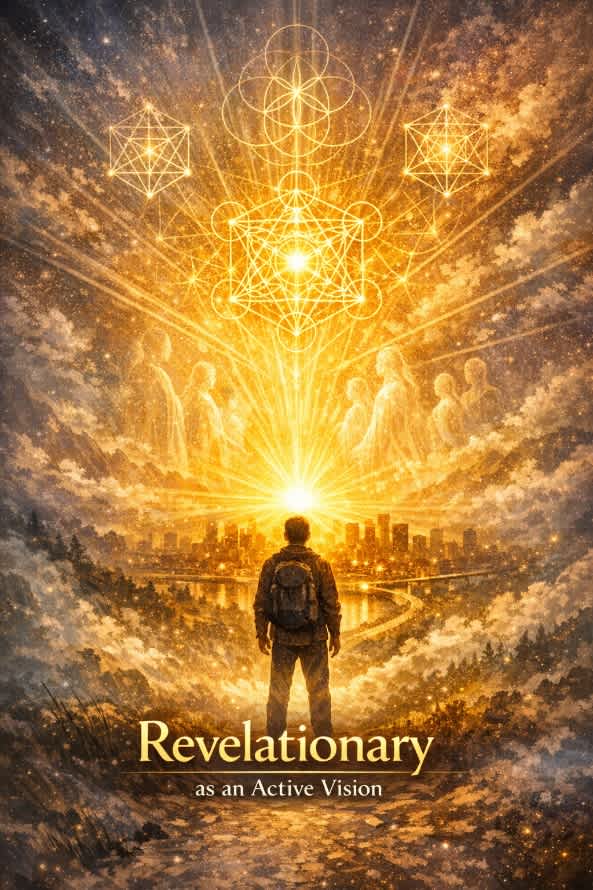
To answer these questions, we must first refine our vocabulary. While we often use "revelatory" as an adjective to describe a static fact received in the past, I propose the coinage "revelationary." This distinction is an argument in itself. Revelationary refers to the ongoing, active, and processual character of a disclosure as it happens. It is the quality of an encounter that opens a door rather than closing a case.
Furthermore, "revelationary" contains within itself the word vision. This is not accidental. The experiences that occur at these edges—Near-Death Experiences (NDEs), psychedelic breakthroughs, or the quiet eruption of presence in a Spanish apartment—are overwhelmingly visionary. They are experienced as forms and patterns. In this context, revelationary is the animating intelligence that organizes the encounter. It is the "revelationary spirit" that sends a person back into the world with sharpened eyes and deeper obligations, rather than merely satisfied conclusions.
2 The Rope-Stretchers and the Restoration of Order
The history of geometry provides a vital clue to its psychological function. The word itself—geo-metry—literally translates to "earth-measure." Its origins lie with the Egyptian harpedonaptae, or "rope-stretchers." Every year, the Nile would flood, obliterating the boundary markers of the fertile delta and returning the world to undifferentiated mud. When the waters receded, the rope-stretchers used knotted cords to re-establish property lines.
This was more than a practical survey; it was a cosmological work. Geometry was the tool used to impose a "limit on the unlimited." By measuring the land, the rope-stretchers were re-creating the field, affirming that chaos does not have the last word. This ancient practice mirrors our psychological movement during crisis. When the "floods" of grief or altered states dissolve the familiar boundaries of our lives, geometry acts as a restorative force. It is the imposition of an underlying order that affirms a persistency of meaning beneath the dissolution of the ego.
3 The Wolf and the High-Voltage Infinite
At the boundary of these intense experiences, many report a "Guardian Figure." In Norse tradition, this is the vargr—the wolf-outlaw existing at the edge of the community. While such figures are often perceived as frightening—the angel with the flaming sword or the growling wolf—their role is actually protective.
This is the Guardian Function. If a human consciousness were to touch the "high-voltage" intensity of the infinite without mediation, it would be destroyed. The scholar Gershom Scholem famously compared this danger to the "live rails of a high-voltage system"—touch them without insulation, and the result is electrocution, not transformation. The wolf at the threshold acts as a biological fuse or a pacer. It assesses our readiness and regulates the flow of the encounter, ensuring the light of revelation is released in a staged, bearable disclosure rather than an annihilating flood.
4 The Scribe as a Geometer of Revelation



If the guardian governs the door, the Scribe organizes the room. In mystical traditions, figures like Enoch-Metatron and Hermes Trismegistus are known as "Celestial Scribes." They are the "Geometers of Revelation" who translate overwhelming intensity into legible form.
This is fundamentally an architectural act. Writing itself is a geometric practice: we use margins, parallel lines, and paragraph breaks to divide the "white space" of the infinite into navigable fields. The scribe takes the continuous, undifferentiated flow of visionary intensity and organizes it into a spatial topology—a "geometry of the page." By creating these spatial conditions, the scribe makes the infinite transmissible for the finite mind, much as a writer organizes a chaotic flood of ideas into the structured geometry of a book.
5 Geometry as Architecture, Not Decoration

When individuals undergo NDEs or psychedelic journeys, they frequently report seeing complex lattices, mandalas, and crystalline structures. Reductive accounts dismiss these as "neural noise" or visual artifacts. However, within the Relational Geometry model, these shapes are seen as architecture, not decoration. They are "scaffolds" or "bridges" that allow the human mind to hold the "more-than-human."
This process can be mapped through the Three Phases of the Threshold:
1. Dissolution: The familiar scaffolding of the self and the "I" gives way. The ordinary equation between "I" and "this body" collapses, often resulting in out-of-body experiences.
2. Encounter: The meeting with an autonomous, relational presence—beings of light or entities—that addresses the consciousness from within a structured field.
3. Emergent Coherence: The moment where overwhelming intensity crystallizes into pattern. The undifferentiated radiance resolves into a mandala or a lattice, providing a fixed point around which the self can reorganize.
6 The Cube of Connection
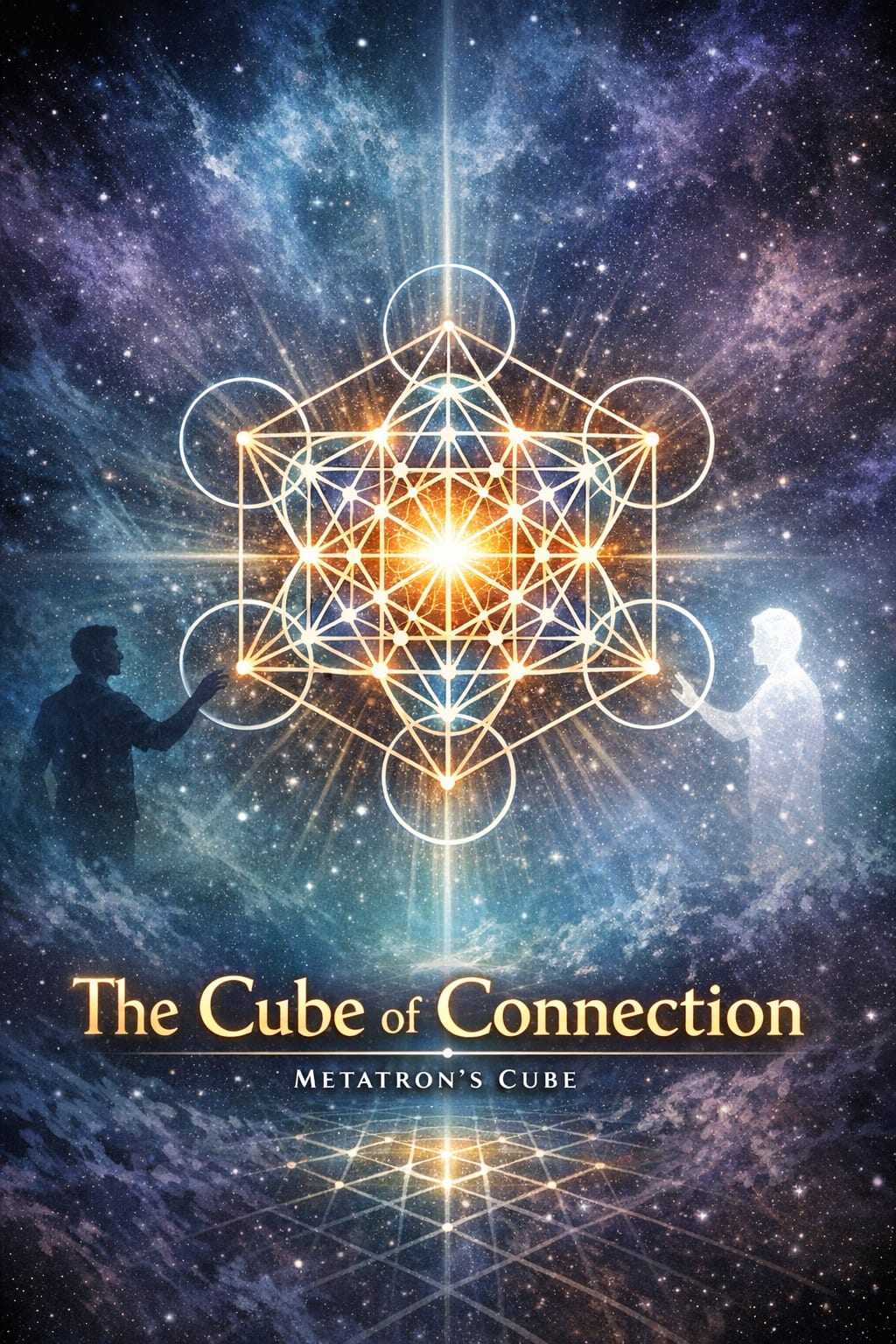
A primary emblem of this "Mediating Architecture" is Metatron’s Cube. Composed of 13 circles and 78 lines, it is what mathematicians call a "complete graph"—a structure where every node is directly connected to every other. While the name "Metatron’s Cube" is a modern synthesis—an "act of cultural intelligence" that converged an ancient scribe with a modern diagram—it holds profound structural truth.
The Cube represents the Relational Field. In the context of the twin dyad, it illustrates how a connection survives even when one "node" (a person) is physically removed. The field does not collapse; it reorganizes. The connection remains intact because the "geometry" of the relationship is held together by shared symbolic residues that persist across the boundary of death. Every node remains connected to the center, even when the center of the field has shifted from the physical to the symbolic.
7 The Return to Responsibility
The "Integration" phase of a threshold experience is never truly finished. It is the work of a lifetime—returning to the world with sharper eyes and deeper obligations. These geometric visions are not meant to provide an escape from reality, but to return us to it.
The patterns we see at the edge of life—the guardians, the scribes, and the crystalline grids—are actually present in every act of attention we give to others. We see this in the "Digital Pietà" of the grieving mother who maintains her child’s relational field in digital space, or in "The Wake"—the condition of living in the aftermath of a catastrophic rupture. These are not merely psychological states; they are geometric spaces where we maintain connections across impassable boundaries.
Revelation is not a monologue from the beyond; it is a relational event that requires us to be present. If the patterns at the edge of life are a map, then the territory is the quality of attention we pay to one another. The question remains: Are the symmetries we find at the threshold of death already waiting for us in the geometry of our daily love?
Yesssssss.