1. The Forgotten Day: Entering the Stillness of Holy Saturday
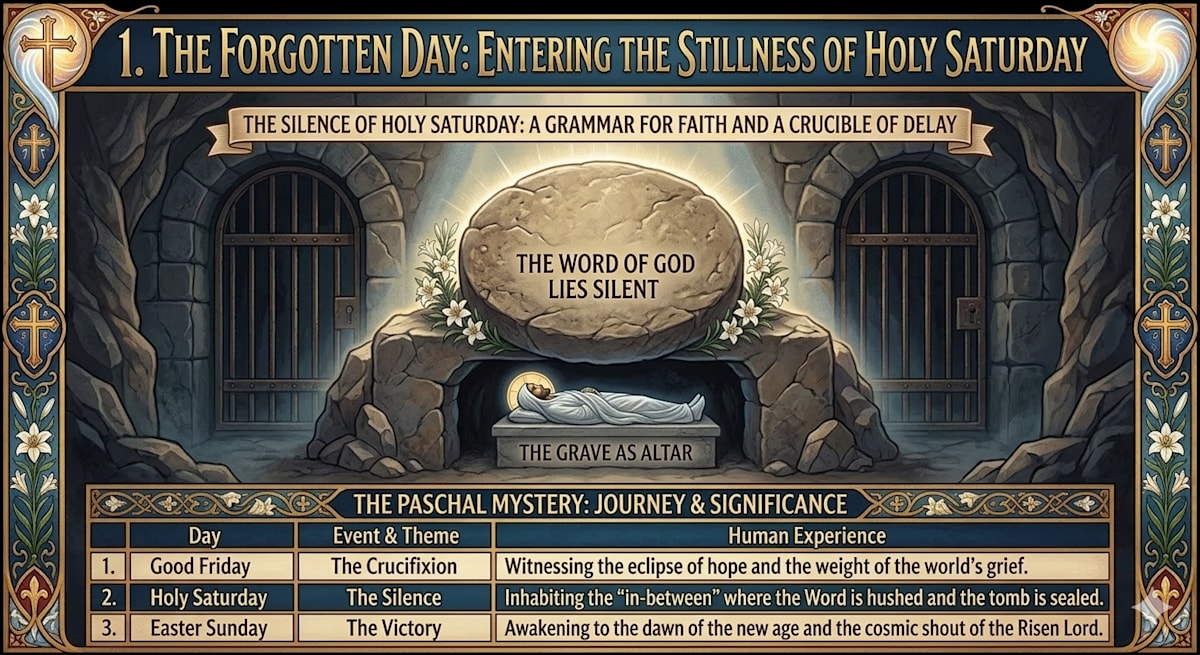
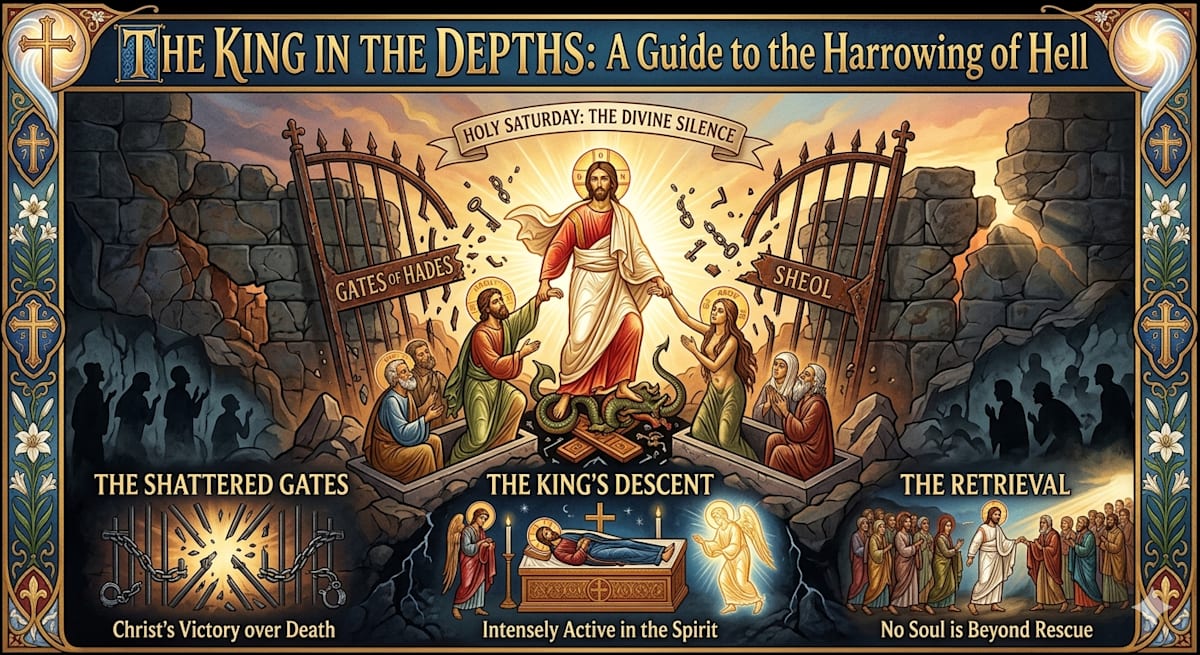
In the high drama of the Paschal Mystery, our eyes are naturally drawn to the "luminous poles" of the journey: the raw agony of the Cross on Good Friday and the radiant, earth-shaking victory of Easter Sunday. Yet, nestled between the cry of dereliction and the cry of glory lies a "forgotten day" wrapped in a staggering stillness. Holy Saturday is no mere pause in the narrative; it is a grammar for faith and a crucible of delay. It is the day when the Word of God lies silent in the tomb, mirroring the interior landscape of every believer who has felt that the promises of God are buried and the story has reached a tragic, final end.
Day | Human Experience
Good Friday | The Crucifixion: Witnessing the eclipse of hope and the weight of the world's grief.
Holy Saturday | The Silence: Inhabiting the "in-between" where the Word is hushed and the tomb is sealed.
Easter Sunday | The Victory: Awakening to the dawn of the new age and the cosmic shout of the Risen Lord.
To truly behold the resurrection, we must first descend into the mystery of what the King was doing while the world thought He was silent.
2. The Paradox of Divine Silence: Appearance vs. Reality
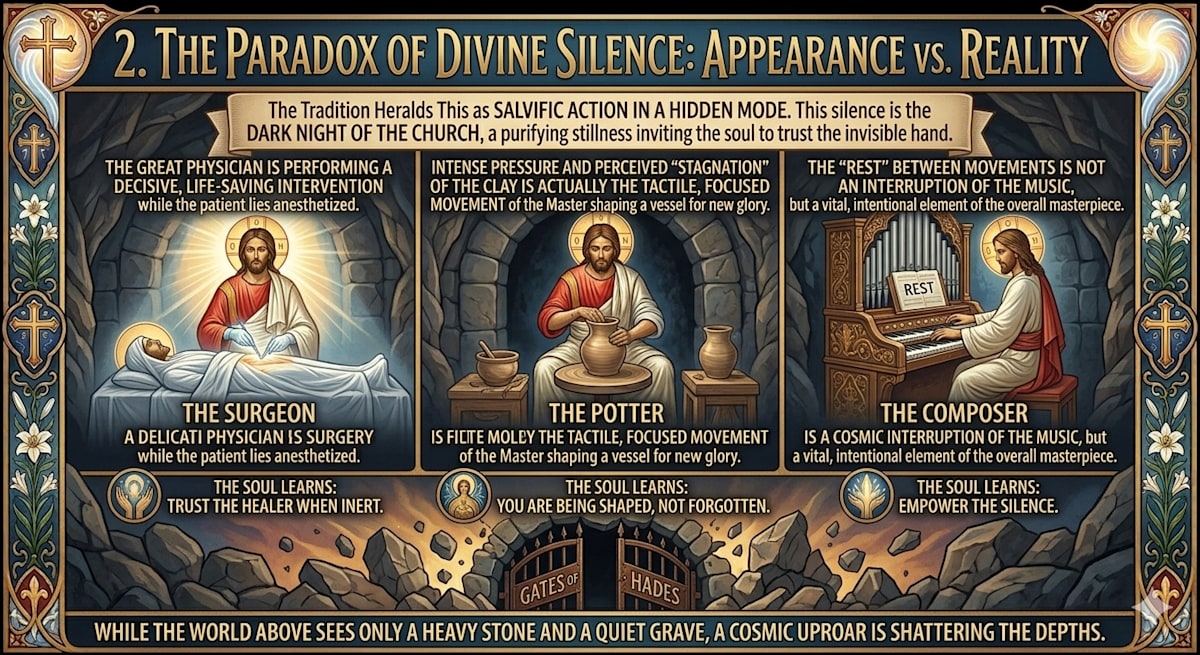
Holy Saturday illuminates the mystery of "Divine Hiddenness." While the surface of history suggests a divine vacuum, the tradition heralds this as salvific action in a hidden mode. This silence is not a sign of indifference or absence; rather, it is the "Dark Night of the Church," a purifying—not punitive—stillness that invites the soul to relinquish control and trust the invisible hand of the Father.
To understand this creative inactivity, we look to three essential metaphors:
-
The Surgeon
- This teaches the soul that the Great Physician is performing a decisive, life-saving intervention while the patient lies anesthetized by grief, unable to assist in their own cure.
-
The Potter
- This teaches the soul that the intense pressure and perceived "stagnation" of the clay is actually the tactile, focused movement of the Master shaping a vessel for new glory.
-
The Composer
- This teaches the soul that the "rest" between movements is not an interruption of the music, but a vital, intentional element of the overall masterpiece.
While the world above sees only a heavy stone and a quiet grave, a cosmic uproar is shattering the foundations of the deep.
3. The Harrowing of Hell: Shattering the Gates
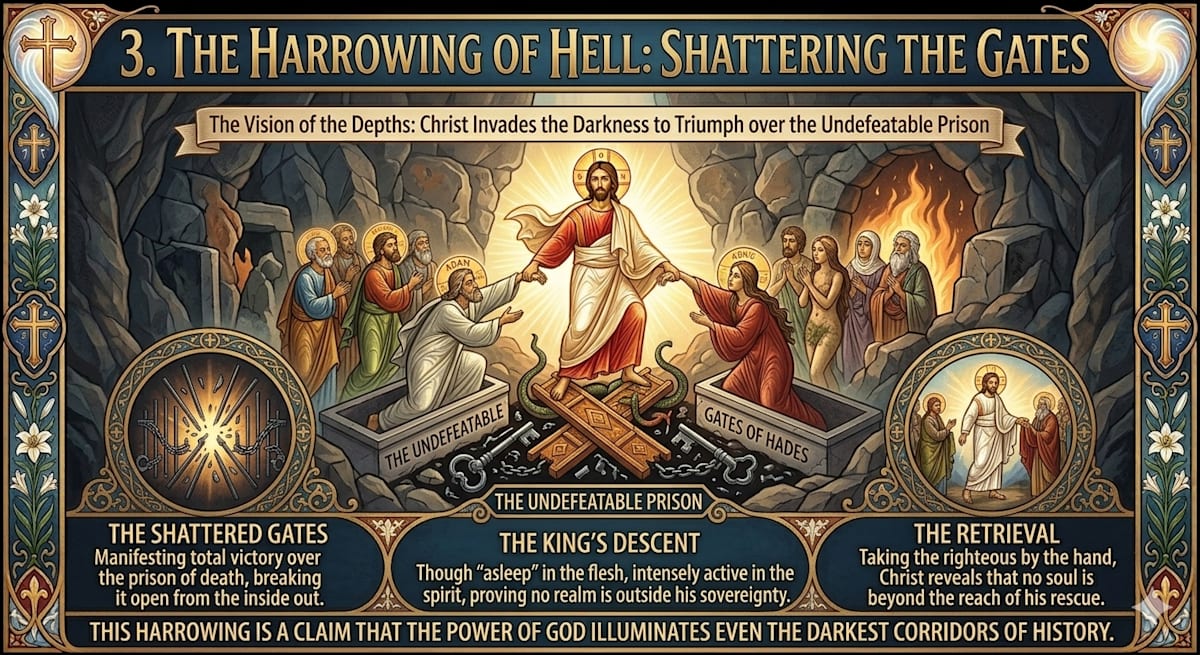
The Church’s creeds boldly testify that Christ "descended to the dead." This was no passive waiting period, but a triumphal entry into the belly of the beast—an event the ancients called the "Harrowing of Hell."
Vision of the Depths Christ invades the darkness of the underworld not as a captive, but as the conquering King. He stands upon the broken, twisted bars of Sheol, the very gates of Hades splintering beneath His feet. In a definitive act of restoration, He reaches into the dust of the ages, grasping Adam and Eve by the wrists to haul them into the light of the new creation. At this sight, the underworld beholds its own undoing.
In this hidden liturgy of redemption, even the stone that blocks the entrance to the tomb is transformed: it becomes an altar behind which Christ performs the work of a hidden glory.
The 3 Keys to the Harrowing:
- The Shattered Gates: Christ manifests total victory over the "undefeatable" prison of death, breaking it open from the inside out.
- The King’s Descent: Though the King is "asleep" in the flesh, He is intensely active in the spirit, proving that no realm—not even the abyss—is outside His sovereignty.
- The Retrieval: By taking the righteous by the hand, Christ reveals that no soul is beyond the reach of His rescue; the bridge of mercy spans the entirety of human time.
This harrowing is not a mere myth of the past; it is a claim that the power of God illuminates even the darkest corridors of history.
4. Lord of the Past: Redemption as a Retrospective Act
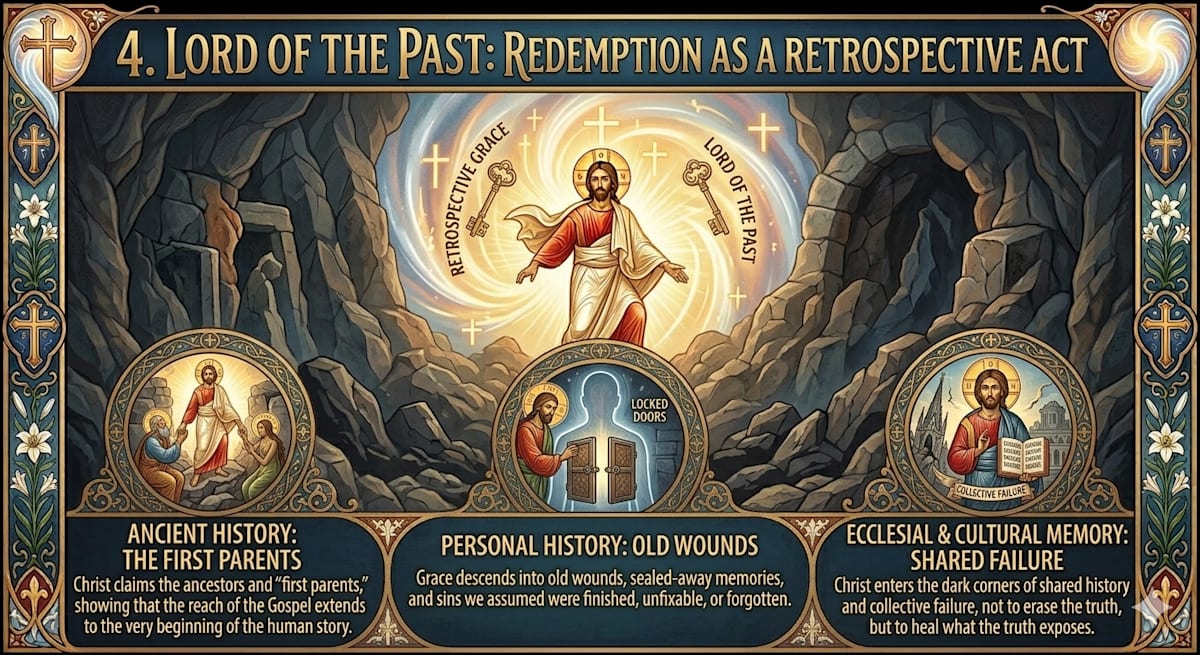
Insight: The Cross reaches backward to heal our history just as surely as it opens the way to our future.
The theology of Holy Saturday asserts that God is the Lord of our "buried places." It proclaims that in the economy of grace, there is no such thing as "too late." Because Christ descended into the depths, His redeeming presence now enters the "locked doors" of human experience—those rooms of our lives we assumed were finished, unfixable, or forgotten.
The Three Realms of Retrospective Grace
- Ancient History: Christ claims the ancestors and the "first parents," showing that the reach of the Gospel extends to the very beginning of the human story.
- Personal History: Grace descends into our old wounds, sealed-away memories, and the sins we believed were beyond the reach of the light.
- Ecclesial & Cultural Memory: Christ enters the dark corners of shared history and collective failure, not to erase the truth, but to heal what the truth exposes.
Because God has claimed the past, we are no longer prisoners of what has been; we are free to inhabit the "liminal" present with hope.
5. Inhabiting the Interval: Five Practices for the Student of Faith
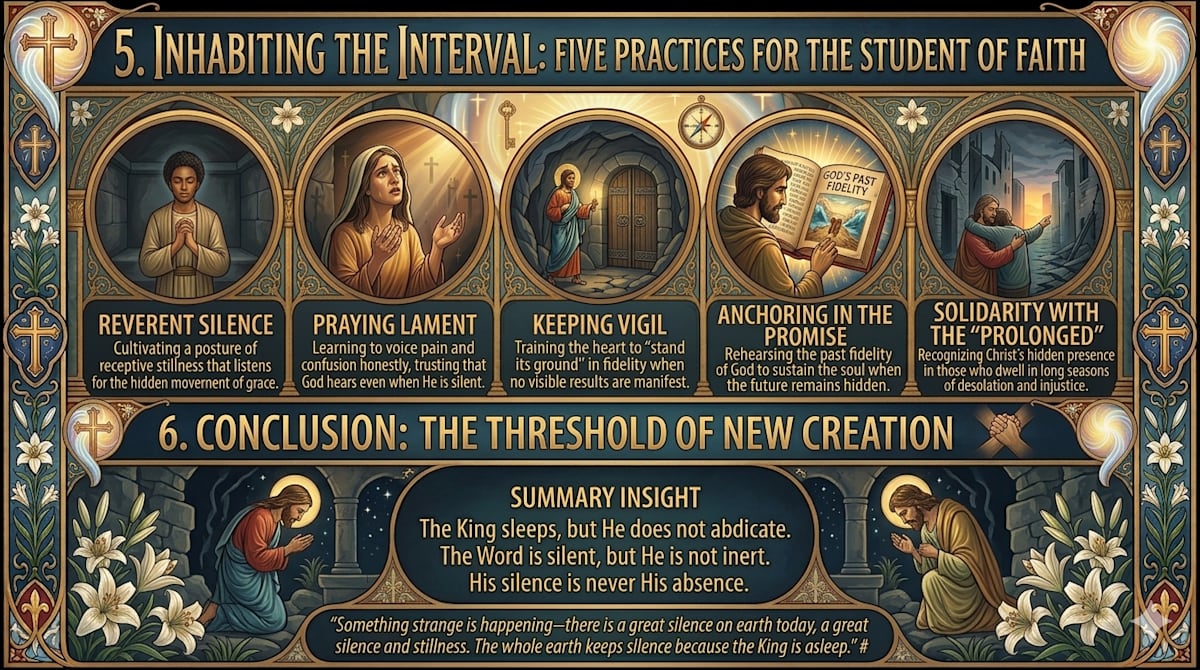
To live the "Holy Saturday" of life is to resist the twin temptations of nostalgia—clinging to an obsolete past—and impatience—demanding a resurrection on our own narrow timetable. Instead, we turn the interval into spiritual formation through these practices:
Practice Name | The Learning Outcome
Reverent Silence | Cultivating a posture of receptive stillness that listens for the hidden movement of grace.
Praying Lament | Learning to voice pain and confusion honestly, trusting that God hears even when He is silent.
Keeping Vigil | Training the heart to "stand its ground" in fidelity when no visible results are manifest.
Anchoring in the Promise | Rehearsing the past fidelity of God to sustain the soul when the future remains hidden.
Solidarity with the "Prolonged" | Recognizing Christ’s hidden presence in those who dwell in long seasons of desolation and injustice.
These practices ensure that the quiet intervals of our lives become thresholds of transformation rather than voids of despair.
6. Conclusion: The Threshold of New Creation
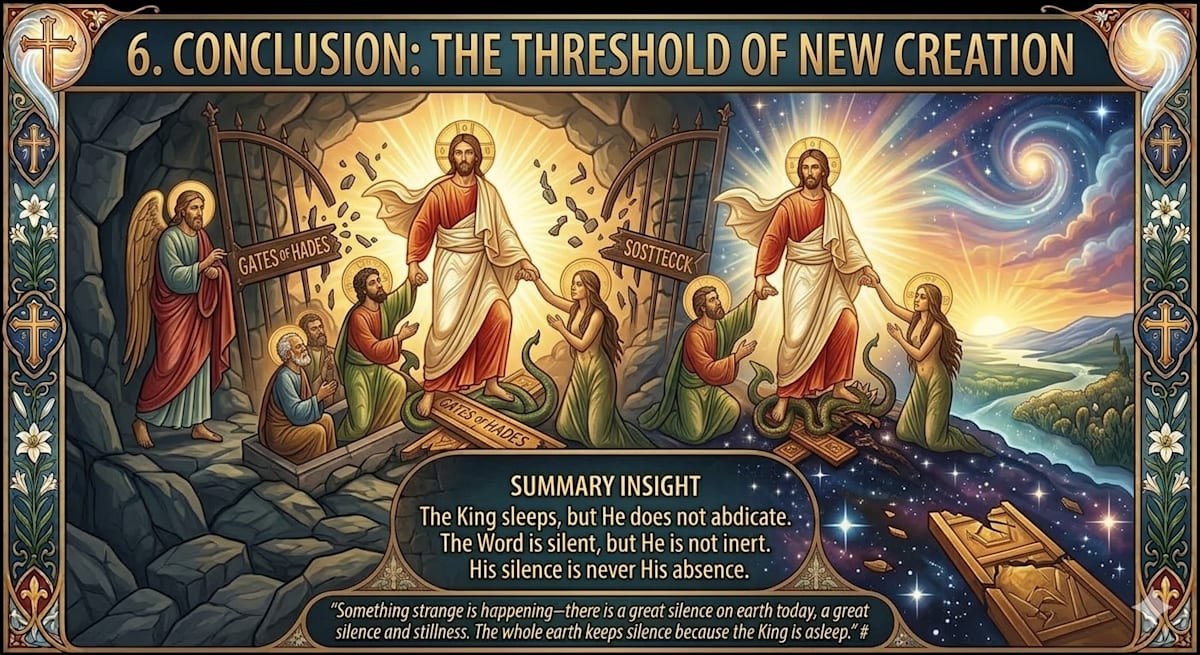
The silence of the tomb is never a void; it is a threshold. Holy Saturday teaches us that even when the stone is sealed and the world seems abandoned, grace is already moving in the deep. The "quiet interval" is precisely where the most intense work of redemption occurs—the undoing of death and the preparation for a new creation.
Summary Insight: The King sleeps, but He does not abdicate. The Word is silent, but He is not inert. Something strange is happening today: the King has entered the shadows to find us where we are most lost, proving that His silence is never His absence.
"Something strange is happening—there is a great silence on earth today, a great silence and stillness. The whole earth keeps silence because the King is asleep."