By Mark Edward Chard,
When a church faces allegations of spiritual or sexual abuse, the first instinct is often to protect the institution. Quiet investigations. Confidential settlements. Non-disclosure agreements. Carefully worded statements that prioritise “the mission” and “the brand.” The language is orderly, professional, even pastoral in tone. Yet for many survivors, this administrative response feels more damaging than the original harm.
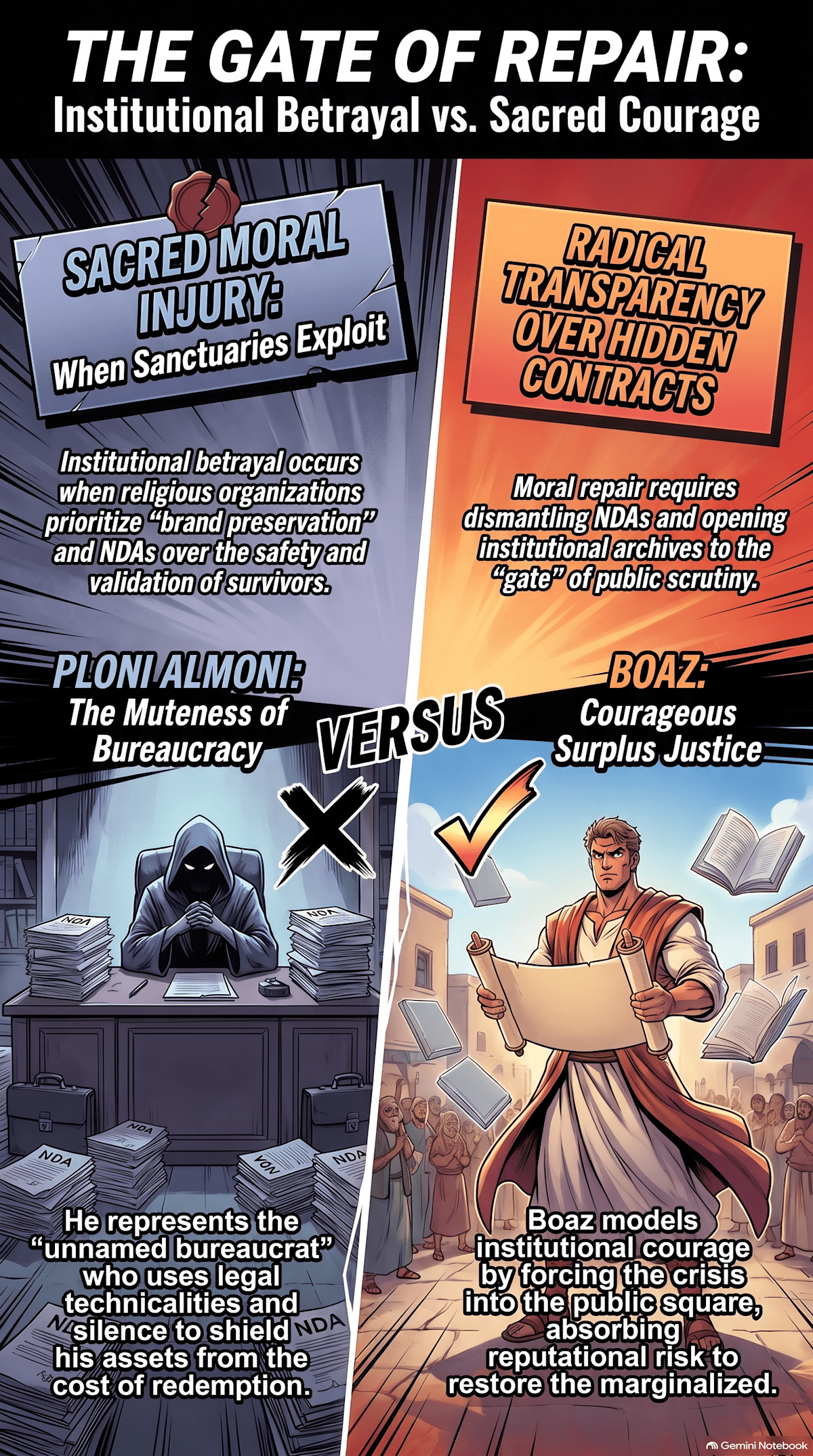
In a recent paper, I argue that the Book of Ruth offers a sharp diagnostic tool for this very pattern. At the city gate in Ruth 4 we meet two figures who stand in stark contrast: the unnamed closer kinsman, called Ploni Almoni, and Boaz.
The One Who Concealed Himself in Muteness
The Hebrew phrase Ploni Almoni is more than a placeholder for “so-and-so.” Philologically it means something like “the one who has concealed himself in muteness.” The closer relative is willing to redeem the land when it looks advantageous. The moment the transaction requires him to take responsibility for the vulnerable outsider, Ruth the Moabite, he withdraws: “I cannot redeem it… lest I ruin my own inheritance.”
The rabbis in Ruth Rabbah are scathing. They say he was “mute from matters of Torah.” He hid behind an outdated legalism and protected his lineage at the cost of the wounded. His name is erased from the story. He disappears into anonymity.
This is institutional betrayal in ancient form. The trusted structure prioritises its own survival, reputation, and assets over the people who depend on it. The modern equivalents are familiar: Non Disclosure Agreements (ADA's), that silence survivors, private investigations whose findings never see the light of day, and the quiet insistence that transparency would “damage the work of the gospel.”
Boaz and Surplus Justice
Boaz does the opposite. He forces the entire matter into the public square at the city gate, before the elders and the community. He accepts reputational risk, social stigma, and potential economic cost. He does not ask for the minimum the law requires; he asks how institutional power can be used to restore the vulnerable fully into the life of the community. Ellen Davis calls this surplus justice—justice that exceeds bare obligation in order to generate life and equity.
Boaz’s action is a public performance of ḥesed, covenant loyalty that goes beyond reciprocity. The result is not merely the resolution of a legal problem. It is the reconfiguration of kinship, land, and future so that Naomi and Ruth are no longer left gleaning at the margins. And, famously, the genealogy that closes the book runs through this costly, public, boundary-crossing act—not through the self-protected inheritance of the unnamed kinsman.
A Blueprint for the Church
The paper develops this contrast into a practical framework for trauma-informed ecclesial leadership. When institutions stand at their own “city gate,” they face a choice:
Protect the brand through bureaucratic muteness, or
Accept vulnerability, pursue radical transparency, and restructure power so that survivors are no longer treated as liabilities.
This is not a call for chaos or performative apology. It is a call for structural repentance: independent oversight, the end of silencing agreements in cases of abuse, and the deliberate conversion of institutional resources into instruments of repair.
The Book of Ruth ends with a genealogy that leads to David—and, for Christian readers, ultimately to the Messiah. The line of redemption does not run through the one who preserved his inheritance by remaining silent. It runs through the one who risked it at the gate.
Quiet, structural repair is holy work. The wounded are still waiting at the gates of many of our institutions. The question Ruth 4 forces upon us is whether we will choose the anonymity of self-protection or the costly name of covenantal courage.
As ever,
Mark.
To watch videos on the subject, 'click' on the 🖇️ 👇
Explainer
https://youtu.be/O1TZqhCL84U?is=BNigVx_q_lS_r-sc
Short
https://youtube.com/shorts/YAK9pT90KBw?is=t9yqUB4kYHJM2zG7