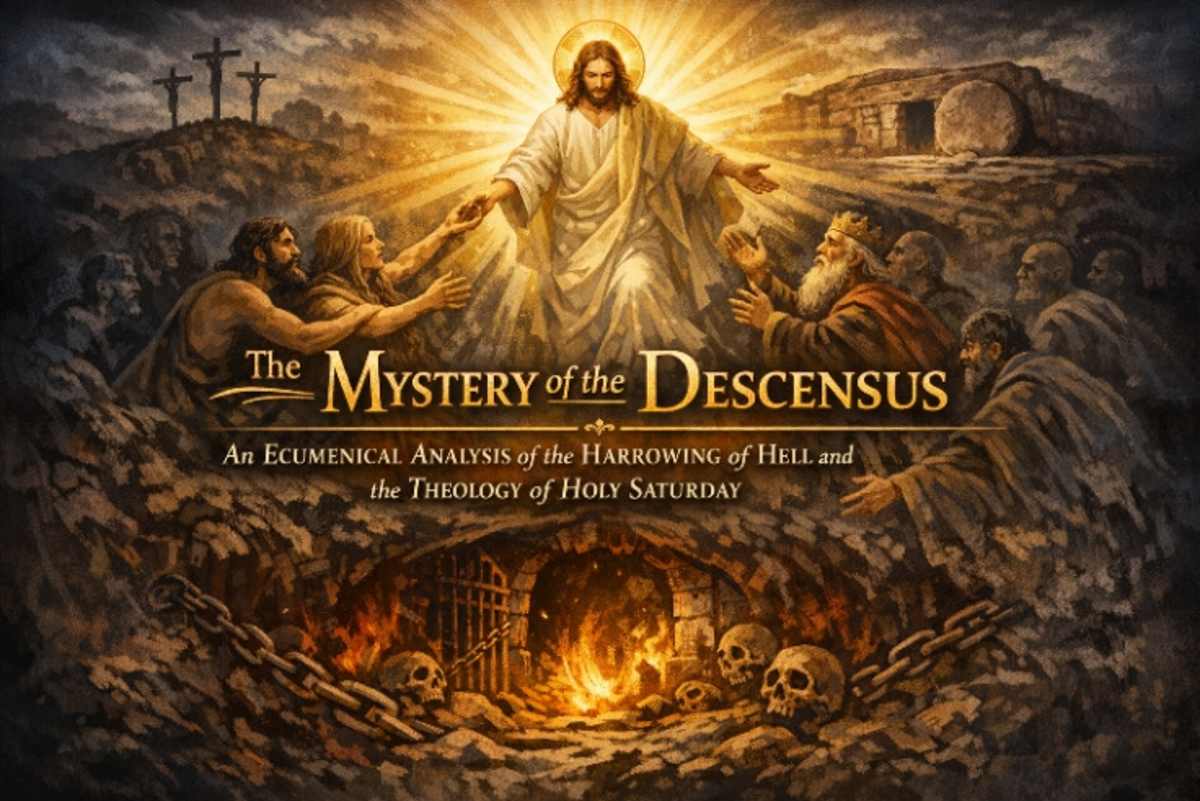
1. Introduction: The Liturgical and Theological Significance of the "Forgotten Day"
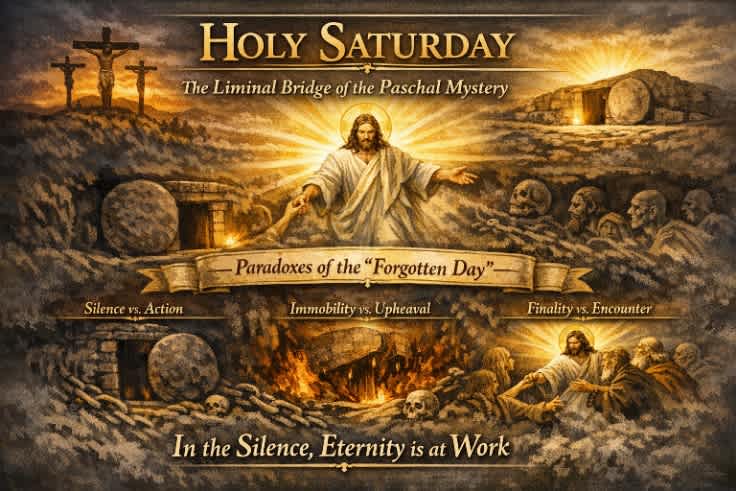
Holy Saturday occupies a unique, liminal space within the Paschal Mystery, serving as the strategic bridge between the historical reality of the Cross on Good Friday and the cosmic victory of the Resurrection on Easter Sunday. Far from being a mere chronological gap or a day of liturgical mourning, it represents the "liminal" center of the Christian narrative—a day wrapped in stillness where the Word of God lies silent in the tomb. This "forgotten day" provides a profound theological architecture that prevents the Triduum from being viewed as a disjointed sequence of tragedy followed by triumph. Instead, it serves as a "grammar for faith," teaching the Church how to navigate the "silence of God" as a vital theological category rather than a void. To understand Holy Saturday is to embrace the primary paradoxes that define this mystery:
- Silence vs. Action: While the surface of the earth is silent, the divine economy is at work in the depths; the Word is mute, yet His power is communicative.
- Immobility vs. Upheaval: The sealed tomb remains physically stationary, yet its spiritual foundation is the site of a cosmic undoing of death.
- Finality vs. Encounter: Human history records a tragic conclusion, while eternity initiates a liberating encounter within the realm of the dead.
This tension grounds the specific creedal confession that both Catholic and Anglican traditions hold as the anchor of their shared liturgical and dogmatic life.
2. Creedal Foundations: "He Descended to the Dead"
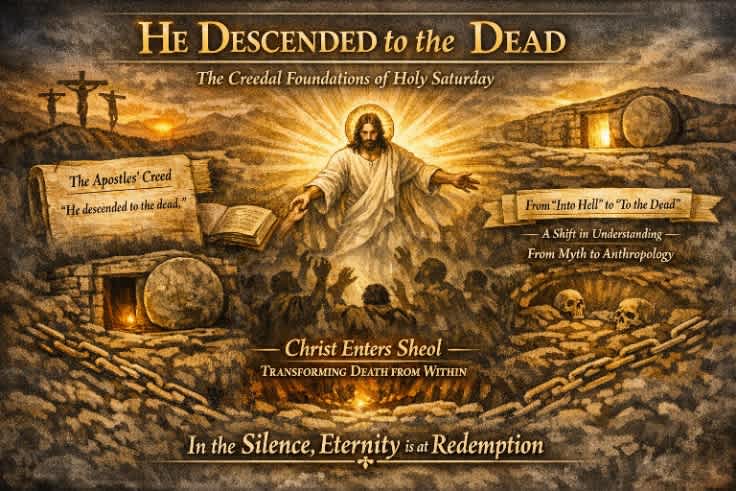
The shared confession of the Apostles’ Creed serves as the authoritative starting point for Catholic-Anglican dialogue on the descensus. When both traditions profess that Christ "descended to the dead," they are asserting that the interval between Christ’s death and His resurrection is not a "theological blank," but a period charged with salvific action. In recent decades, the shift in liturgical language from "into hell" to "to the dead" has served to clarify a more robust biblical anthropology. This shift moves the dialogue away from medieval mythologizing of a literal place of torment toward the more profound reality that Christ truly entered the universal human condition of death—Sheol—to transform it from within.
The Gospels are strikingly quiet on this day, recording no public deeds or words. However, this silence is not empty; it is the moment where the narrative shifts from the visible world of the disciples to the hidden realm of eternity.
The Interval of the Tomb The time between the burial and the resurrection is not a tragic conclusion to a failed mission. It is the beginning of eternity’s hidden work. It is a period where the victory of the Cross is applied to the very depths of the human condition, transforming the state of death from a place of isolation into a place of encounter with the Word.
This creedal statement provides the foundation for the Patristic imagination, which seeks to visualize the hidden drama occurring behind the sealed stone.
3. The Patristic Narrative: The Harrowing of Hell as Cosmic Victory
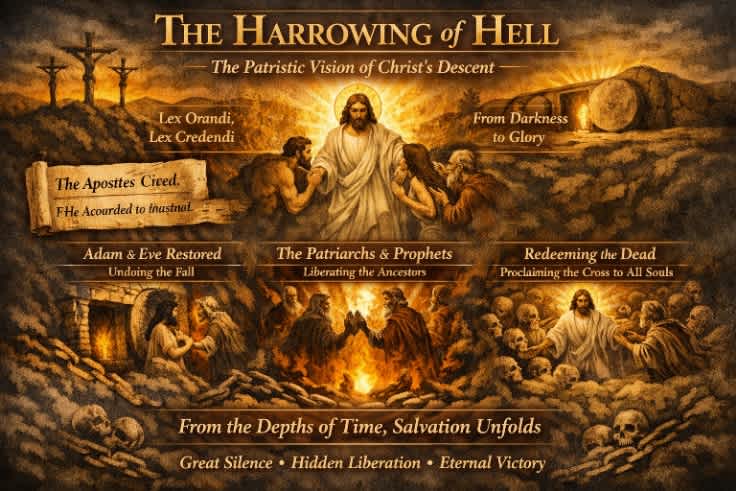
The principle of Lex Orandi, Lex Credendi—the law of prayer is the law of belief—finds its highest expression in the role of Patristic preaching within the Triduum. The "Ancient Holy Saturday Homily," found in the Liturgy of the Hours for both Catholic and Anglican usage, shapes our understanding of the "Harrowing of Hell" as a cosmic victory. It describes a "great silence and stillness" because the "King is asleep," yet this image of the sleeping King transforms the tomb from a site of decay into an "altar of hidden glory."
This narrative evaluates the descent as a movement of liberation, "healing the roots of the human story" by extending the reach of the Cross backward through time. The "Harrowing" illustrates that Christ’s reach is not limited by chronology; it is a retrospective redemption that restores the ancestors of the faith:
- Adam and Eve: Christ takes the first parents by the hand, drawing them out of the shadows and undoing the original fall.
- The Patriarchs and Prophets: The righteous ones of the old covenant are greeted by the victorious King, fulfilling the promises they saw from afar.
- The Totality of the Dead: Every soul that died in hope is reached by the proclamation of the Cross, ensuring that no part of the human story is left unvisited.
By shifting focus from a mythic past to a cosmic present, the Patristic view transitions the believer from observing an event to experiencing the reality of God’s work in the midst of apparent absence.
4. The Theology of Divine Hiddenness: Navigating the Silence of God
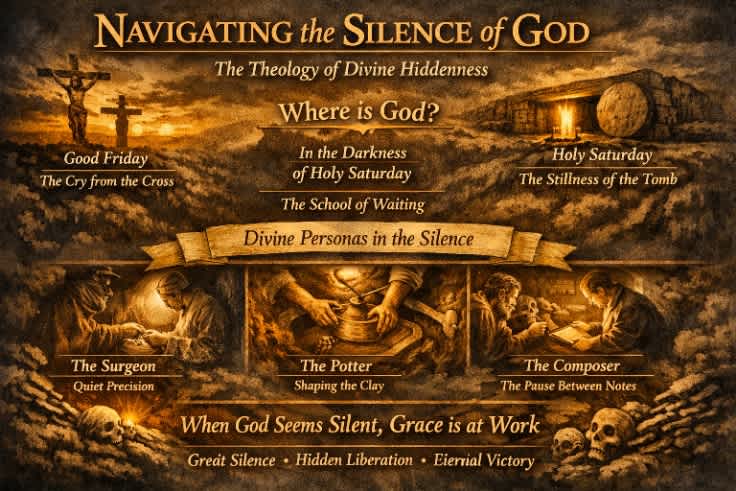
Divine Hiddenness is a recurring biblical theme that reaches its climax on Holy Saturday. While Good Friday is defined by the audible "cry of dereliction," Holy Saturday represents the "stretched-out anguish" of that question across time. There is no voice from heaven and no miracle to interrupt the stillness of the tomb.
As a liturgical consultant, I must critique the common "haste" of modern homiletics to move directly from the Cross to the Resurrection. This rush to "Easter Joy" is detrimental to spiritual formation; it short-circuits the "school of waiting" and denies the congregant a language for their own experiences of God’s absence. Holy Saturday legitimizes the struggle to discern God’s presence in the actual fabric of history—in war, injustice, and the "long grind" of unanswered prayer. Silence is not indifference, as shown by these Divine Personas in the Silence:
- The Surgeon: Operating with quiet precision while the patient is unaware.
- The Potter: Silently shaping the clay, working toward a form not yet visible.
- The Composer: The intentional silence between movements that gives the entire work its meaning.
5. Liminality and the "Dark Night": A Pastoral Grammar for Suffering
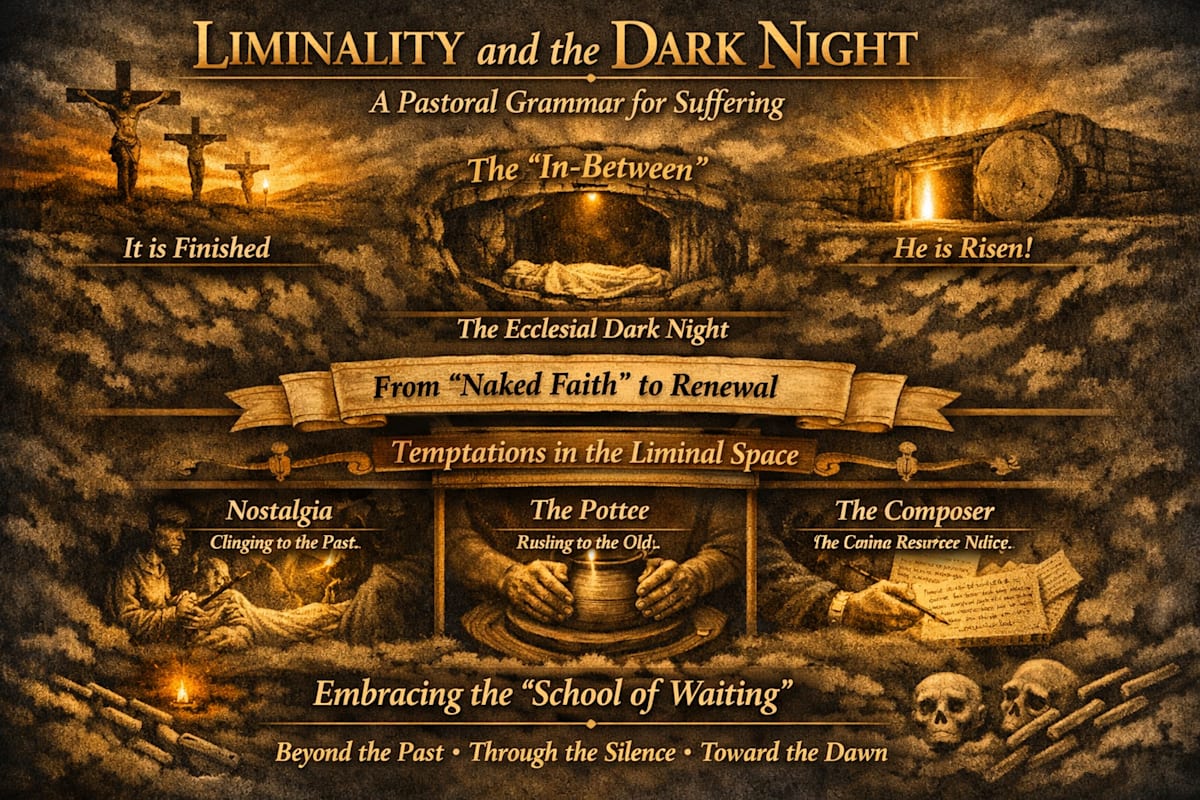
Holy Saturday is the Church’s supreme "liminal" day, suspended between "It is finished" and "He is risen." This "in-between" state is a period of spiritual purification mirroring the "Dark Night" described by St. John of the Cross. In this "ecclesial dark night," God may withdraw sensible consolation to force a transition to a "naked faith" grounded solely in His fidelity. During this time, the Church must resist two primary temptations:
Comparative Table of TemptationsTemptation | Description | Theological Remedy
Nostalgia | Clinging to obsolete forms of security or the "Galilee" of early ministry. | Accepting that the Cross has rendered the old ways obsolete and that we cannot return to the past.
Impatience | Demanding resurrection on a human timetable; skipping the "uncomfortable middle." | Entering the "school of waiting" and acknowledging that God’s rhythm is not identical to ours.
This liminal state connects the interior spiritual life to the broader cosmic scope of redemption, asserting that grace is moving precisely where it appears most inert.
6. Retrospective Redemption: Healing the Buried Strata of History

The theology of the descensus asserts that Christ is Lord of both the future and the past. There is no "too late" in Christ. The descent into the "shadowed terrain" of history provides a framework for addressing the deep strata of human experience. Christ enters the most secluded areas of our existence, which the tradition identifies as Closed Rooms:
- Personal Wounds: Grace descends into the buried places—old wounds, hidden memories, and sins we assume are beyond healing.
- Shared Cultural Memory: The Risen Christ enters the dark corners of history, addressing generations of failure, betrayal, and systemic injustice that haunt our shared life.
- Locked Doors of Resentment: Christ stands in the midst of our shame and sorrow to speak peace where we have written off relationships as irreparable.
7. Ecumenical Proclamation: Practices for the Church Today
There is a "deep consonance" between the Catholic and Anglican traditions in their shared Holy Saturday witness. In a "noisy," secularized culture, recovering the practices of this day counters the modern crisis of faith.
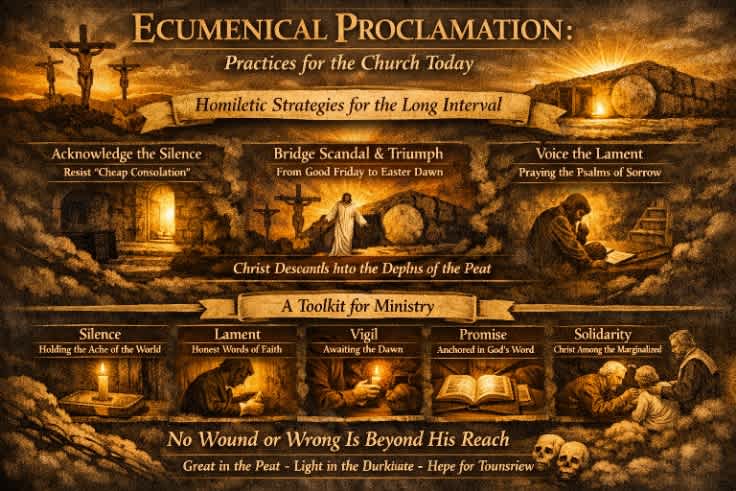
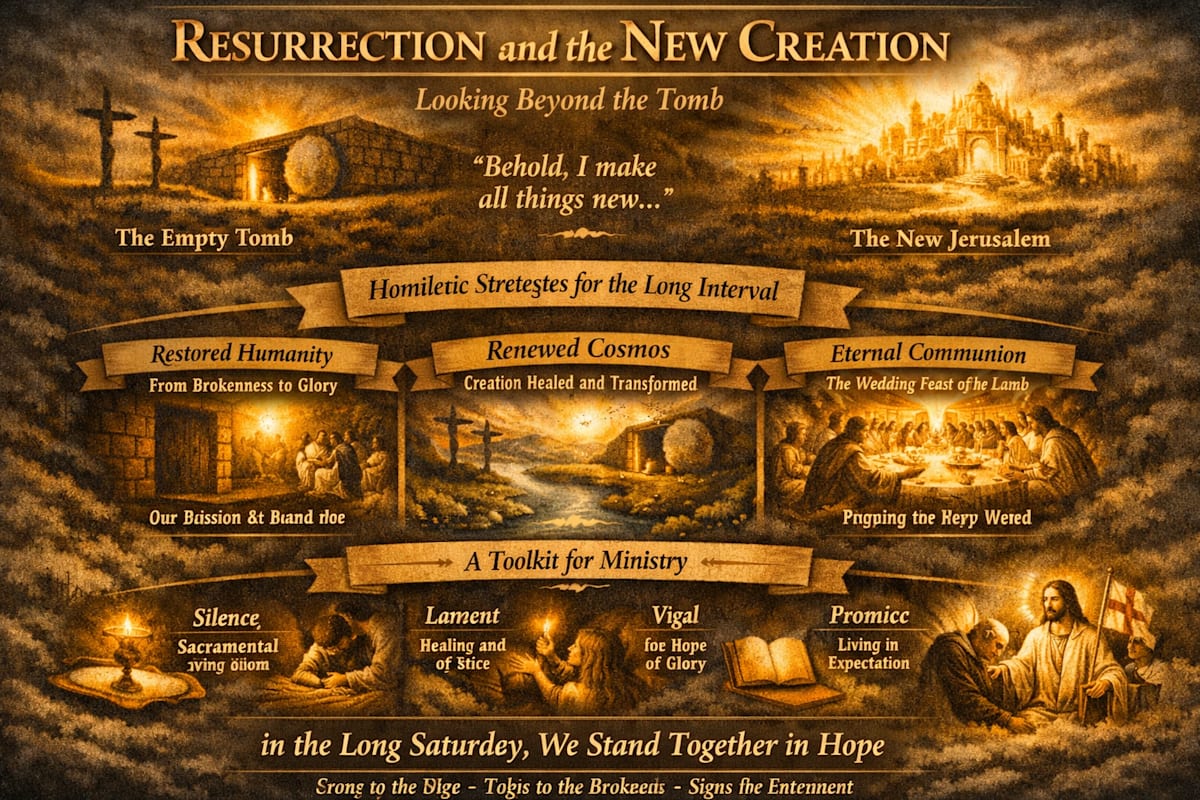
Homiletic Strategies for the Long Interval:
- Acknowledge the Silence: Resisted the urge to provide "cheap consolation." Preachers must create space for the "felt absence" of God.
- Bridge Scandal and Triumph: Connect the "scandal" of the Cross to the "triumph" of Easter through the lens of patient waiting, showing that grace is active even when it appears dormant.
- Voice the Lament: Utilize the "vocabulary of the psalms" to voice pain and confusion, ensuring the community remains in communion with God even in protest.
A Toolkit for Ministry:
- Silence: Counters the crisis of noise by holding the wounds of the world before God in receptive stillness.
- Lament: Counters the crisis of "toxic positivity" by validating honest pain as a form of faith.
- Vigil: Counters the crisis of "spectacle" by standing one's ground in patient, quiet fidelity.
- Promise: Counters the crisis of "aimlessness" by anchoring the community in the memory of God’s word.
- Solidarity: Counters the crisis of "marginalization" by recognizing Christ’s hidden presence in those living in prolonged Holy Saturdays (the bereaved, the refugee, the poor).
8. Conclusion: The Paradox of the Silent King
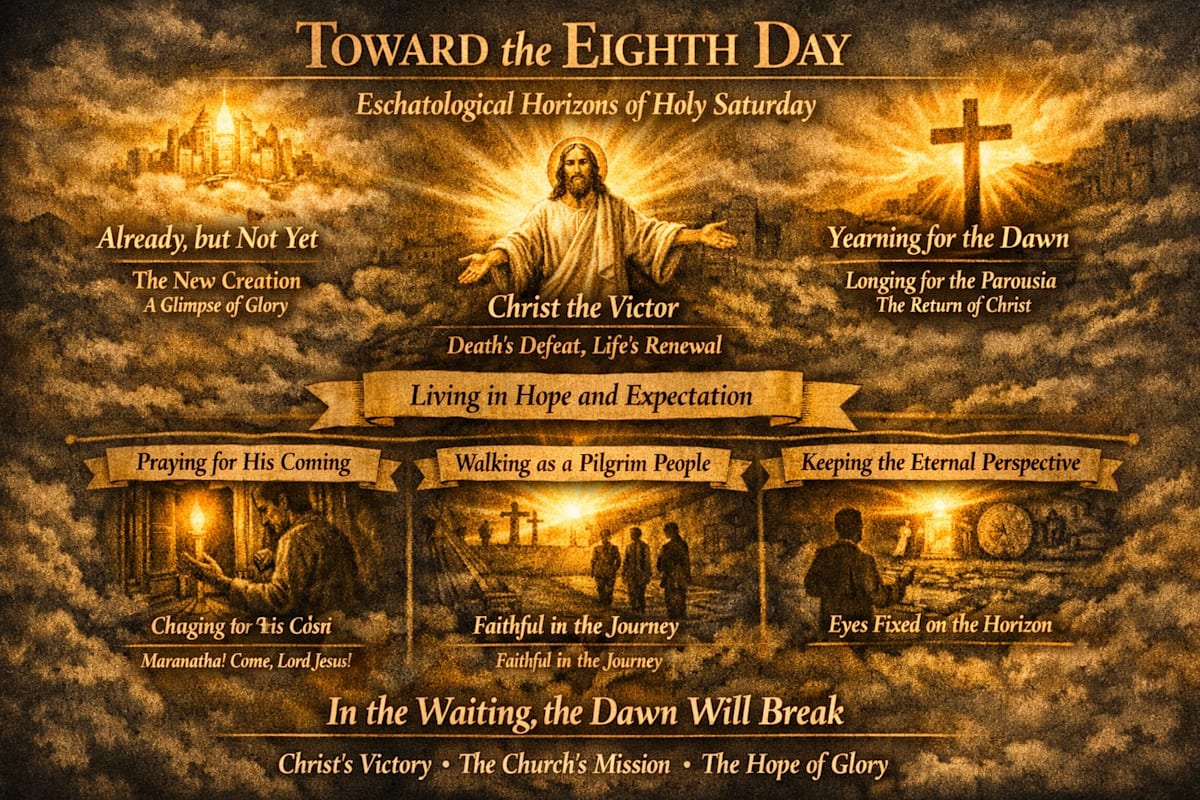
Holy Saturday is not a mere prelude to Easter, but a mystery in its own right. It reveals a cosmic view of redemption where the crucified Christ is at work in the depths of the earth and the depths of human history. For the Catholic and Anglican believer, the descensus provides the assurance that grace is moving precisely where it appears most inert. In the quiet interval between the Cross and the Resurrection, we discover that the King may sleep, but He does not abdicate; the Word may be silent, but He is never inactive.
God’s silence is not his absence.