When we think of biblical stories like the Tower of Babel or the destruction of Sodom, our minds usually jump straight to individual morality—pride, language confusion, wickedness, or poor hospitality. But what if we’ve been missing the most important character in these ancient dramas?
What if the primary stage for these crises—the physical landscape itself—was sending us a urgent, systemic message about technology, ecology, and human overreach?
In a groundbreaking research paper titled “The Topographical Paradox: Eco-Urban Crisis, Alluvial Hubris, and the Spatial Hermeneutics of Levelling in Genesis 11 and 19,” scholar Mark Edward Chard introduces a fresh lens for reading scripture: the "moral physics of topography."
By combining critical spatial theory, biblical ecocriticism, and contemporary African ecotheology, Chard argues that the geography of the ancient world wasn't just a passive backdrop—it was a dynamic moral agent. And its laws are startlingly relevant to our modern ecological crisis.
What is "Alluvial Hubris"?
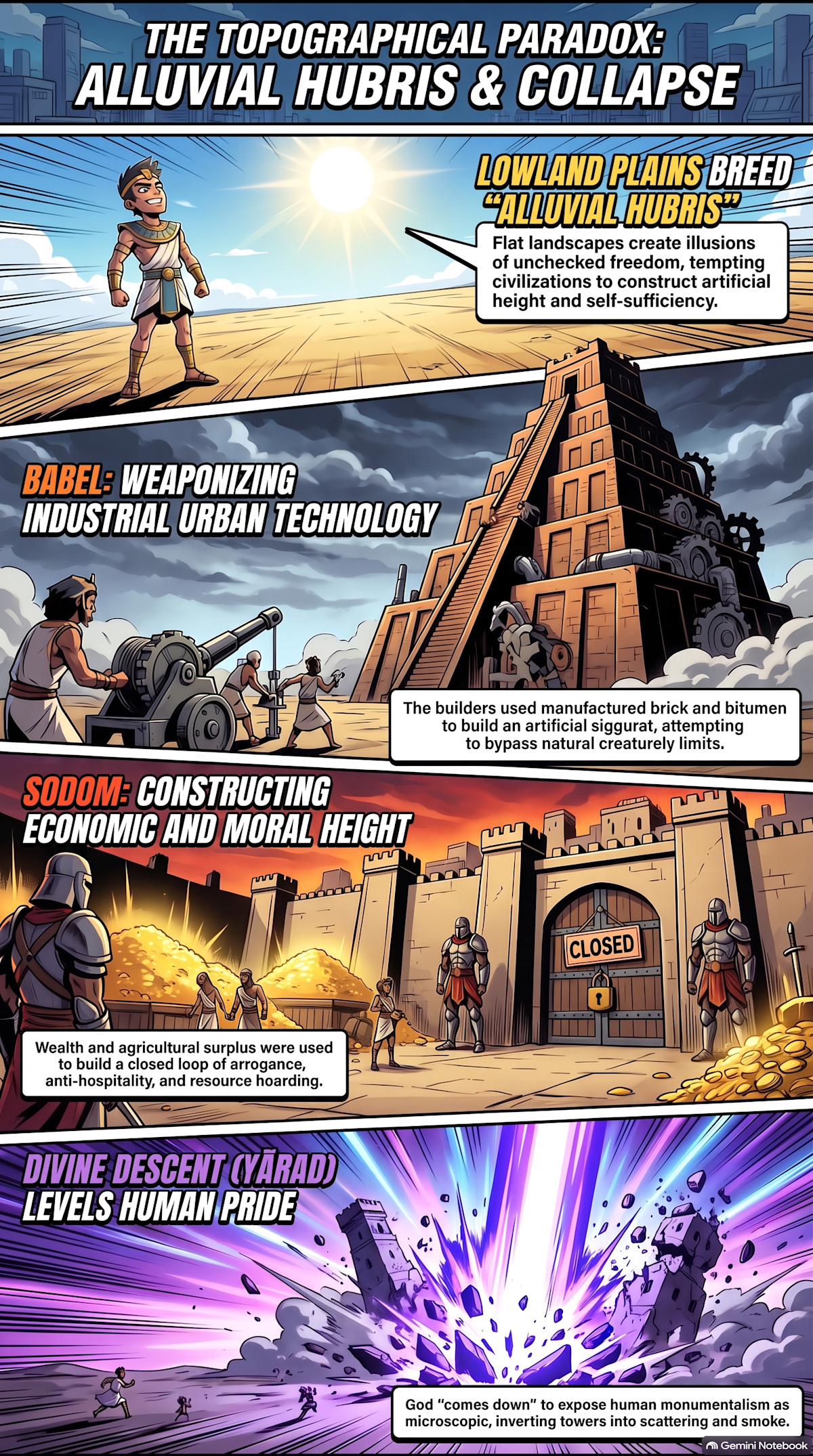
Throughout human history, flat, fertile lowlands (alluvial plains) have been the cradle of civilization. The plain of Shinar in Mesopotamia (Genesis 11) and the circular disk (Kikkar) of the Jordan Valley (Genesis 19) offered ancient societies unlimited room to expand, rich soil, easy water access, and unprecedented agricultural wealth.
Because these flatlands lacked the natural, towering boundaries of mountains, they invited a subtle psychological delusion: Alluvial Hubris.
In the lowlands, human society begins to feel invincible. Free from geographic obstacles, humanity falls into the illusion that horizontal expansion can go on forever—provided we build artificial, technological verticality to anchor ourselves.
Babel (Genesis 11): Lacking natural stone, the builders invent industrial kiln-baked bricks and petroleum asphalt bitumen. They manufacture their own stone to build a ziggurat "with its top in the heavens"—an architecture of display meant to wall themselves off from vulnerability and resist being scattered.
Sodom (Genesis 19 & Ezekiel 16): Nestled in a well-watered paradise "like the garden of the Lord," Sodom didn't need to build a physical tower. As Ezekiel 16:49 notes, Sodom constructed a "moral ziggurat"—a system built on pride, excess food, and prosperous ease that walled off its wealth and violently rejected the vulnerable stranger.
In both cases, human civilization used technological triumph or economic surplus to build an insulated, artificial "height" on a flat plain.
The Paradox of Divine Descent (Yārad)
Here is where the "moral physics" comes into play: In the biblical worldview, artificial height in low places creates a severe spatial anomaly. What goes up in self-exaltation becomes structurally top-heavy and poised for catastrophic collapse.
How does God react to these massive architectural and economic systems?
Not by competing on human terms. Divine sovereignty doesn't build a taller tower or deploy superior military force.
Instead, the text uses a surprising counter-movement: Divine Descent (y\bar{a}rad).
"And the LORD came down (wayy\bar{e}red) to see the city and the tower..." (Gen 11:5)
From the divine perspective, human monumentalism is so microscopic that God has to "come down" just to see it! This creates a brilliant, ironic scale-mismatch that unmasks human hubris.
The divine inspection triggers an immediate, symmetrical leveling:
The builders of Babel wanted to avoid being scattered; their industrial centralization is shattered into linguistic confusion and forced global diversification.
The hoarders of Sodom wanted to protect their luxury within closed walls; their closed system ends in fire, sulfur, and smoke rising like a furnace—a tragic mirror image of the tower they tried to build heavenward.
Lessons from African Ecotheology: The Land as a Covenant Partner
Drawing on contemporary African ecotheological hermeneutics, Chard reminds us that in non-Western worldviews, the biosphere, human social ethics, and the divine realm exist in an indivisible, relational web.
The land (Ardhi) is not passive real estate to be exploited for unilateral profit. It is a living partner with its own boundaries and covenantal expectations.
When ancient societies manipulated soil to manufacture artificial stone, or exploited alluvial abundance to hoard wealth while ignoring the poor, they didn't just break a moral rule—they inflicted an ecological wound upon the landscape itself.
Modern "Towers" in a Flat World
The warnings of Genesis 11 and 19 are not archaic relics of divine anger; they are ecosystemic corrections.
Today, we live in our own era of "alluvial hubris." We build modern "towers" of insulation—globalized supply chains that hoard resources, tech-driven systems that flatten cultural and ecological boundaries, and closed economic loops that ignore the environmental refugees at our gates.
The moral physics of topography reminds us of a timeless law:
Topographical integrity is a theological vocation.
Systems that prioritize technological triumphalism and resource hoarding over bounded, relational care for the planet are fundamentally unstable.
The God who "comes down" continues to level the high and scatter the proud, inviting us back into a humble, sustainable harmony with the Creator, our neighbors, and the earth.
What artificial "towers" of insulation do you see humanity building today? How can we cultivate a deeper, bounded harmony with the landscapes we inhabit?
As ever,
Mark
To enjoy videos on these subjects, please 'click' on the 🖇️ 👇
Expanded
https://youtu.be/DVe_2EHh_6Q?is=ITBYA-lD8hNUIkCq
Short
https://youtube.com/shorts/sht34HBXs9Q?is=ZjCkY-BG4c-BNy2s