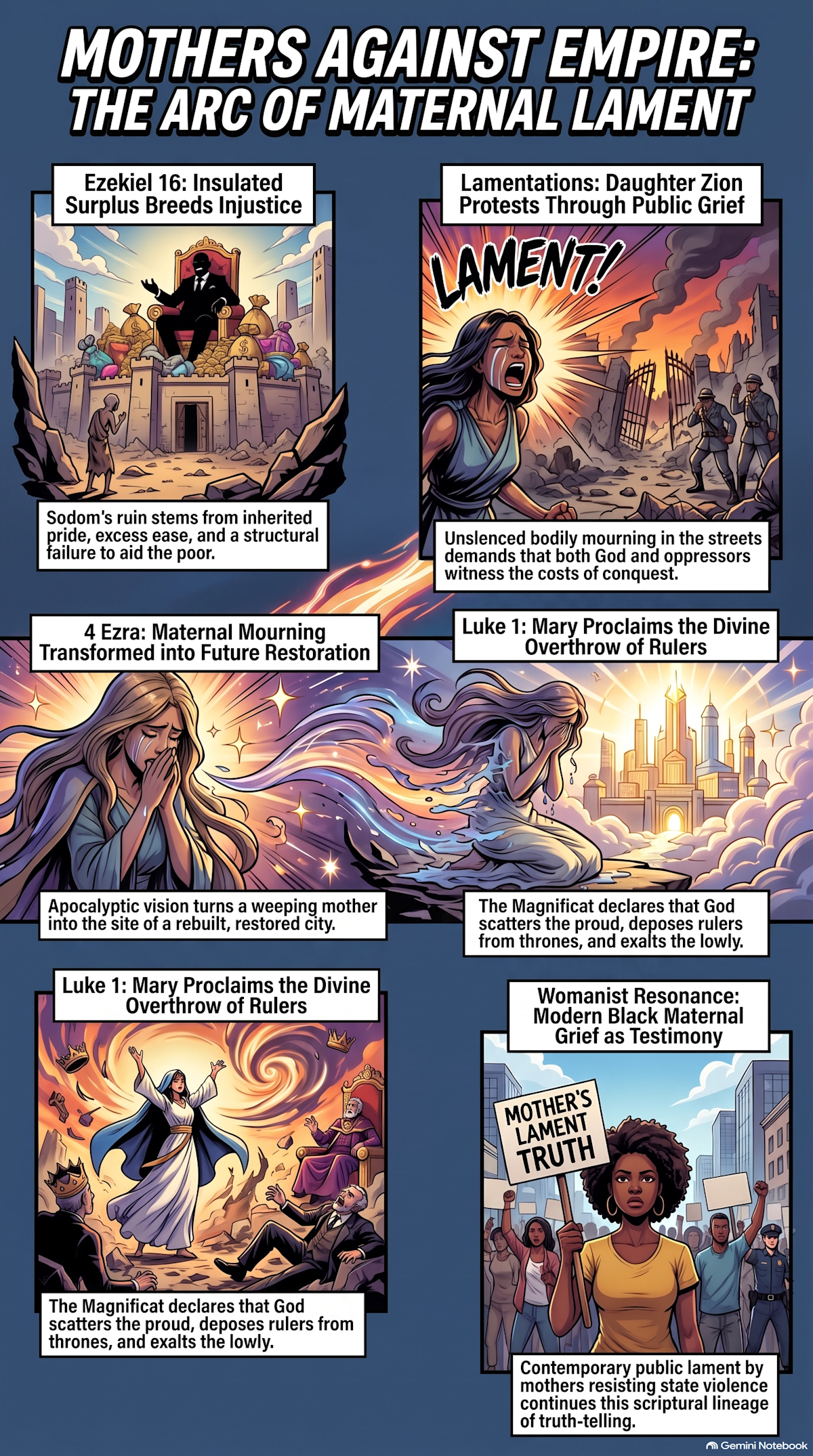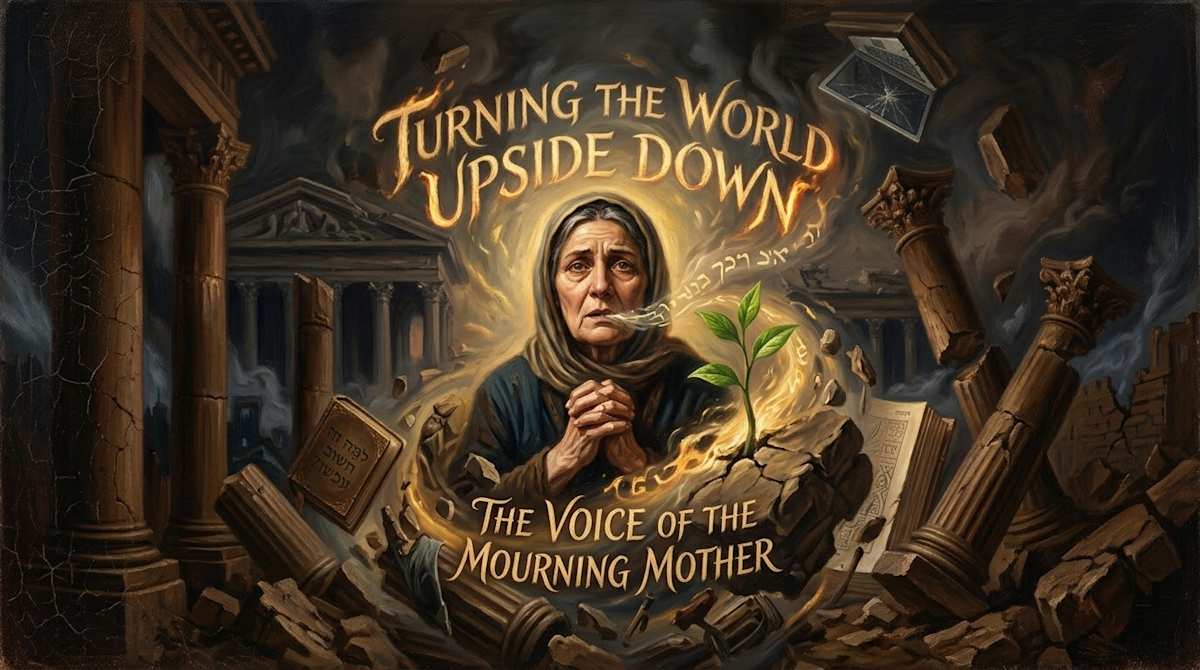
When Mothers Speak, Empires are forced to Listen... Daughters of Sodom, Daughters of Zion, and the revolutionary voice of maternal lament.
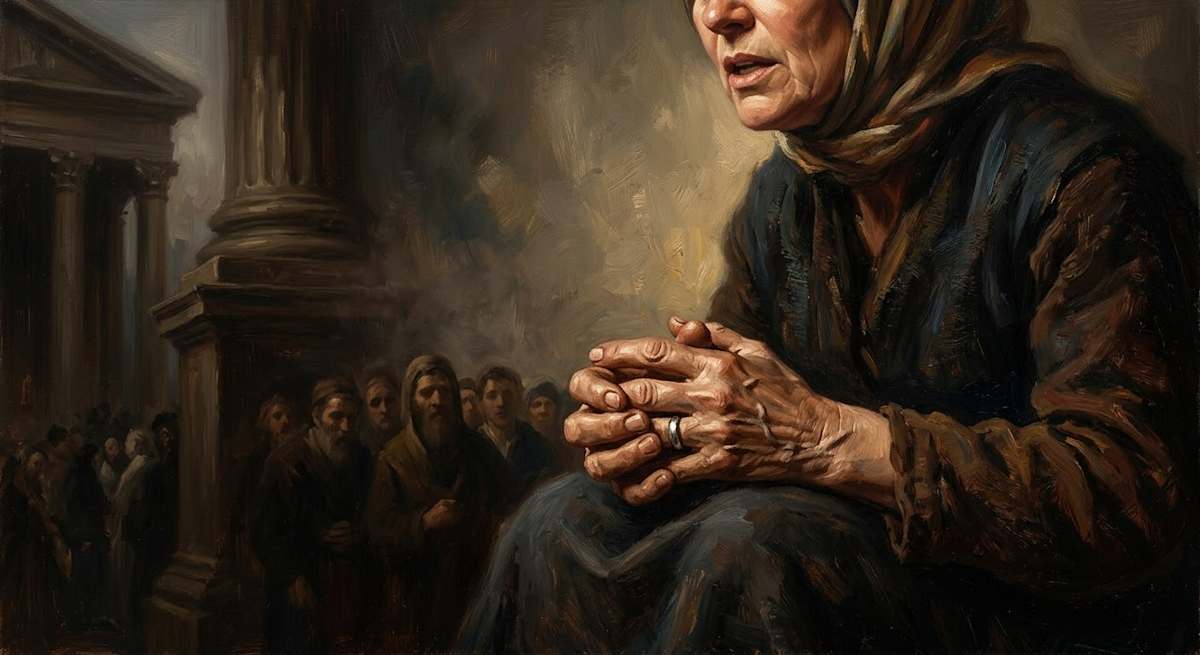
What if some of the Bible’s most powerful challenges to empire are not spoken by kings, generals or prophets—but by mothers?
That question lies at the heart of my new paper, Daughters of Sodom, Daughters of Zion, Daughters of Mary: Maternal Lament, Inhospitality and Divine Reversal as Canonical Grammars of Trauma.
The argument begins in an unexpected place: Sodom.
We often remember Sodom through the story of Genesis 19. But Ezekiel 16 gives a strikingly different account of the city's guilt:
“She and her daughters had pride, excess of food, and prosperous ease, but did not aid the poor and needy.”
Here Sodom's problem is not simply that it is wicked in some abstract sense. Ezekiel describes a society characterised by height, surplus and insulation.
It has enough.
It has security.
It has abundance.
And yet it does not help those who are vulnerable.
That is a profoundly material description of sin.
The wealthy city becomes separated from the people who are hungry.
Its abundance becomes a wall.
Its height prevents it from hearing the cries of those below.
And Ezekiel does something particularly interesting with this image: he speaks of Sodom and her daughters.
The language of family matters.
A social order can teach its children what to value. Pride can become inherited. Indifference can become normalised. A society that learns to protect its surplus rather than its vulnerable can pass that moral imagination from one generation to the next.
But then the biblical story turns.
The height begins to fall.
And when it does, the voice we hear is not the voice of the empire.
It is the voice of a grieving woman.
Daughter Zion refuses to be silent
Lamentations gives us one of Scripture's most devastating portraits of collective catastrophe.
Jerusalem is personified as Daughter Zion.
She weeps.
She is humiliated.
Her children are starving.
Her sanctuary has been destroyed.
Her social world has collapsed.
And yet she does something extraordinary.
She speaks.
“Is it nothing to you, all you who pass by?”
That question is more than grief.
It is accusation.
Daughter Zion refuses to allow suffering to disappear into silence. She demands that somebody look.
Again and again, she calls upon God:
Look. See. Remember.
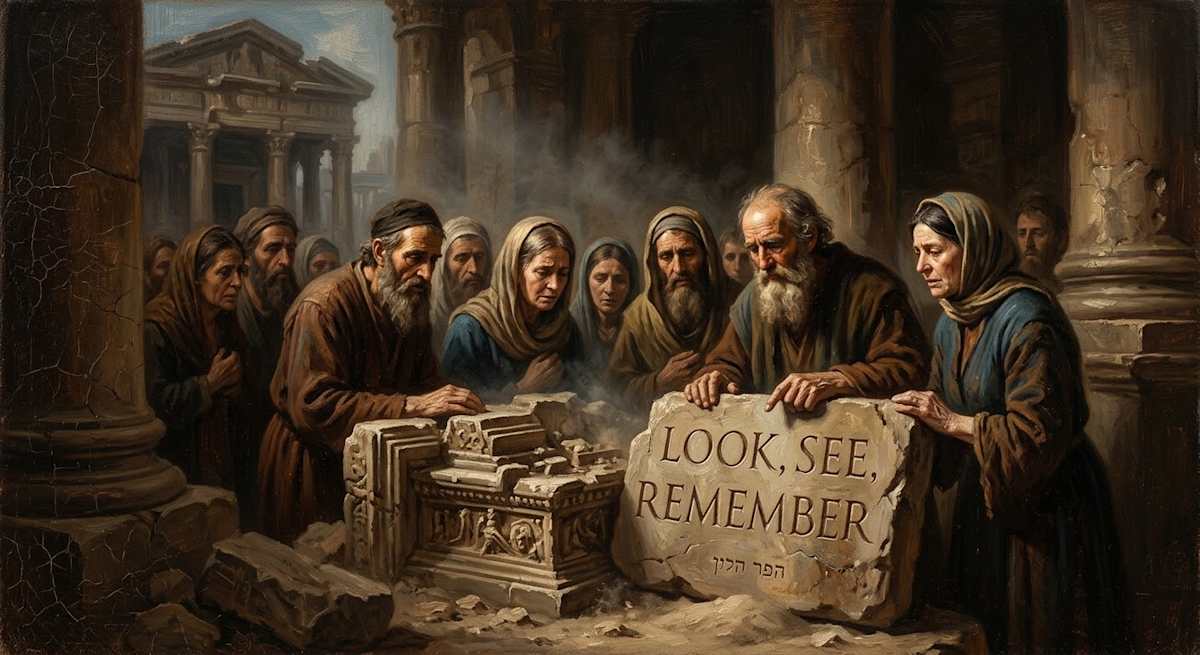
Her grief becomes public testimony.
This matters because conquest always has a story.
Empires tell stories about victory, order, security and restoration. But Lamentations tells the story from underneath the monument—from the street, the ruined city, the starving child and the grieving mother.
The conquered body becomes an archive.
The mother becomes a witness.
And lament becomes a form of resistance.
This is why the maternal imagery in Lamentations is so important.
The catastrophe is not described abstractly. It is experienced through bodies.
Eyes are exhausted from weeping.
Stomachs churn.
Children faint from hunger.
Mothers' breasts fail.
And in the text's most horrifying images, the normal relationship between mother and child is grotesquely inverted by siege and starvation.
The text will not allow us to speak about conquest without speaking about what conquest does to human bodies.
That is one of the deepest theological claims of lament:
suffering must be embodied before it can be remembered truthfully.
From Zion to the mother of exile
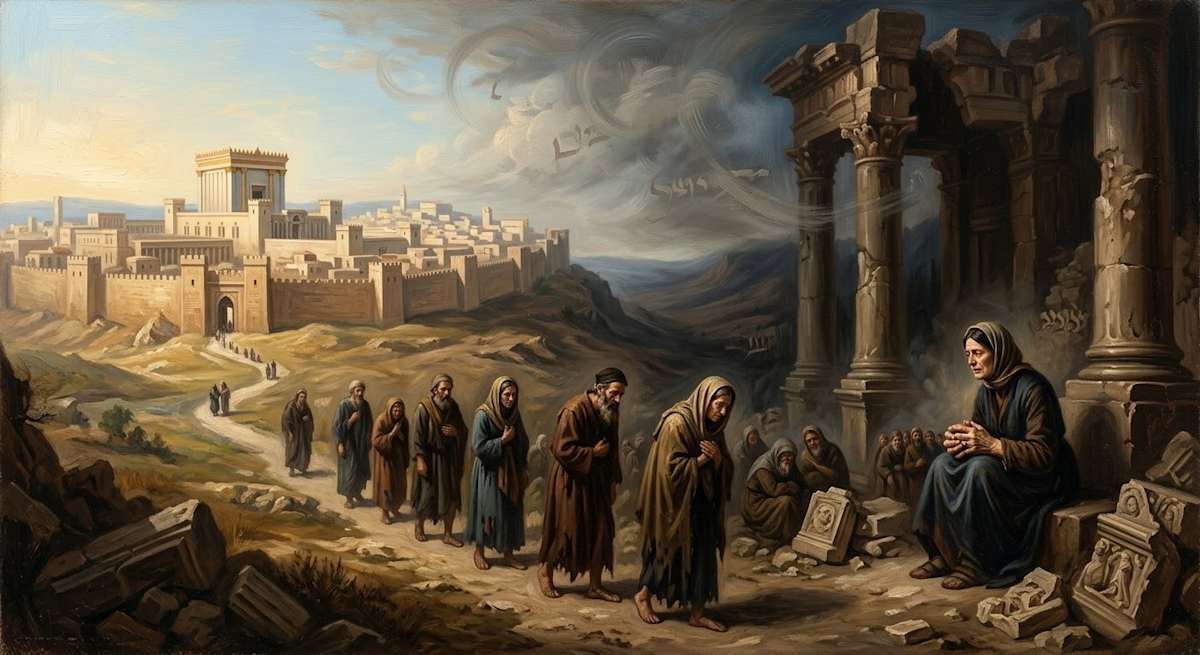
The story does not end with Lamentations.
In Baruch, Jerusalem speaks as a mother who has lost her children.
She describes herself as widowed and bereaved.
She has nourished her children.
She has watched them depart.
She has sent them away in tears.
Yet she still believes that they can return.
The maternal voice therefore becomes the voice of a scattered people.
Exile is not merely political geography.
It becomes maternal separation.
The community is imagined through the body of a mother who longs for her children.
Then 4 Ezra takes the imagery even further.
Ezra encounters a woman in profound grief. Her only son has died after a long-awaited birth. Ezra initially tells her that her grief over one child should be placed beside the much greater catastrophe of Jerusalem.
But then the woman is transformed.
She becomes the city.
Her grief becomes an apocalypse.
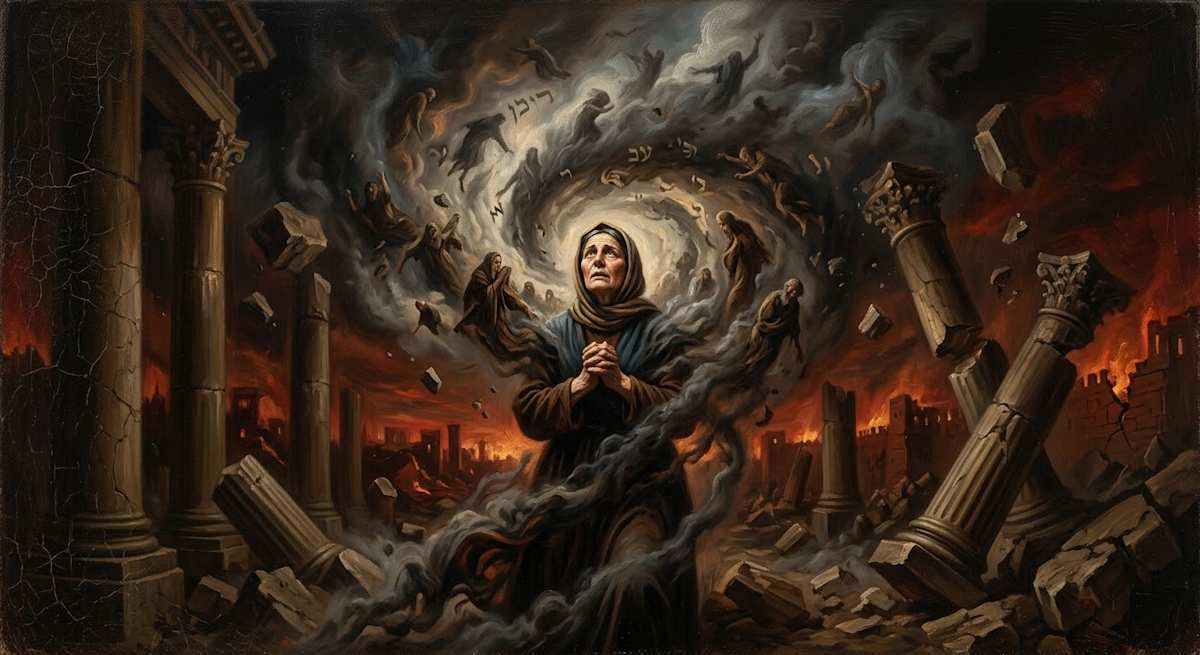
The woman does not simply receive the vision.
She is the vision.
The maternal body becomes the place where political catastrophe is disclosed.
This is an extraordinary biblical and Jewish theological imagination.
When a community has suffered a catastrophe that is almost too large to describe, Scripture sometimes tells its story through a mother's body.
The political becomes personal.
The communal becomes maternal.
The destruction of a city becomes the death of a child.
And the mother's lament becomes a way of seeing what official narratives cannot see.
And then comes Mary
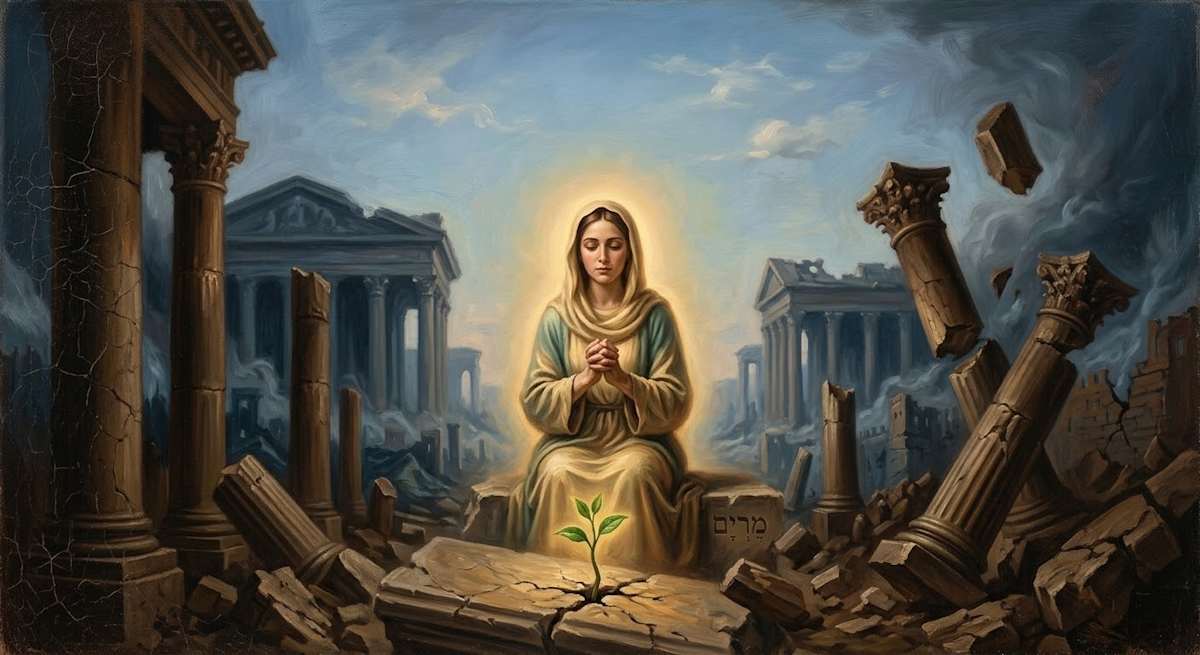
This brings us to one of the New Testament's most famous songs.
Mary's Magnificat.
It is often read as a beautiful hymn of personal devotion.
But listen to what Mary actually sings:
The proud are scattered.
The powerful are brought down.
The lowly are lifted up.
The hungry are filled.
The rich are sent away empty.
This is not sentimental spirituality.
It is a song about reversal.
And Mary is not the first biblical mother to sing this way.
Her closest maternal predecessor is Hannah.
Hannah sings of the mighty whose bows are broken, the hungry who are fed, the poor who are raised from the dust and the powerful whose positions are overturned.
Mary takes up that maternal grammar of reversal and sings it again.
But something else happens in the Magnificat.
The vocabulary of height itself is transformed.
Earlier in the biblical tradition, height can signify pride—the swollen city, the powerful ruler, the person or society that has lifted itself above others.
Mary sings that God has brought rulers down from their thrones and lifted up the lowly.
God does not abolish height.
God redistributes it.
The question becomes:
Who gets to stand on high ground?
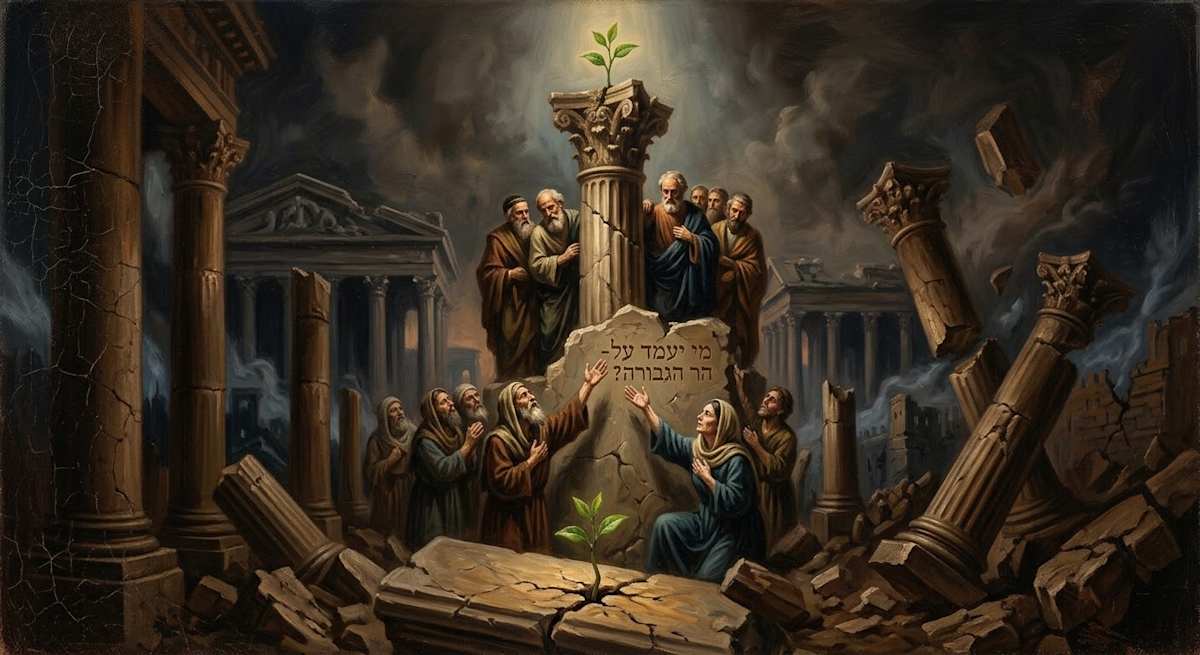
And who has been pushed down?
That is the revolutionary heart of the Magnificat.
The mother's body becomes the place of reversal
There is one final movement that I find particularly striking.
In Lamentations, the maternal body is where the violence of empire is experienced.
In Luke, the maternal body becomes where divine reversal enters history.
Mary is pregnant when she sings.
The child she carries is the child whose kingdom, Luke says, will have no end.
The body that earlier texts associate with suffering, siege, hunger and bereavement becomes, in Luke's telling, the body through which hope enters history.
The movement is therefore not simply:
lament → comfort.
It is:
lament → testimony → resistance → reversal → hope.
That distinction matters.
Biblical hope is not the denial of suffering.
It is the refusal to allow suffering to have the final word.
Why does this matter now?

This is where the ancient texts begin to speak with surprising force to contemporary Black maternal theology.
The connection is not one of historical descent. I am not arguing that Ezekiel knew Mamie Till-Mobley, or that Mary was consciously anticipating modern womanist theology.
The connection is theological resonance.
Again and again, Black mothers have publicly mourned children killed by racism and state or vigilante violence.
And again and again, that mourning has become testimony.
Mamie Till-Mobley's decision to have Emmett Till's funeral open to public view in 1955 refused to allow violence against her son to be sanitised or hidden.
The grieving mother effectively says:
Look.
See what happened.
Do not look away.
That is remarkably close to the theological force of Daughter Zion's cry.
“Look.”
“See.”
Remember.
The connection is not that these women are simply repeating biblical characters.
It is that both traditions recognise something profound:
the person who bears the wound may also become the person who tells the truth about the wound.
Womanist theology has long insisted that Black women's bodies, survival, suffering and resistance are not peripheral to theology. They are sources of theological knowledge.
That insight allows us to hear these biblical texts differently.
The mother is not merely an illustration.
She is not merely an object of compassion.
She is a knower.
She is a witness.
She is an accuser.
And sometimes she is a prophet.
A different way of reading the Bible

The larger argument of my paper is therefore about how we read Scripture.
Ezekiel, Lamentations, Baruch, 4 Ezra and Luke come from different periods, genres and historical circumstances. I am not arguing that they form a single literary chain, nor that each author consciously intended to continue the previous text.
Rather, when these texts are placed beside one another canonically, something becomes audible.
A recurring theological grammar emerges.
Sodom represents height without solidarity.
Daughter Zion gives suffering a public voice.
Baruch gives exile the voice of a bereaved mother.
4 Ezra transforms maternal grief into apocalyptic revelation.
Hannah and Mary turn maternal song into divine reversal.
And across this movement, the biblical tradition repeatedly asks the same disturbing question:
What happens when those at the bottom are finally heard?
The answer is unsettling for every system built on hierarchy.
The proud are scattered.
The rulers are brought down.
The hungry are filled.
The lowly are lifted.
The rich discover what it means to be sent away empty.
And the voices that empire would rather silence become the voices through which Scripture imagines another world.
The theology of making people look
Perhaps that is ultimately what maternal lament does.
It makes people look.
It refuses the convenient distance between suffering and those who benefit from the structures producing it.
It says:
Look at the child.
Look at the mother.
Look at the body.
Look at the ruins.
Look at what happened.
And, above all:
Do not look away.
The Bible's maternal voices therefore do more than express grief.
They challenge the politics of visibility.
They expose what power wants hidden.
They hold God accountable to the suffering of the vulnerable.
And they preserve the possibility that the world can be otherwise.
The final word of these texts is not that mothers suffer.
It is that mothers speak.
And when they speak, the height of empire is no longer secure.
The mother who mourns becomes the witness.
The witness becomes the accuser.
The accuser becomes the singer.
And the singer begins to imagine the world turned upside down.
That is the extraordinary theological grammar of maternal lament.
And perhaps it is why, across centuries, when the powerful tell us to look elsewhere, the biblical mothers keep saying the same thing:
Look.
See.
Remember.
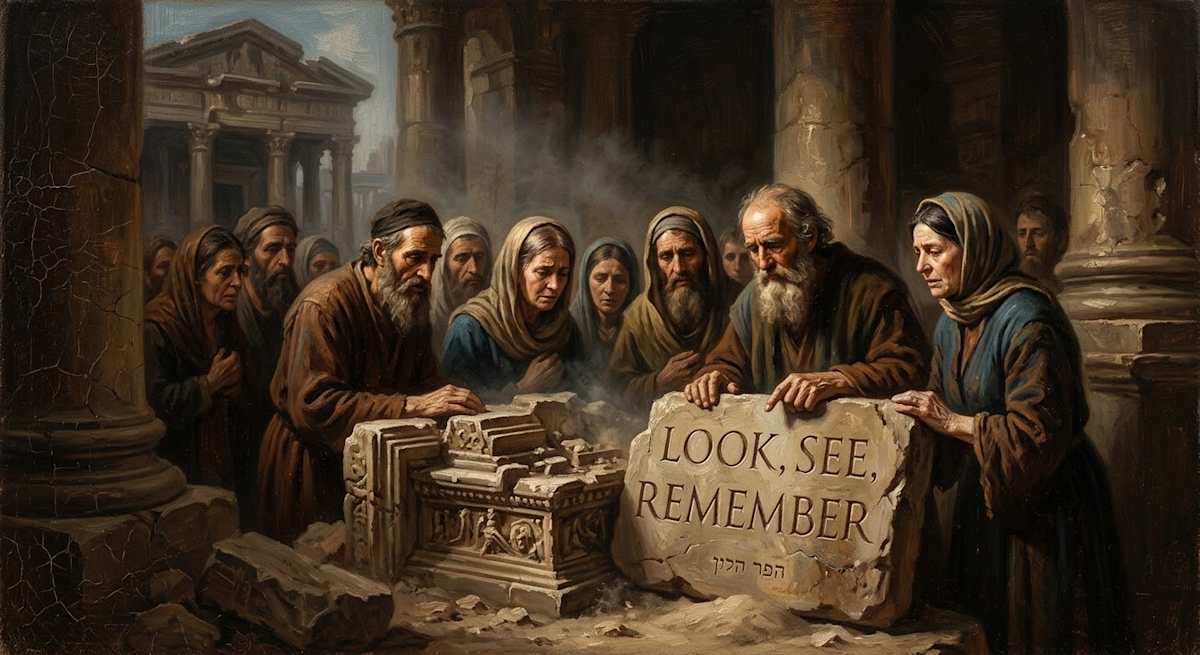
And do not let the suffering of our children disappear.
As ever,
Mark.
To watch Videos in connection with this paper, please 'click' on the 🖇️ 👇
Explainer
https://youtu.be/y_x0XYuD0ic?is=3Ml342JjK9S2lEPG
Short
https://youtube.com/shorts/uVUEcyrxidA?is=HoJTC7mNWGhwPig-
Music: Mary's Magnificat (Versions)
Short
https://youtu.be/pHPmWERMO3s?is=eyetZFqeUFtyfs9A
Long
https://youtu.be/Rlp3aCAYTSE?is=cAdsNRqv3-lZtToP