1. Introduction: When the World Shatters

When trauma strikes—whether through the sudden gravity of bereavement, the corrosive sting of racialized violence, or the shock of collective tragedy—it does more than inflict pain. It creates an "existential rupture," a profound dislocation from oneself, others, and God. For those in the aftermath, the world as they once knew it simply ceases to exist. The narrative threads that once held life together are frayed, leaving behind a terrifying silence. In these moments, survivors often find themselves searching for a language sturdy enough to hold the weight of what has happened without breaking.
Paradoxically, the most sophisticated resource for this work may be a text often dismissed as a cryptic timetable for the "end times." When viewed through a trauma-informed lens, the Book of Revelation reveals its original identity: it is not a roadmap for the future, but a pastoral intervention designed for communities navigating catastrophe. It functions as symbolic wisdom literature, providing a "grammar for the aftermath" that helps survivors move from the collapse of meaning toward a path of endurance and integration.
2. Takeaway 1: Rebuilding the "Assumptive World"

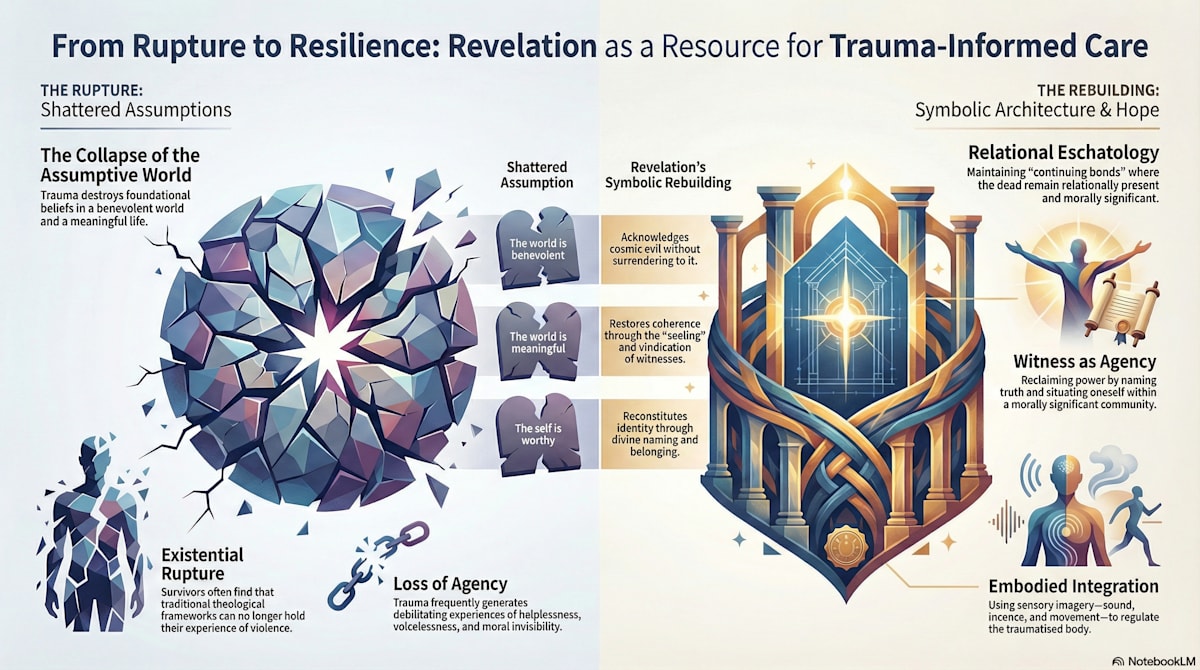
Trauma is a rupture that destabilizes the "assumptive world"—the internal cognitive map we use to navigate reality. According to the Janoff-Bulman model, trauma shatters three foundational pillars of human existence:
"Janoff-Bulman's model identifies three core assumptions shattered by trauma: the world is benevolent; the world is meaningful; the self is worthy."
Revelation systematically addresses this collapse by utilizing what psychologists call "meaning-making." It distinguishes between global meaning (the enduring belief that God is faithful and life has a purpose) and situational meaning (the attempt to interpret the current traumatic event). While a survivor’s situational meaning may be dominated by chaos, Revelation preserves their global meaning—insisting that even if the world is currently malevolent, it is ultimately held by a benevolent force.
Crucially, the text restores a sense of worth through "divine naming." For a survivor who feels erased or defined solely by their victimization, being "named" and "sealed" by the divine reconstitutes their identity. It reminds them that they are seen, valued, and held in an unbreakable relationship, providing a secure foothold for rebuilding a sense of self.
3. Takeaway 2: Symbolic Exposure—Processing Trauma at a "Safe Distance"
The Power of Indirect Healing
A primary challenge in trauma recovery is the risk of retraumatization; confronting a horrific event "head-on" can easily overwhelm the nervous system. Revelation provides an alternative: "symbolic exposure." Instead of literal descriptions of violence, the text refracts the experience of suffering through vivid, visionary cycles.
The Rhythm of Containment

The text is organized into repetitive cycles—the opening of seven seals, the sounding of seven trumpets, and the pouring of seven bowls. This patterned structure is not just a literary device; it provides a "rhythmic containment" for chaotic experiences. By approaching the trauma indirectly through symbols—such as incense representing prayers or earthquakes representing social upheaval—Revelation creates a "safe distance." This allows the survivor to process overwhelming material through an imaginal lens, slowly integrating the traumatic event into their personal narrative without flooding their psychological defenses.
4. Takeaway 3: The "Continuing Bonds" of the Slain

In many Western clinical models, "healing" from grief is often equated with "letting go" or achieving "closure." However, the Book of Revelation aligns with a more resilient psychological model: "Continuing Bonds." This approach recognizes that ongoing relationships with the deceased are adaptive and necessary, a reality long understood within African American reception history.
Through the lens of "homegoing liturgies," spirituals, and civil rights testimony, we see that the dead in Revelation—specifically the "slain witnesses"—are not simply gone. They remain morally active and relationally present.
"The dead are not simply absent; they remain relationally and ethically present... the murdered remain morally present and ultimately vindicated."
This "relational eschatology" offers a mediated connection across the boundary of death. In the text, the slain cry out for justice and participate in the community’s life. For those navigating racialized violence or systemic loss, this framework affirms that their loved ones are not merely "victims of the past," but witnesses who continue to have a voice and moral significance in the present.
5. Takeaway 4: Healing is Somatic (The Sensory Landscape)

As trauma specialist Bessel van der Kolk famously noted, "the body keeps the score." Because trauma is stored in the nervous system rather than just the intellect, purely cognitive "talk therapy" is often insufficient for total healing. Revelation meets this need through a dense, sensorimotor landscape that is "physiologically regulating."
The text utilizes specific sensory elements to anchor the traumatized body in a communal, liturgical space:
- Sound: The rhythmic blasts of trumpets and the "roar of a great multitude" provide a sonic architecture for collective expression.
- Smell: The frequent mention of the fragrance of incense engages the olfactory system, which is deeply tied to memory and calming the limbic system.
- Posture and Gesture: Descriptions of prostration, standing in white robes, and communal movement create an "embodied liturgy" that grounds the body.
- Song: The use of repetitive, rhythmic hymns helps regulate arousal levels and synchronized breathing.
These elements are not merely decorative; they serve a "sensorimotor" function, inviting the body into patterns of safety and coherence that abstract theology alone cannot provide.
6. Takeaway 5: From Victim to Witness (The Power of 'Hypomonē')
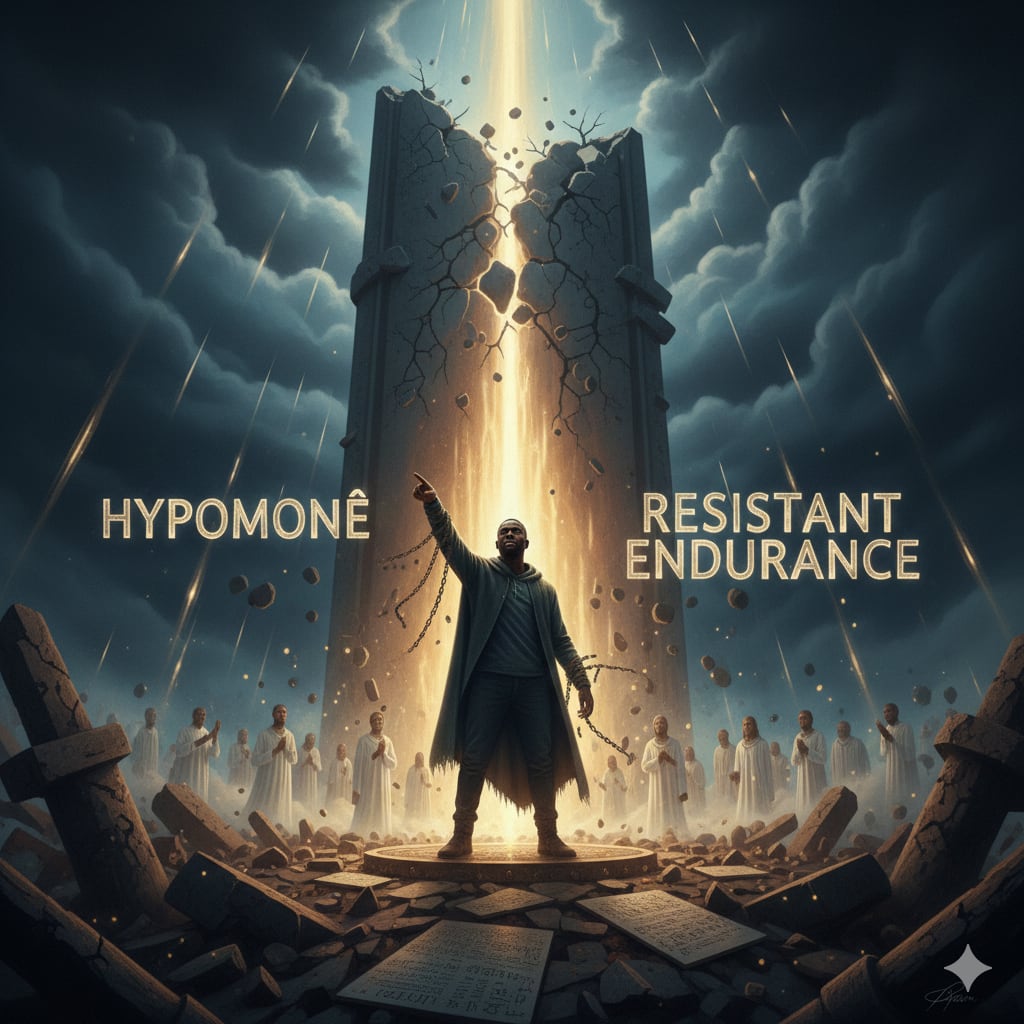
Trauma often leaves individuals feeling like passive victims—powerless and stripped of agency. Revelation counters this by reframing the survivor’s role through the concept of Hypomonē. This is defined not as passive waiting, but as "active, relational perseverance."
Hypomonē is a form of "resistant endurance" that contests the narratives of the "empire" or the perpetrator. By adopting the language of the "witness" (martys), the survivor reclaims the power to name the truth of their experience and articulate injustice. This shift is vital: it allows the individual to re-author their identity. They are no longer defined by what was done to them, but by their active participation in a morally significant community that refuses to be silenced.
7. Conclusion: A Grammar for the Aftermath

The Book of Revelation offers a "symbolic architecture" sturdy enough to hold the weight of devastation without demanding "premature closure." In pastoral practice, it is a vital warning against "theological closure"—the hollow assurance that "everything happens for a reason," which can often retraumatize the sufferer. Instead, Revelation creates a space where lament is amplified and grief is honored as a faithful response.
Integrating this text requires what we call "Bifocal Competence"—the ability to hold the psychological and theological lenses together simultaneously. It reminds us that even when the world shatters, meaning can be rebuilt through witness, ritual, and the persistence of our bonds with those we have lost.
How can we, in our own lives and communities, create better spaces to truly "witness" each other’s trauma without rushing toward a resolution?