
There are moments in history when grief refuses to stay private.
In September 1955, Mamie Till-Bradley stood beside the body of her fourteen-year-old son Emmett, lynched in Mississippi and returned to Chicago almost unrecognisable.
Against every pressure to close the coffin, to bury quietly, to move on, she made a different decision. “Let the world see what they did to my boy.”
That refusal changed history. It exposed the violence of empire. It forced witnesses. It would not allow silence to masquerade as peace.
Nearly 2,500 years earlier, another mother stood among the bodies of her children and issued a strikingly similar command:
“See, O LORD, and look!
To whom have you done this?”
(Lamentations 2:20)
The speaker is Daughter Zion - Jerusalem personified as a bereaved and violated mother. Her words are not private sorrow. They are public accusation. They are summons.
Lamentations Is Not Just a Lament
The Book of Lamentations is often treated as poetry for grief, a therapeutic outlet after catastrophe. But that reading does not go far enough.
Lamentations stages something far more dangerous: a courtroom drama, drawing on the ancient prophetic rîb (covenant lawsuit) tradition, where God normally prosecutes Israel for covenant breach, the book flips the genre entirely.
This time, the victim becomes the plaintiff. The mother brings the case. And God is placed in the dock.
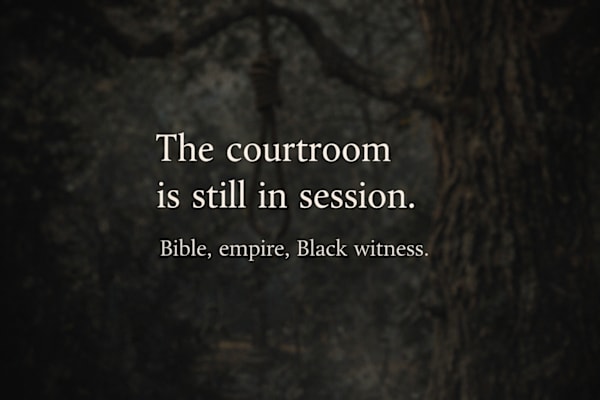
Daughter Zion summons witnesses. She demands divine attention. She exhibits evidence, the bodies of her children. She accuses God not of absence alone, but of excessive and unpitying violence:
“You have slain them in the day of your anger,
slaughtered without pity.” (Lam 2:21)
This is not atheism. It is wounded covenantal faith pushed to its breaking point.The Trial Never Ended
What biblical scholarship has rarely noticed is this:
Daughter Zion’s lawsuit did not stop in the sixth century BCE.
It has been carried forward, embodied, lived, and performed, by Black mothers for over four centuries.
From enslaved women weeping in hush harbors over children sold away, to mothers standing at lynching trees, to Mamie Till’s open casket, to the Mothers of the Movement today, Black maternal grief has refused erasure, refused silence, refused premature consolation.
Again and again, mothers have exhibited the bodies.
Again and again, they have summoned the world, and God, to look.
This is not metaphor.
It is living exegesis.
Black maternal witness does not merely illustrate Lamentations; it continues it.
Accusation as Faith, Grief as Hope
The deepest theological claim here is unsettling:
Accusing God can be an act of faith.
Unrelieved grief can be a form of hope.
Lamentations offers no verdict. No reconciliation scene. No neat resurrection at the end. The book closes with an unanswered question:
“Why have you forgotten us completely?” (Lam 5:20)
That refusal of closure is not despair. It is fidelity that will not lie.
True resurrection theology does not rush past the bodies. It does not silence the mothers. It does not demand that grief “move on.” It waits, dangerously, vulnerably, until divine solidarity is risked in the presence of those who refuse to leave the site of execution.
The courtroom is still in session.
And the mothers are still speaking.