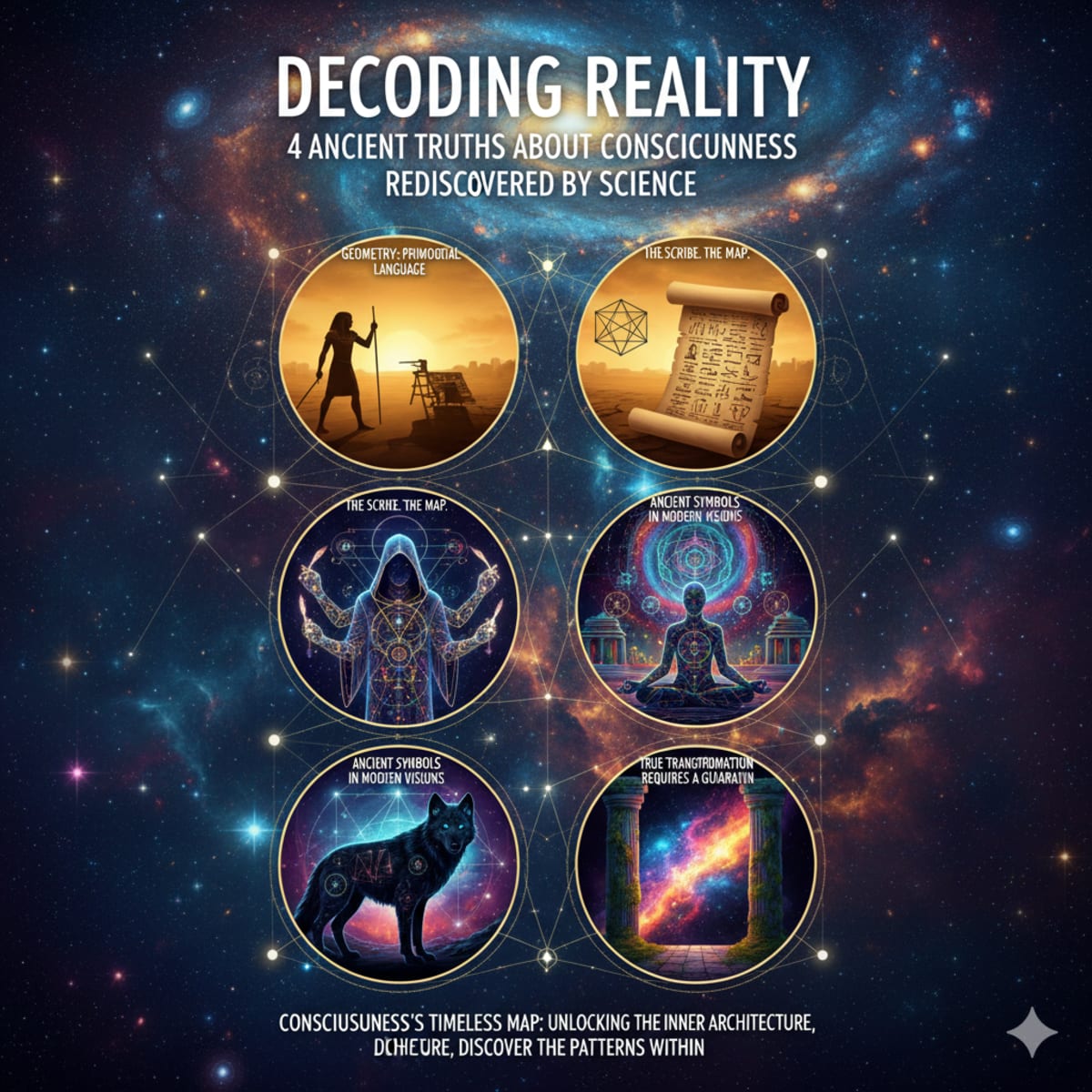
Introduction: The Patterns That Connect Us All
We are pattern-seeking creatures. From the constellations in the night sky to the rhythms in a piece of music, our minds are built to find, and create, order. But what if some of the most profound patterns aren't just in the world around us, but are hardwired into the very structure of human consciousness?
This question is at the heart of a deep scholarly dive into Metatron's Cube, a symbol that connects ancient mysticism, sacred geometry, and modern experiences of consciousness.
In a world saturated with information yet starved of meaning, this research distills four surprising takeaways that reveal how ancient wisdom offers a potent map for our inner lives.
1. Geometry Isn't Just Math - It's a Primordial Language for Meaning
Long before it was an abstract discipline, geometry was a sacred art that evolved from the urgent need to impose order on a chaotic world. In ancient Egypt, "rope-stretchers" used knotted cords to restore property boundaries erased by the Nile's annual floods. Their work was practical, but it was also profoundly metaphysical: in re-establishing order, they were restoring ma'at—the principle of cosmic balance. In the Indus Valley, entire cities were laid out on precise cosmological grids, transforming urban planning into a statement about reality itself.
This practical art soon deepened into a metaphysical language. The Greek philosopher Plato proposed that the fundamental elements were shaped like geometric forms—the cube for solid earth, the tetrahedron for flickering fire. The leap was profound: geometry became a way to articulate the hidden architecture of the universe, suggesting that humans are wired to see the structure of reality not just through stories or equations, but through pattern and form.
Geometry, therefore, is not something newly fabricated by the mind. It is rediscovered, carried within the depths of the collective unconscious as the timeless expression of wholeness.
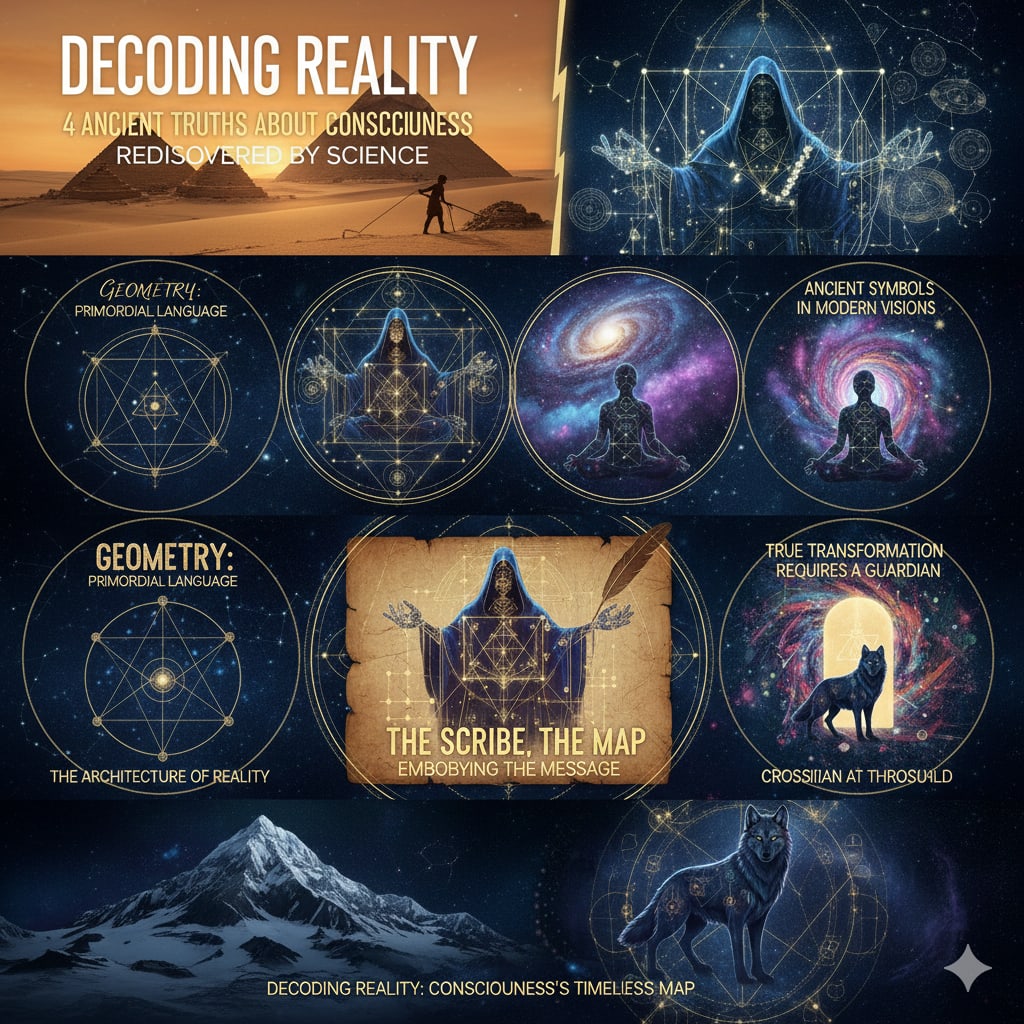
2. The Most Powerful Revelations Required a Scribe Who Became the Map
A recurring figure in ancient traditions is the scribe-mediator,a person whose function was to translate cosmic knowledge into a form humans could understand. This archetype appears with remarkable consistency across cultures, but a comparison of two primary examples reveals a deeper insight into how different civilizations mapped the path to revelation.
- Enoch-Metatron: In Jewish mysticism, the biblical figure Enoch "walked with God" and was taken from the earth. Later traditions describe his transformation into the angel Metatron, a celestial scribe whose very body was described as being "composed of letters, numbers, and fiery geometries." His journey was one of ascent through a structured, architectural heaven.
- Hermes Trismegistus: In Greco-Egyptian tradition, a parallel figure emerged—a fusion of the Greek god Hermes and the Egyptian god Thoth. Known as Hermes the "thrice-great," he received cosmic knowledge not through ascent, but through interior illumination via the Divine Mind (Nous).
The insight is stunning: for these cultures, the person receiving revelation had to embody its structure. Whether through architectural ascent or interior illumination, they didn't just write the map of reality; they had to become the map.
The symbolic logic is unmistakable: the scribe becomes the geometry he records. The mediator becomes the structure of mediation.
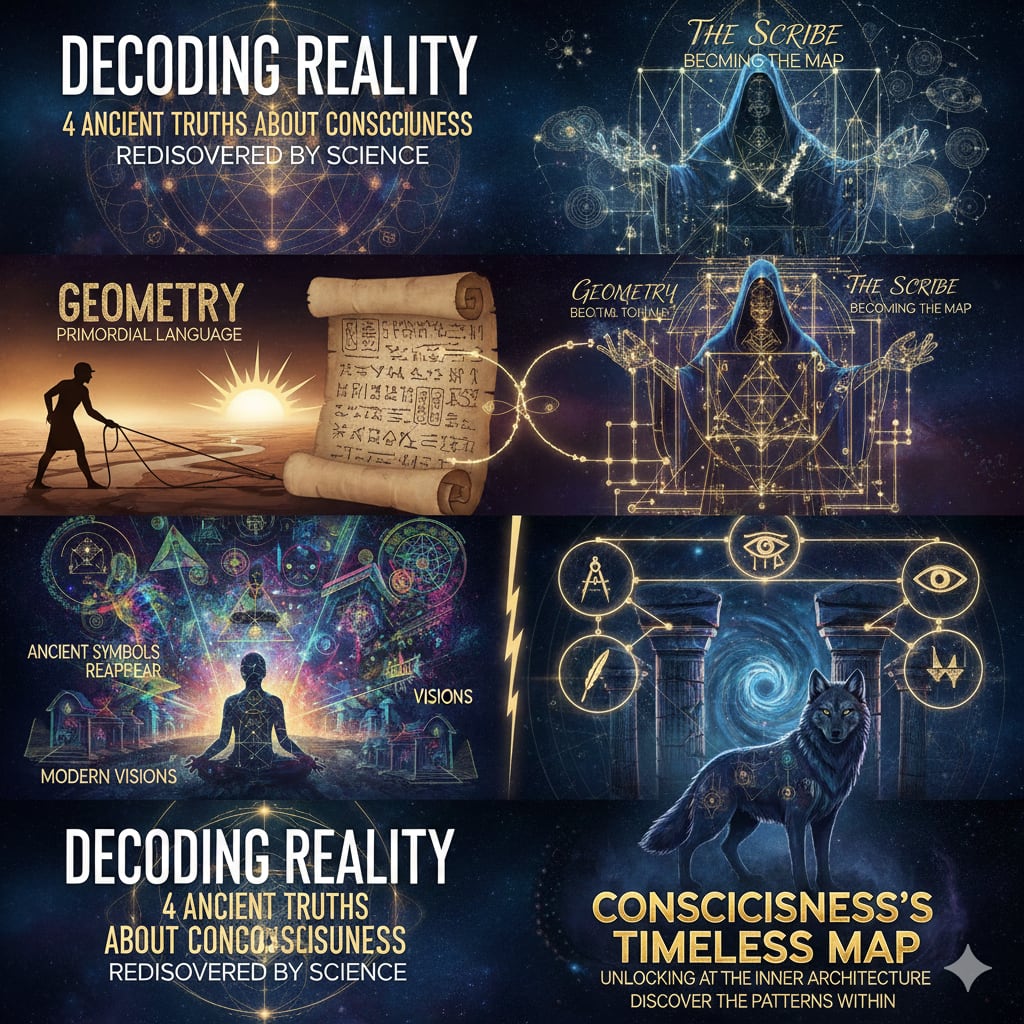
3. Ancient Symbols Are Reappearing in Modern Psychedelic and Near-Death Research
Geometric patterns like Metatron's Cube, once the exclusive domain of mystics, are now being consistently reported in formal scientific studies of altered states of consciousness. For centuries, these visions were considered mythological. Today, they are appearing as data.
In clinical trials involving psychedelics like DMT and psilocybin, participants frequently report seeing intricate, luminous patterns: fractals, mandalas, complex symmetries, and vast architectural structures like temples and palaces. Similar visions are a common feature of near-death experiences (NDEs). Crucially, participants often describe these geometric structures as feeling "more real than real" not as random hallucinations, but as coherent, intelligent patterns communicating meaning directly through their form.
This is a groundbreaking connection, bridging the gap between ancient mysticism and contemporary science. It suggests these symbols may point to fundamental structures of human consciousness that emerge under specific, and now, scientifically observable conditions.
It appears in psychedelic visions, near-death experiences, and spontaneous altered states. It surfaces in the testimonies of individuals with no prior exposure to esoteric symbolism. It emerges in moments of trauma, transformation, and relational intensity.
4. True Transformation Requires a Guardian at the Gate
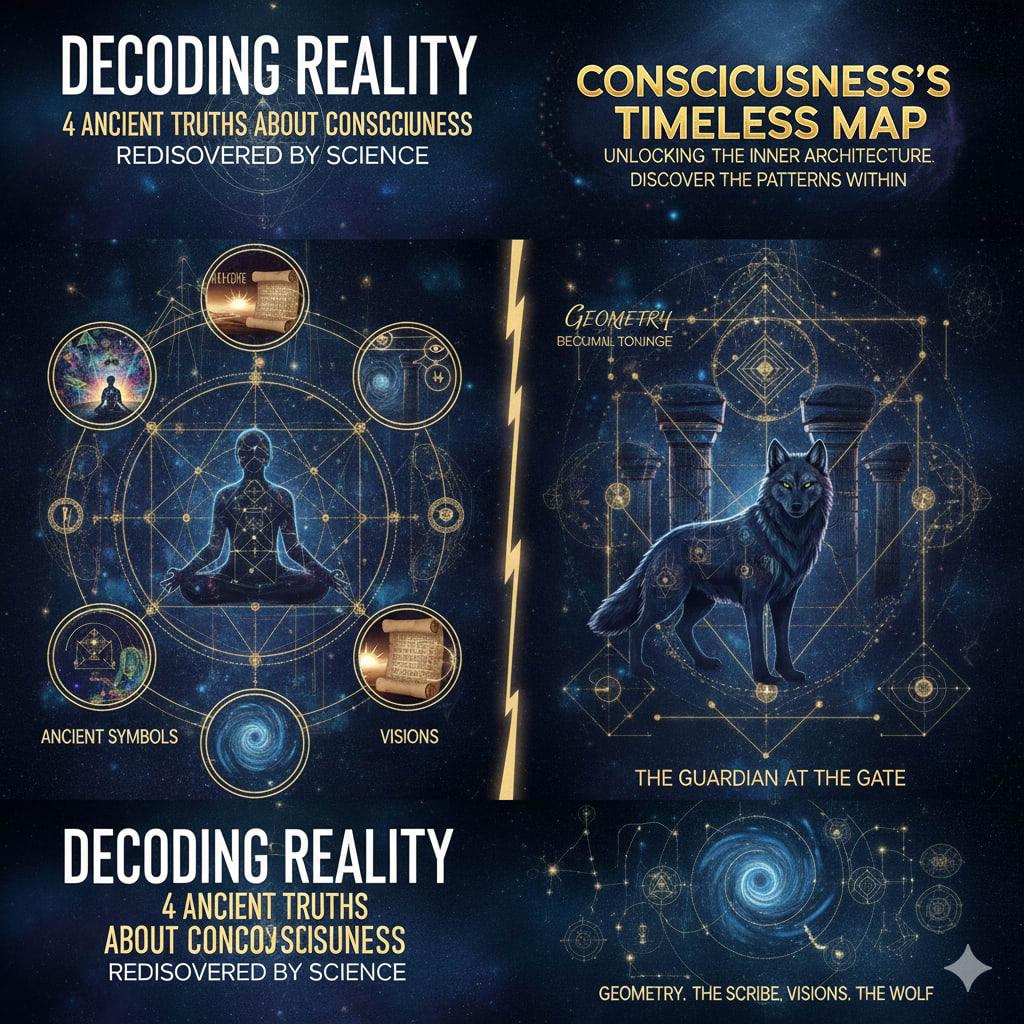
In myth, shamanic journeys, and modern visionary states, a powerful archetype often appears at the threshold of profound change: a guardian, frequently in the form of a Wolf. This figure's role is counter-intuitive; it doesn't just block the way but serves a crucial regulatory function.
The process of deep transformation is one of liminality a dangerous, in-between state where the old self dissolves. The guardian is a stabilizing presence that ensures the psyche doesn't fragment under pressure. This ancient archetype has a striking parallel in the work of modern psychologist Stanislav Grof on "spiritual emergency," where a profound crisis can become a catalyst for growth, but only if properly contained. The parallel isn't a coincidence; it's evidence that the human psyche has timeless, recurring structures for managing profound change.
The guardian ensures we meet the moment with the gravity it deserves. Its presence signifies that real change demands courage, respect, and a readiness to face our own limits, reminding us that the path to a new self is not a gentle stroll but a perilous crossing.
The Wolf does not merely stand at the threshold; he is the embodied cost of crossing it, the visceral recognition that true change exacts something from the core of the self, a surrender that, while liberating, leaves an indelible mark on the one who dares to step through.
Conclusion: Are These Ancient Maps for Our Inner World?
These recurring patterns of cosmic geometry, of scribes who become the message, of visions that bridge science and spirit, and of guardians who protect the path, are not separate curiosities. They are the essential, interdependent components of consciousness's timeless operating manual for transformation. They suggest a hidden architecture to our inner lives, one that our ancestors understood intuitively and that we are only now beginning to rediscover.
What if these ancient maps were never just about the stars above, but were always meant to chart the vast, undiscovered territory within ourselves?