Introduction: The Modern Problem and an Ancient Answer
Many of us feel a growing sense of anxiety about the state of our world. We see intertwined crises that seem too big to solve: overwhelming personal and national debt, and an ecological crisis marked by climate instability, soil degradation, and biodiversity loss. These problems can feel uniquely modern, the inevitable result of our complex global systems. But what if a framework for addressing them could be found in an ancient and powerful biblical concept?
This is the radical idea behind deror, a Hebrew term for "release" or "liberty" found in the tradition of the Jubilee. More than just an ancient law, deror represents a complete theological vision where land, labor, and livelihood are held within the orbit of God’s sovereignty rather than human possession. This tradition offers a surprisingly relevant and coherent way to think about socioeconomic and ecological repair. This post will explore a few of the most impactful ideas from this ancient vision of release.
1. The Ultimate Owner's Manual: The Land Belongs to God, Not Us
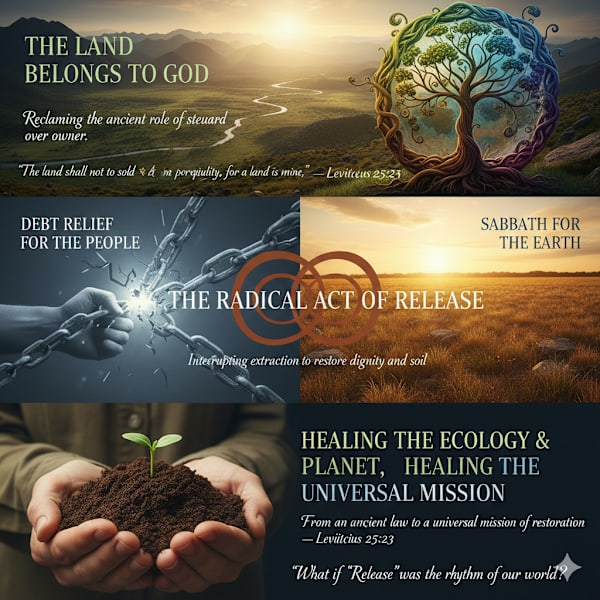
The foundational principle of the Jubilee, laid out in the biblical book of Leviticus, is a simple but revolutionary idea: God is the ultimate owner of the land, and human beings are merely temporary stewards or occupants. This directly challenges modern concepts of absolute and permanent ownership, where property and resources can be accumulated without limit.
This ancient law establishes a theological boundary on human possession and greed. It asserts that because the land ultimately belongs to God, it cannot be permanently bought, sold, or alienated from the community. This is profoundly counter-intuitive in a world built on the indefinite accumulation of private property. It exposes our modern assumption of endless acquisition as a kind of theological distortion—a failure to see the world as it truly is. It reframes our entire relationship with the material world, suggesting that we are caretakers of a gift, not masters of a resource.
The land belongs to God, not to its temporary human occupants, and therefore cannot be permanently alienated (Lev. 25:23).
2. Debt Isn't Just About Money—It's About Power
The Jubilee vision reframes debt not as a simple financial transaction, but as a relational and theological issue. The regular release of debts was designed to serve as a structural safeguard, preventing individuals or families from falling into a permanent state of dependency. It was a mechanism for restoring people to their place within the covenant community, ensuring that economic hardship did not lead to permanent social exclusion.
This stands in jarring contrast to modern financial systems where, as scholar Kathryn Tanner notes, perpetual indebtedness has become the organizing logic. For millions, debt is not a temporary arrangement but a permanent condition; not exceptional but structural; not productive but extractive. The Jubilee logic challenges this system at its root. It frames debt relief not as a one-time charitable gesture, but as a necessary, ongoing structural intervention. It is an act of justice meant to restore social relationships distorted by financial power and re-establish people as full participants in a shared community.
3. The Earth Deserves a Break: The "Sabbath for the Land"
The concept of deror extends its logic of release to the environment itself. Leviticus 25 calls for a periodic "sabbath for the land," a year of rest where the ground is not cultivated. This wasn't just a primitive farming technique; it was a profound theological recognition that the land itself participates in the covenantal order. It acknowledges that creation is not a mere object for human use but an active partner in a web of relationships, requiring protection from relentless extraction. The land, like people, was given a right to rest and renewal.
This ancient principle reveals our modern ecological crisis as another theological distortion: the failure to acknowledge that the earth is not an endlessly exploitable resource but a gift entrusted to our care. Our refusal to recognize limits and provide periods of rest has led to widespread soil degradation, climate instability, and the loss of biodiversity. The land sabbath teaches that human flourishing depends on respecting the rhythms and limits of the natural world. It is an interruption of our extractive habits for the sake of creation itself.
Just as debt cancellation interrupts economic extraction from persons, Land Sabbath interrupts ecological extraction from creation.
4. You Can't Separate a Healthy Economy from a Healthy Planet
Pope Francis has championed the concept of "integral ecology," the recognition that social and environmental crises are deeply interconnected. This modern idea finds deep roots in the ancient Jubilee vision. It understands that you cannot solve one crisis without addressing the other, because they exist in a devastating feedback loop: climate disruption in vulnerable regions creates the very economic precarity that then drives ecologically destructive practices like deforestation, which in turn worsens climate disruption.
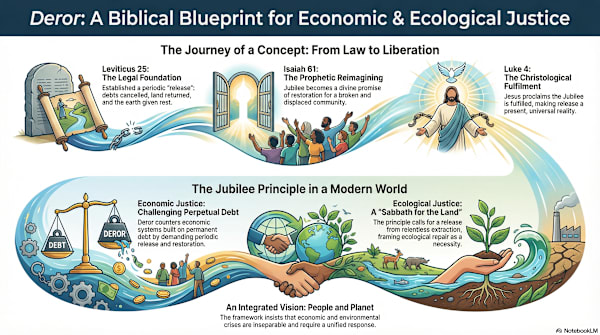
The Jubilee offers an integrated approach. It understands that you cannot restore human communities without renewing the land, and you cannot renew the land without creating just and stable economic relationships. This is a crucial insight for contemporary justice movements, which can sometimes treat economic and environmental issues as separate domains. The vision of deror insists that they are two dimensions of a single moral landscape, bound together by a responsibility to care for both people and the planet.
5. From a National Law to a World-Changing Mission
The idea of deror was not static; it grew and deepened over time. It began in Leviticus as a specific legal code for the nation of Israel, designed to structure its economic and social life. Hundreds of years later, the prophet Isaiah reinterpreted it not as a scheduled event, but as a grand, future hope for God's divine restoration of a broken world.
This trajectory culminates in the New Testament, when Jesus, in his first public sermon in Luke 4, reads from Isaiah's prophecy and declares that this long-awaited Jubilee "release" is being fulfilled in his ministry. The source text highlights that what happens next is crucial: Jesus immediately references the healing of Gentiles by the prophets Elijah and Elisha, extending the promise beyond Israel to all people. This detail transforms the scope of restoration, making it universal. The significance of this journey is immense: a specific national law evolves into a prophetic promise and is ultimately revealed as a foundational principle for a world-changing mission of universal restoration—social, economic, physical, and spiritual.
Conclusion: A Vision of Repair
The biblical tradition of deror offers more than just an interesting historical footnote; it provides a coherent and holistic vision for repair. It challenges us to see the world not as a resource to be endlessly extracted, but as a gift governed by generosity, limits, and the constant need for restoration. It reminds us that our economic well-being, our social cohesion, and the health of our planet are all profoundly interconnected.
This ancient vision invites us to move away from a logic of accumulation and toward an ethic of shared responsibility and renewal. It leaves us with a critical and thought-provoking question for our time: What might change if we learned to embed a regular rhythm of 'release'—for our debts, our relationships, and the land itself—into the very structure of our world?