The Architecture of Hubris: Why the Tallest Towers and Greatest Giants Always Fall
1. Introduction: Our Obsession with Verticality

Human history is marked by a persistent fascination with "bigness." We gravitate toward the massive, whether in the form of soaring skyscrapers, global corporations, or the "giants" of industry and politics. Yet, within the biblical imagination, this fascination is diagnosed as a spiritual pathology—the "Idolatry of the Large." In the sacred texts, height is never a neutral physical attribute; it is "theologically charged." This article explores the biblical "grammar of height" (gābōah), a recurring rhetorical pattern where verticality serves as a multifaceted metaphor for human pride, or hubris.
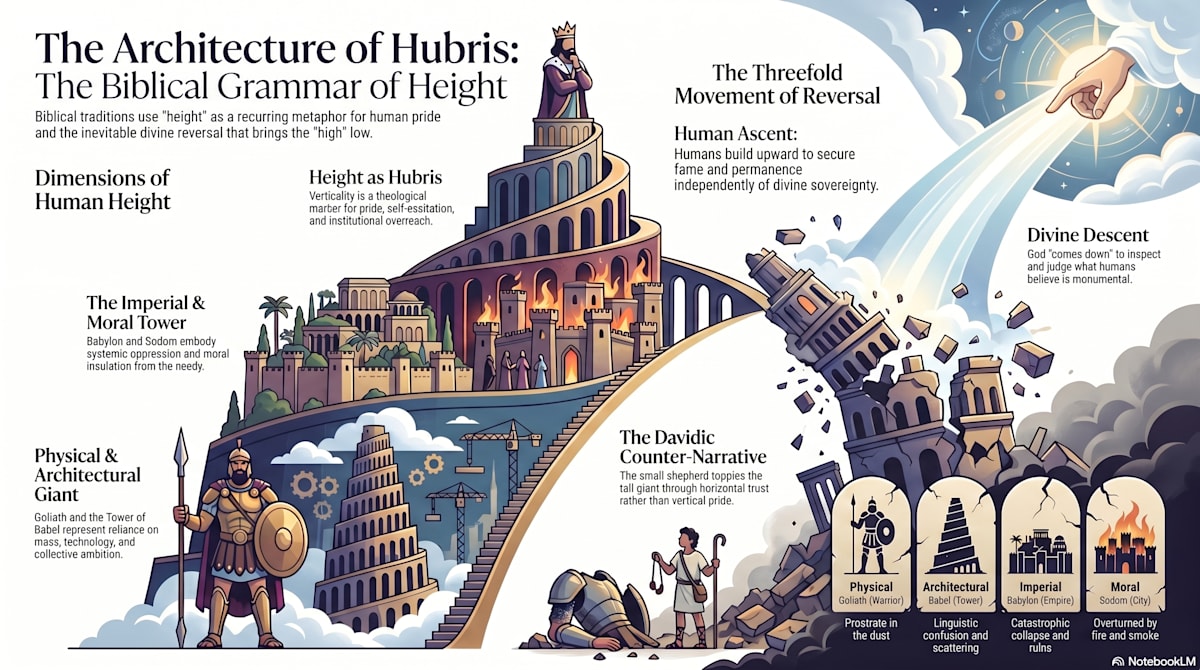
By examining the figures and structures that reach toward the heavens, we uncover a consistent "architecture of hubris" and a "semiotics of verticality" where that which exalts itself is already poised for collapse. The biblical narrative operates within a specific "symbolic economy" defined by a threefold movement: Ascent (the rise of pride), Descent (the divine inspection), and Reversal (the inevitable leveling). This pattern reveals that the "fall of the tall" is not a historical accident but a theological certainty, as a sovereign God consistently brings down the high and lifts up the lowly.
2. The Human Ziggurat: Goliath and the Myth of Physical Invincibility

The biblical critique of hubris begins with the body, specifically in the figure of Goliath. He is not merely a tall warrior; he is a "physical architecture of hubris" and an "animate tower of metal and flesh." The description in 1 Samuel 17 is deliberately excessive to emphasize his reliance on physical mass and military technology. Standing nearly ten feet tall and clad in bronze scale armor weighing 5,000 shekels, Goliath represents a "metal wall" of self-reliance. He is a living monument to the belief that size and technology can secure total autonomy. Goliath attempts to strip the conflict of its theological dimensions, reducing it to a purely human contest of strength:
"Choose a man for yourselves and let him come down to me." (1 Sam 17:8)
However, the "liturgical reversal" of his fall reveals the fragility of this gābōah. When David’s stone strikes his forehead—the symbolic seat of human intent and pride—Goliath falls "face down." In the symbolic language of the text, this is not just a defeat but a forced prostration. It is an involuntary act of worship, a visual "bowing" before the God he mocked, signaling the total humiliation of human pride.
3. The Irony of the Tower: Why God Had to "Come Down" to Babel

In Genesis 11, the grammar of height transitions from the "tall man" to the "tall tower." The builders in the plain of Shinar utilize the "Technology of Hubris"—specifically baked brick and bitumen—to construct a monument to collective autonomy. Their goal to reach "the heavens" and "make a name" for themselves represents an attempt to collapse the ontological distance between the creature and the Creator.
The narrative employs a biting theological irony regarding the divine descent, or yārad. While the builders aimed for a peak that reached the divine realm, the structure was so insignificant from a heavenly perspective that God had to "come down" just to see it:
"The Lord came down to see the city and the tower that the people had built." (Gen 11:5)
This yārad is the ultimate counter-movement to human ascent. The judgment—scattering the people and confusing their language—is a perfect reversal of their original goal to "not be scattered." By seeking to secure themselves through vertical ambition, they ensured their own fragmentation.
4. The Imperial Zenith: Babylon’s Fall from the Stars

Babylon represents the "macrocosmic giant," where individual hubris is scaled up into a systemic, international superpower. There is a deliberate theological continuity between the primeval tower and the historical empire; both are situated in Shinar, and both share the same name (Babel/Babylon). Babylon is the "political and military reincarnation" of the tower, where the "logic of height" defines an entire world order.
The vertical imagery of Isaiah 14 captures the peak of this imperial arrogance, depicting a king who seeks to transcend his creaturely limits:
"I will ascend to heaven; I will raise my throne above the stars of God... I will make myself like the Most High." (Isa 14:13–14)
The prophetic response completes the threefold movement of reversal: "But you are brought down to Sheol, to the depths of the Pit" (Isa 14:15). Ezekiel further deconstructs this "illusion of height" through the metaphor of the "Cedar of Lebanon"—a tree so lofty its top reached the clouds, yet was destined to be cut down because it became proud of its stature. Whether expressed through the king’s throne or the empire’s walls, Babylon’s height is shown to be a fragile mask for impending collapse.
5. The High City of Indifference: Sodom as a Moral Tower

Height is not always measured in cubits or bricks; it can be measured in "prosperous ease" and "pride" (gā'ôn). Sodom and Gomorrah serve as the biblical paradigm for "Moral Height." Their elevation was not architectural but internal, characterized by a sense of self-sufficiency that led to a delusion of autonomy.
According to the diagnostic lens of Ezekiel 16:49–50, Sodom’s sin was an "internal elevation" that walled the city off from both divine law and human empathy. The text explicitly links their social indifference to the terminology of height (gābah):
"This was the guilt of your sister Sodom: she and her daughters had pride (gā'ôn), excess of food, and prosperous ease, but did not aid the poor and needy." (Ezek 16:49)
Sodom became a "closed city," a "moral ziggurat" that rejected the stranger and prioritized its own abundance over justice. This moral and social insulation is a form of self-exaltation that, like the towers of Babel and Babylon, invited a cataclysmic divine descent and reversal.
6. The Power of the Small: David as the Anti-Giant

In contrast to these towering figures and structures, David serves as the "human-scale prototype" of divine reversal. David’s effectiveness lies in his radical rejection of the "logic of height." We see this most clearly in the "compromised middle" figure of King Saul. Saul, who was "head and shoulders taller" than his peers, attempted to confront Goliath by adopting the giant’s own logic—offering David heavy armor and bronze weaponry.
David decisively removes the armor, symbolically rejecting the architecture of hubris and the reliance on mass and spectacle. While Goliath represents "vertical pride," David represents "horizontal power"—defined by agility, precision, and covenantal trust. His choice of "five smooth stones" was not merely a tactical decision but a symbolic preparation for a "systemic" threat. As revealed in 2 Samuel 21, the giant was a recurring lineage (the Rephaim); thus, "felling the tall" became a shared communal vocation for David and his "mighty men." This "Davidic Way" of obedient humility provides the blueprint for the ultimate anti-giant: the Suffering Servant who triumphs through vulnerability rather than stature.
7. Conclusion: Discerning the Giants of Today

The biblical canon reveals a consistent "threefold movement" regarding human overreach: Ascent (the construction of self-sufficient systems), Descent (the divine yārad that exposes human insignificance), and Reversal (the fall into the "Pit"). This grammar provides a sharp diagnostic lens for the modern world, challenging us to look past the visible stature of our institutions and technologies.
The "fall of the tall" is a theological certainty because God actively resists the proud but gives grace to the humble. This biblical framework forces us to confront our own "Idolatry of the Large." As we survey our contemporary landscape, we must ask: Which of our "giants," "towers," or "Sodoms"—whether they manifest in digital monopolies, political empires, or the "prosperous ease" of our private lives—are currently poised for collapse because they have attempted to build a name for themselves apart from God?